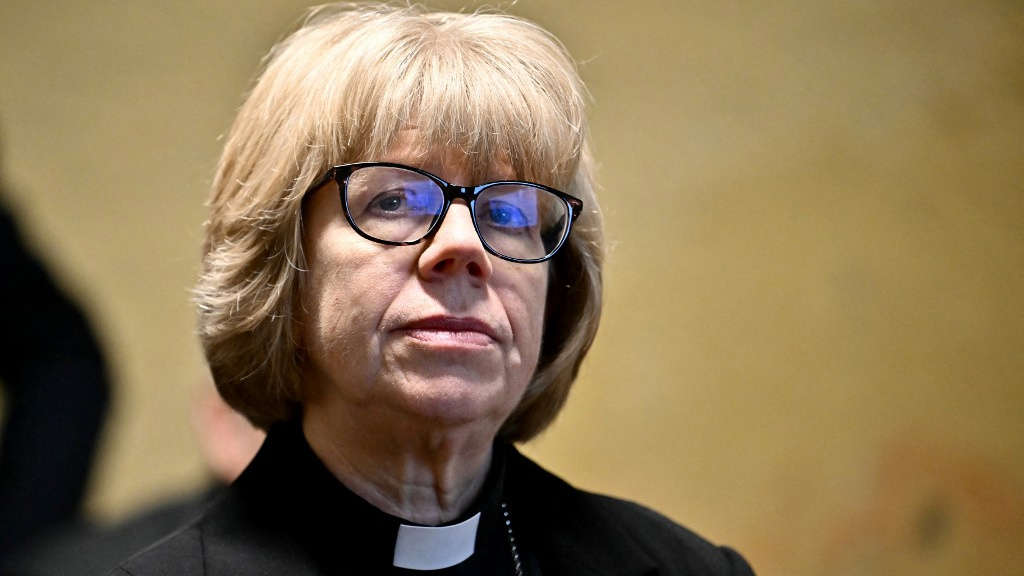
During a high-profile visit to the occupied West Bank, the head of the Church of England, Archbishop Dame Sarah Mullally, has publicly committed to using her influential position to advocate for the peace and freedom that Palestinians are inherently owed, while framing the daily acts of persistence amid occupation as powerful examples of “faithful resistance”.
Mullally delivered these remarks in a sermon this past Sunday at St Peter’s Anglican Church, located in Birzeit, a Palestinian Christian community in the West Bank. She told gathered worshippers that this quiet, faithful resistance does not always take dramatic forms: it can be seen in the everyday efforts of parents who navigate the complex, restrictive network of Israeli checkpoints every day just to earn a living to support their households, or to get their children to school to build a better future. It is also visible, she added, in the simple act of congregating week after week in this church to share communion together.
“All these acts of faithful resistance point to our hope in Jesus Christ and reflect your ongoing struggle for freedom and dignity,” Mullally told the congregation. She acknowledged the profound gap in experience between her own life and the reality of Palestinians under occupation, noting that she takes for granted basic privileges that are out of reach for most people living in the territory: the ability to cross borders and checkpoints without obstruction, to gather freely with neighboring communities, and to travel to Jerusalem without restriction.
“I will use my role as archbishop to seek the peace you desire and the freedom you deserve,” she stated. Mullally also emphasized that the global Christian community has not forgotten Palestinian people, adding: “The church is called to rejoice with those who rejoice and to weep with those who weep. The church stands with you in your right to live in freedom and dignity.”
As part of her regional tour, which also included stops in Jerusalem, Nazareth and Bethlehem alongside Hosam Naoum, the Anglican Archbishop in Jerusalem, Mullally met with 26-year-old Palestinian Christian woman Layan Nasir, who has been detained by Israeli authorities three times over the past five years. After being welcomed by Nasir’s family in their home, Mullally said she would hold the family in her prayers, and ask for divine blessing and healing for Layan following what she described as the terrible trauma of her imprisonment. She also extended her prayers to all people held in what she called unjust detention across Palestine, Israel, and the entire globe.
Mullally noted that the core purpose of her visit was to create space to listen directly to the experiences of local communities, to hear both their hopes and their anxieties, their moments of joy and the enormous challenges they face daily, and to join them in praying for justice and peace that can bring healing to both people and the land.
This visit comes amid growing concern from senior Church of England leaders over the deteriorating situation in the occupied Palestinian territories. Last year, four senior bishops from the church called on the British government to take immediate action to address escalating Israeli settler violence, warning that the ongoing aggression is eroding Palestinian life and putting the long-standing Christian presence in the Holy Land at severe risk. In their statement, the bishops highlighted that as the war in Gaza continues, conditions in the West Bank have deteriorated rapidly, with rising levels of settler violence and intimidation—including direct attacks on land and church properties in Taybeh, another Christian-majority West Bank town.
Just earlier this year, the Archbishop of York, Stephen Cottrell, shared his own firsthand experience of occupation during a visit to the region, recounting that he was stopped at checkpoints and intimidated by armed militias who barred him from visiting Palestinian families in the West Bank. “It was sobering for me to see this wall for real on my visit to the Holy Land, and we were stopped at various checkpoints and intimidated by Israeli militias who told us that we couldn’t visit Palestinian families in the occupied West Bank,” Cottrell said.
The warnings from Church of England leaders align with recent alerts from Palestinian church affairs officials. Just last month, a delegation from Palestine’s Higher Presidential Committee for Church Affairs told European Union officials that long-standing Israeli policies pose an existential threat to the centuries-old Palestinian Christian community in the Holy Land.