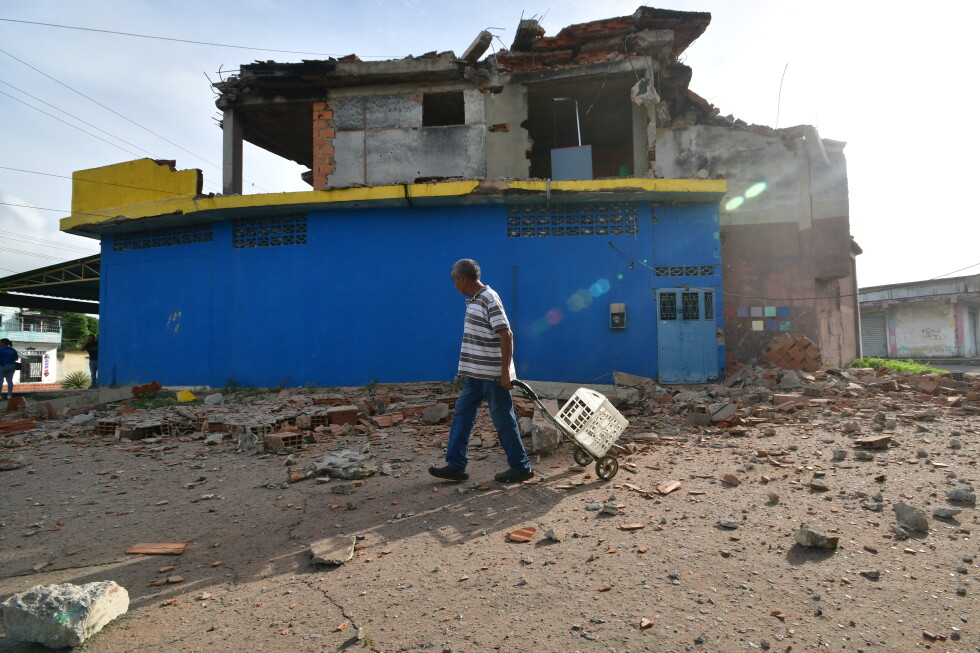
On Wednesday, a rare and powerful double earthquake event, formally called an earthquake doublet, devastated northern Venezuela, leaving at least 188 people confirmed dead, more than 200 trapped under rubble, and over 1,500 injured. Thousands more are currently unaccounted for, with rescue officials warning that the death toll is almost certain to rise as search operations continue through collapsed infrastructure. One of the hardest-hit areas is La Guaira, a coastal region located just north of the capital city Caracas, where dozens of buildings have been completely leveled.
According to data from the U.S. Geological Survey (USGS), the two major seismic events struck just 39 seconds apart along the San Sebastian fault on Venezuela’s northern Caribbean coastline. The first, a 7.2-magnitude foreshock, originated 22 kilometers (14 miles) deep, 170 kilometers (105 miles) west of Caracas near the coastal town of Morón. Barely half a minute later, a stronger 7.5-magnitude mainshock hit 10 kilometers (6 miles) deep, just 16 kilometers (10 miles) southwest of Morón. USGS experts confirmed that the back-to-back quakes, classified as a doublet due to their similar magnitude, close timing and proximity, resulted from shallow strike-slip faulting along the complex tectonic boundary between the Caribbean and South American plates. The event ranks among the most powerful seismic activity recorded in Venezuela in more than a century.
Acting President Delcy Rodríguez has declared La Guaira, which sits around 165 kilometers (103 miles) east of the mainshock’s epicenter, a full disaster zone. Authorities have deployed all available rescue resources from across the country to the region, where civilian volunteers and first responders have worked around the clock to pull survivors from crumbled concrete. Footage from the scene shows survivors covered in dust and blood emerging from rubble, while distraught families grieve outside flattened homes. Grief-stricken residents have posted hundreds of missing-person flyers with photos of lost loved ones, and shared handwritten lists of unaccounted-for names across social media and community boards in a frantic search for information.
Widespread damage extends far beyond La Guaira, reaching all the way into the capital Caracas and triggering evacuations as far away as Brazil’s Amazon region, more than 1,700 kilometers (1,050 miles) from the epicenter. In downtown Caracas, hundreds of residents spent the first night after the quake huddled in open public spaces including parks and parking lots, terrified to return to damaged, unstable structures for fear of aftershocks. Large swathes of the capital lost power and cellular connectivity immediately after the quake. Caracas’ main international airport sustained significant structural damage and has been closed to all traffic, subway operations across the city have been suspended, and natural gas service has been shut off as a safety precaution. Local officials have canceled classes at all schools for several days, repurposing the facilities as emergency public shelters and donation collection centers. In response to the disaster, Rodríguez announced the government has established a $200 million reconstruction fund to repair damaged hospitals and residential buildings.
The disaster comes as Venezuela faces already severe political and economic challenges, adding an unprecedented new crisis to Rodríguez’ tenure. Rodríguez, a former vice president, assumed office in January after former President Nicolás Maduro was captured by U.S. authorities. Maduro and his wife Cilia Flores are currently jailed in New York City awaiting trial on drug trafficking charges. Rodríguez inherited a nation that has struggled with crippling economic turmoil for more than a decade, and her government already faces deep political division: large segments of the Venezuelan population reject the legitimacy of her ruling movement, even as some of her former loyalists have criticized her leadership and recent diplomatic warming toward the U.S.
International support has already begun mobilizing to assist Venezuela’s response to the disaster. The U.S. government announced Thursday it would deploy two specialized urban search and rescue teams to the country, alongside $150 million in humanitarian aid distributed through independent nongovernmental organizations and the United Nations Office for the Coordination of Humanitarian Affairs. The United Nations confirmed that international search and rescue teams are expected to begin arriving in the country within hours of the announcement. Additional aid pledges have come from Qatar and Mexico, among other nations. Meanwhile, the large Venezuelan diaspora in the U.S. — which counts more than 770,000 people, with large concentrated communities in Florida, Texas and Utah — has moved quickly to organize grassroots donation drives to support disaster survivors.