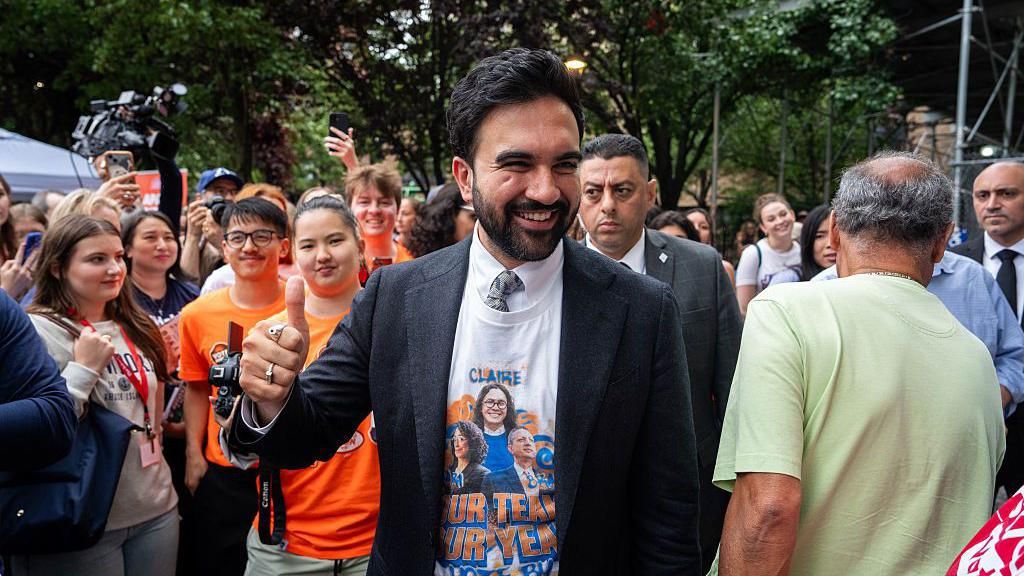
On a consequential primary election day Tuesday, a political earthquake rippled through New York City’s Democratic Party, reshaping the future of progressive politics and exposing deep ideological rifts that threaten to roil the party ahead of November’s midterm elections.
Just seven months ago, Zohran Mamdani stunned the political establishment by defeating former Governor Andrew Cuomo to become New York City’s youngest mayor in 100 years. That historic upset was dismissed by many centrist Democrats as a one-off fluke. On Tuesday, Mamdani proved his movement is here to stay, as every left-wing congressional candidate he endorsed pulled off shocking primary victories against incumbent and establishment-backed opponents.
Two of the three candidates ousted sitting Democratic House members. The first, New York City Comptroller Brad Lander, defeated Dan Goldman – a high-profile Democrat who gained national fame as lead counsel for Donald Trump’s first impeachment, and who enjoyed massive financial backing from the American Israel Public Affairs Committee (AIPAC), the powerful pro-Israel lobbying group. The second, community activist Darializa Avila Chevalier, unseated five-term incumbent Adriano Espaillat, who led the Congressional Hispanic Caucus. In the third race, state assemblywoman Claire Valdez defeated an opponent supported by most of New York’s Democratic Party leadership.
At post-election victory celebrations, all three candidates highlighted Mamdani’s influence, crediting his grassroots coalition for their wins. Valdez called the sweep a proof of progressive movement’s staying power, saying: “Tonight we have not just won an election, but we have proved that this movement is durable.”
With New York City’s heavily Democratic voter base making the three nominees all but guaranteed to win their House seats in November, Mamdani’s populist socialist movement – which pushes for government-funded universal healthcare, higher taxes on the top earners, and expanded affordable housing – is no longer confined to city hall. It is now set to reshape national partisan politics in Washington.
If Democrats retake the House majority in November, the party’s caucus will include a larger, more vocal progressive bloc that presents a major challenge to party leader Hopen Jeffries, the New York Congressman who is expected to seek the House speaker’s position if Democrats take control. Notably, neither Chevalier nor Valdez have committed to supporting Jeffries for speaker, adding to intra-party tension.
Political analysts have already drawn comparisons between Tuesday’s anti-incumbent, anti-establishment progressive wave and the right-wing Tea Party movement that rose in 2010, ousting dozens of long-serving Republican incumbents and creating an uncompromising conservative bloc in Congress. Lander pushed back on that comparison in a Wednesday television interview, arguing the progressive movement’s goal is constructive, not disruptive. “We’re joyful about what it looks like to deliver,” he said. “That is very different energy than what the Tea Party brought. We want to build something, not just break something.”
Even so, the results have already sparked fierce pushback from across the political spectrum. Congressional Republicans have seized on the wins to argue the entire Democratic Party is shifting sharply left, with former President Trump leading the attack. In a series of late-night social media posts, Trump falsely labeled the three candidates “Communists,” writing that “America the beautiful will never be [a] communist country.” He also complained that mainstream media outlets fail to acknowledge his own endorsement record.
Republicans have also amplified controversial past comments by Chevalier, a 32-year-old community organizer who previously called for open borders, the elimination of prisons and police, used an expletive to criticize former Vice President Kamala Harris, and falsely accused former President Joe Biden of rape. Chevalier has since disavowed those remarks, which were made between 2018 and 2022, saying she has grown and changed as a person.
The criticism isn’t limited to Republicans. Some top centrist Democrats have also publicly pushed back against Chevalier’s victory. Former Democratic National Committee chair Jaime Harrison wrote on social media platform Bluesky: “If you hate the Democratic Party, then please don’t run for our nomination. Don’t use our resources. Don’t rely on our volunteers. Don’t use our infrastructure. Don’t ask Democrats to invest their time, money, and energy in your campaign.”
Chevalier’s win is not an isolated incident. Just two weeks prior, Democratic voters in Maine nominated Graham Platner for Senate, despite his history of inflammatory social media posts, a Nazi-linked tattoo, and allegations of abusive behavior toward former partners. That said, Tuesday’s primary results across the country were mixed: centrist, establishment-aligned Democrats claimed victory in multiple key races. In Utah, Democrats backed former Congressman Ben McAdams, a moderate, over more progressive challengers for a newly drawn Democratic-leaning House seat. In a Maryland district outside Washington, D.C., Democratic voters chose a moderate candidate who supports continued U.S. military aid to Israel – a stark contrast to the pro-Palestinian positions held by New York’s victorious progressive candidates.
The mixed results underscore a core challenge for Democrats ahead of November: to win a House majority, the party needs to carry competitive battleground seats across the country, many of which are in suburban areas far less liberal than New York City, where moderate candidates are far more likely to win general elections. The ideological gap between these battleground candidates and the new progressive bloc from New York will force the party to grapple with its core identity and political direction heading into November, and ahead of the 2028 presidential election – a race Mamdani has already signaled he intends to influence.
Speaking to supporters Tuesday night as he moved between victory parties, Mamdani framed the wins as a rejection of old-line politics that led to the country’s current crises. “The old politics that got us into this crisis is not the politics that’s going to get us out of this crisis,” he said. For one election night, at least, the Democratic Party’s old guard in Washington was left scrambling to respond to a progressive movement that is quickly gaining national power.