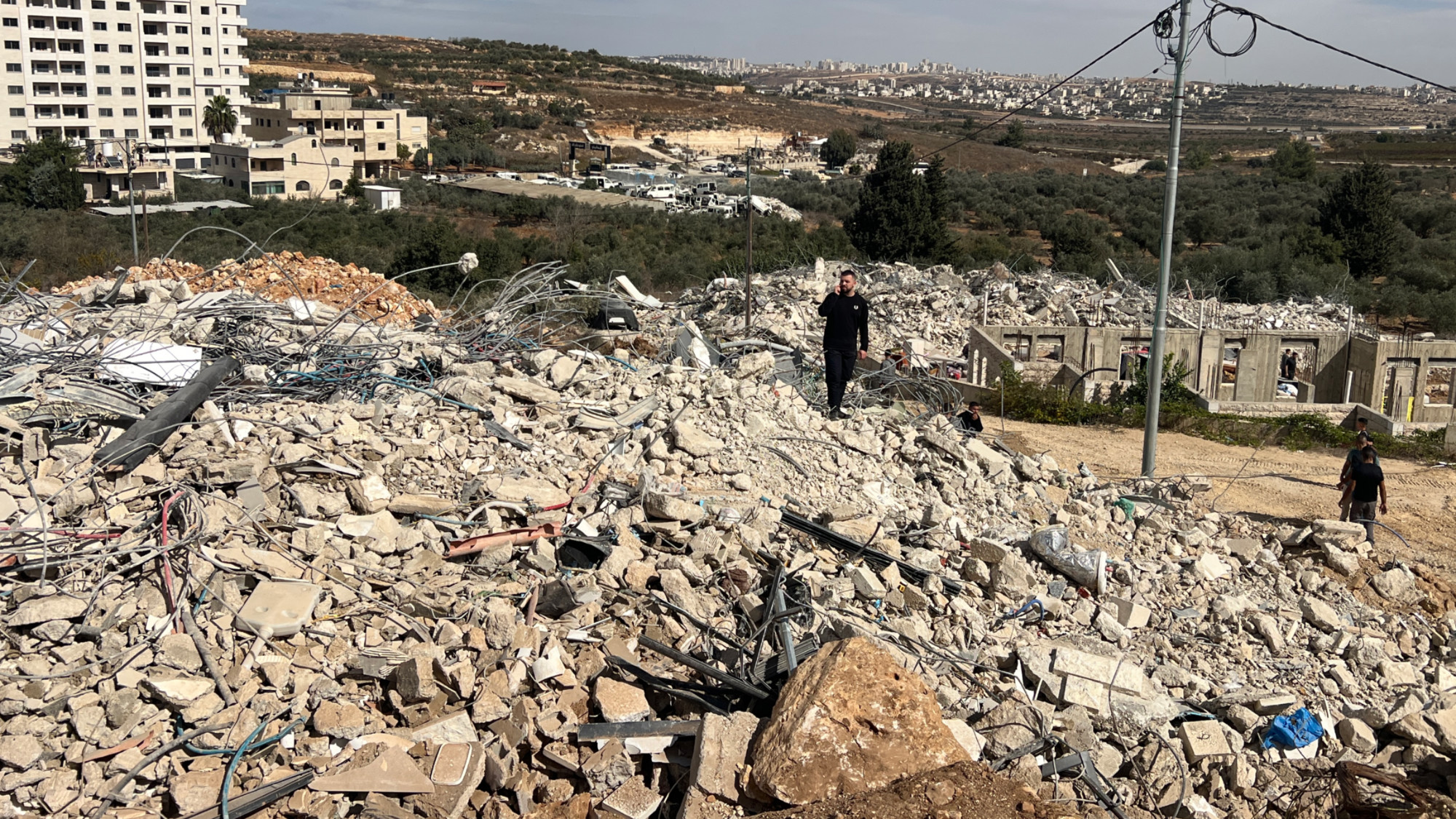
In a sudden, unheralded pre-dawn operation on Thursday, Israeli military units entered the Palestinian town of Biddu, located northwest of Jerusalem in the occupied West Bank, and demolished five residential buildings encompassing 12 individual apartments, leaving more than 100 local residents displaced. Witness accounts confirm that Israeli troops deployed stun grenades and tear gas against homeowners upon their arrival, blocking access to the targeted properties and granting families barely any time to evacuate, let alone retrieve their furniture, clothing, documents and other personal possessions before bulldozers moved in to level the structures. One of the affected property owners, Ahmad Abu Eid, explained that the demolished homes belonged to himself, his adult sons and his daughter, and shared his belief that the operation was a deliberate act of retaliation tied to his son Salman, a former Palestinian prisoner released in last year’s cross-border prisoner exchange and subsequently deported to Egypt. Israeli military officials cited a lack of official building permits as the formal justification for the demolitions, noting that the properties sit within Area C of the occupied West Bank. Per the terms of the 1995 Oslo Accords, the West Bank was partitioned into three distinct administrative zones: Area A falls under full Palestinian Authority (PA) administrative and security control, Area B falls under PA civil administration with Israeli security oversight, while Area C remains under full Israeli administrative and security jurisdiction. Palestinian residents have long faced systemic barriers to securing Israeli-issued building permits for construction in Area C, with approval rates so low that nearly all new Palestinian construction in the zone is deemed unauthorised by Israeli authorities. Local municipal and PA officials have pushed back strongly against the operation: the PA’s Jerusalem Governorate labelled the demolitions and mass displacement a dangerous, escalating tactic designed to erode longstanding Palestinian residential presence on the outskirts of Jerusalem, and a clear violation of established international humanitarian law. A member of the Biddu municipal council, Salem Abu Eid, confirmed that two of the five demolished homes had never received formal judicial demolition orders, even after homeowners filed formal legal challenges through Israeli court channels. He added that more than 20 other residential properties in Biddu had previously only received temporary stop-construction notices rather than final demolition mandates, with a team of Palestinian and international lawyers currently processing formal objections to those notices through the Israeli Civil Administration based in the West Bank settlement of Beit El. He also noted that the last prior demolition operation in Biddu occurred several months earlier, when Israeli forces levelled a small wood and tile structure and cleared the town’s public municipal park. He further pushed back against Israeli claims that the targeted homes sat close to the West Bank separation wall, noting that the nearest of the demolished properties stood roughly 700 metres away from the barrier. Local community leaders are now calling on the PA and international humanitarian organisations to deliver financial compensation for the families’ destroyed homes and lost personal property, as well as provide emergency alternative housing or support to rebuild new residential units for the displaced residents. Data released by the Jerusalem Governorate documents a sharp surge in Israeli demolition and land-clearing operations across Jerusalem and its surrounding West Bank peripheries in 2026: over the first nine months of the year, 427 separate operations were recorded, including 66 instances where Palestinian residents were forced to demolish their own homes to avoid steep Israeli state fines, 294 demolitions carried out directly by Israeli military machinery, and 32 separate land-levelling projects. An additional 44 demolition and land-clearing operations were documented in the month of October alone, bringing the total number of such verified actions between January and the end of October 2026 to 471, a figure that covers residential properties, auxiliary agricultural and commercial structures, and undeveloped Palestinian-owned land.
Israeli forces demolish five West Bank buildings and displace over 100 Palestinians