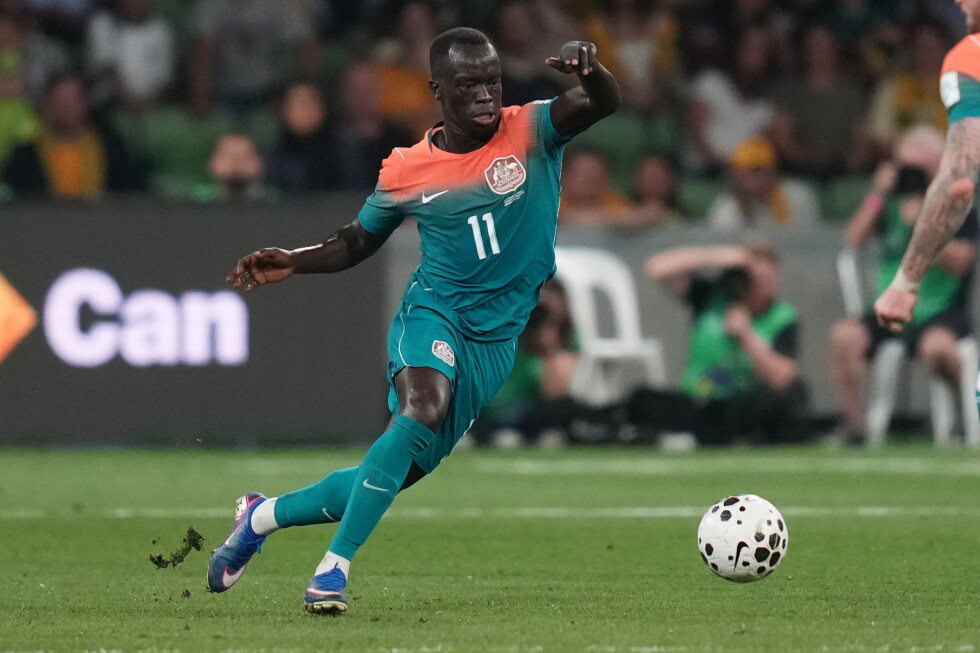
SEATTLE — Ahead of Australia’s high-stakes FIFA World Cup matchup against the United States, an unplanned, heartfelt moment at a post-training press conference this week put the remarkable personal journey of Socceroos veteran forward Awer Mabil front and center, offering a moving reminder of sport’s power to transcend competition and unite communities.
When long-time Australian SBS network sports commentator David Basheer posed a question from the press room Tuesday, 30-year-old Mabil’s usual composure melted into unfiltered joy. Caught off guard by the familiar face of the commentator he had grown up watching on television after resettling in Australia, Mabil openly admitted he was overcome, asking Basheer to repeat his question. The soft, emotional exchange cut through the typical high-pressure buzz of the quadrennial tournament, highlighting the sincere authenticity that has made Mabil one of the most compelling key figures on Australia’s World Cup roster this year.
Mabil’s path to global soccer’s biggest stage has been far from ordinary. Born in Kenya’s sprawling Kakuma refugee camp to South Sudanese parents who fled their country’s civil war, Mabil arrived in Australia 20 years ago at age 10, accepted through the nation’s formal humanitarian resettlement program. He launched his organized soccer career playing in Adelaide, South Australia, and now, decades later, he is using his platform at the World Cup to lift up other displaced people around the globe — a mission made even more meaningful by the timing of this year’s tournament, which coincides with Australia’s Refugee Week, leading up to World Refugee Day on Saturday.
“During Refugee Week, I want to say to anybody that is misplaced all over the world that we are with you,” Mabil shared in an interview. “We are on a world stage right now, in a big tournament — and just to tell you everything is possible, so keep going.”
This theme of inclusion has defined Mabil’s work leading into the tournament. A pre-World Cup video message he recorded championing global soccer diversity went viral, delivering a simple, powerful message: “No matter where you come from, football is for everyone.” Mabil noted that the overlap between Refugee Week and the World Cup is more than coincidence, pointing to the number of refugee-background players on the current Socceroos squad, including himself.
“when I reflect back, I’m like we all belong to this world together,” he said. “And now we’re representing Australia.”
Mabil also takes on an informal mentorship role for his two younger teammates, Mo Touré and Nestory Irankunda, both African-born refugees who resettled in Australia just like Mabil. The 20-year-old Irankunda recently notched a major milestone for the team, becoming the youngest player ever to score a World Cup goal for the Socceroos during a 2-0 friendly win over Turkey in Vancouver, British Columbia earlier this week.
As the team prepares to face the US in Seattle on Friday, Australian defender Alessandro Circati said the squad is eager to prove how far Australian men’s soccer has progressed, shedding the long-held underdog label that has followed the team at past major tournaments.
“I hope we’re starting to gain a little bit more respect,” Circati said. “I don’t want to be the underdogs for the rest of my life.”
Mabil, who made brief substitute appearances in two group-stage matches at the 2018 World Cup and did not feature in Australia’s 2026 tournament opener, is focused on supporting the squad from every role, including guiding the team’s next generation of talent. As a senior player, he says his job extends beyond the pitch: he acts as a steadying presence for younger players, and even for veteran teammates navigating the stress of high-stakes tournament play.
“Coming in as a senior player I think it’s more mental — you have to be present for the younger ones,” Mabil joked. “Sometimes you want to slap them.”
“I’ll play my role to the best of my abilities to be available for the young ones and also the older ones because the older ones also they go through difficulties so they don’t have all the answers — nobody has all the answers. We just have to continue to be there for each other. In these kind of tournaments, it’s very important to remain united.”
Off the pitch, Mabil says the squad has been enjoying small moments of calm at their Berkeley-area team base at the Claremont Resort and Club, where players have become quick fans of the on-site omelet bar. The team conducts daily training sessions at the former headquarters of the NFL’s Oakland Raiders, a historic venue that adds extra context to their World Cup run on US soil.
For Mabil, every minute of this tournament is a testament to the second chance he was given — and a promise to every displaced person chasing their own dream, no matter how out of reach it may seem.