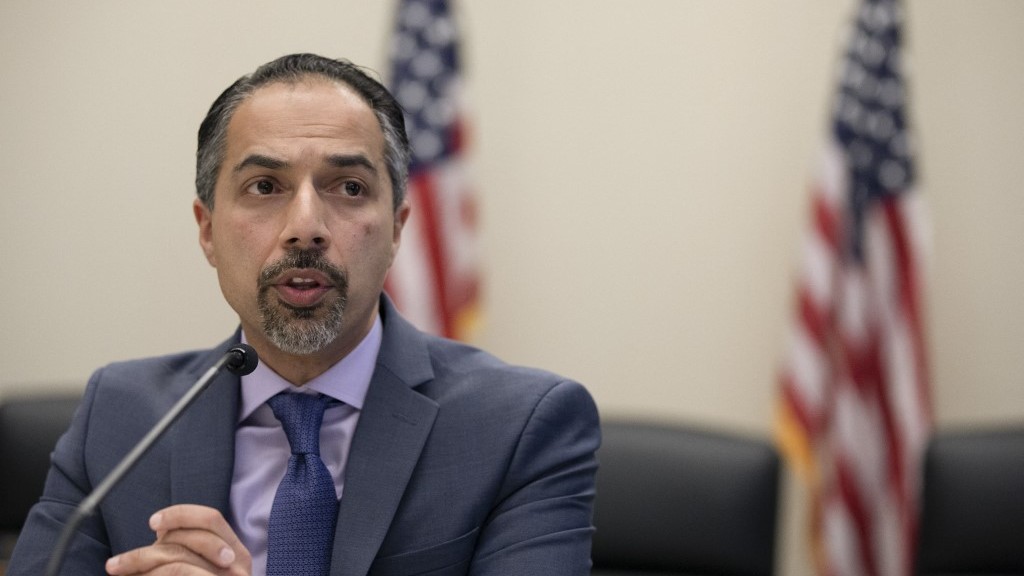
A growing political controversy has emerged following a new report from the Free Press revealing that the second Trump administration has opened an official investigation into Trita Parsi, one of the most vocal and high-profile critics of Washington’s aggressive military policy toward Iran, with deportation explicitly listed as a potential outcome of the probe.
Parsi, who holds dual Iranian and Swedish citizenship, occupies key leadership roles in two major U.S. foreign policy organizations: he is co-founder and executive vice president of the Quincy Institute for Responsible Statecraft, and also co-founded the National Iranian-American Council (NIAC). For years, he has been an outspoken opponent of ongoing U.S. military strikes and aggressive posture against Iran, and has recently amplified criticism of U.S. backing for Israel’s military campaign in Gaza and attacks on Lebanon.
Notably, Parsi is himself a public critic of Iran’s Islamic Republic; his family fled the country decades ago to escape political persecution by the ruling government, and he has faced repeated attacks from both Iranian monarchist factions and pro-Trump conservatives over his anti-war stance.
A senior Trump administration official speaking to the pro-Trump outlet confirmed that Secretary of State Marco Rubio has explicitly framed the administration’s push to target individuals accused of advancing the interests of U.S. adversaries at the expense of American security. “Anyone who seeks to undermine the US, we’re taking a hard look at,” the official stated.
The investigation into Parsi is part of a wider, escalating crackdown on people of Iranian descent based in the United States that launched shortly after the U.S.-Israeli joint offensive against Iran began in February. In April, Hamideh Soleimani Afshar and her daughter Sarina were taken into federal custody and had their U.S. residency permits revoked, after far-right political influencer Laura Loomer incorrectly identified the pair as relatives of the late former Iranian military commander Qassem Soleimani. Despite the pair’s repeated, unrefuted denials of any connection to Soleimani, they remain detained in a Texas facility as of the latest reporting. That same month, U.S. authorities also detained multiple relatives of former Iranian minister Masoumeh Ebtekar and revoked their green cards.
In comments given to Middle East Eye (MEE) in May, Parsi warned that any potential diplomatic deal between Washington and Tehran would depend entirely on the U.S. willingness to rein in unprovoked Israeli military aggression across the Middle East. “If Trump either cannot or will not do so, then the value of any agreement with Washington comes sharply into question,” Parsi said. He added that a fragile ceasefire that leaves Israel free to restart hostilities on its own terms – while the U.S. remains unable to avoid being pulled back into open conflict – cannot deliver long-term regional stability, drastically reducing any benefit of a diplomatic agreement with the United States.
MEE reached out to both the U.S. State Department and the Department of Homeland Security to request comment on the investigation into Parsi and the broader crackdown, but neither agency had issued a response by the time of this report’s publication.