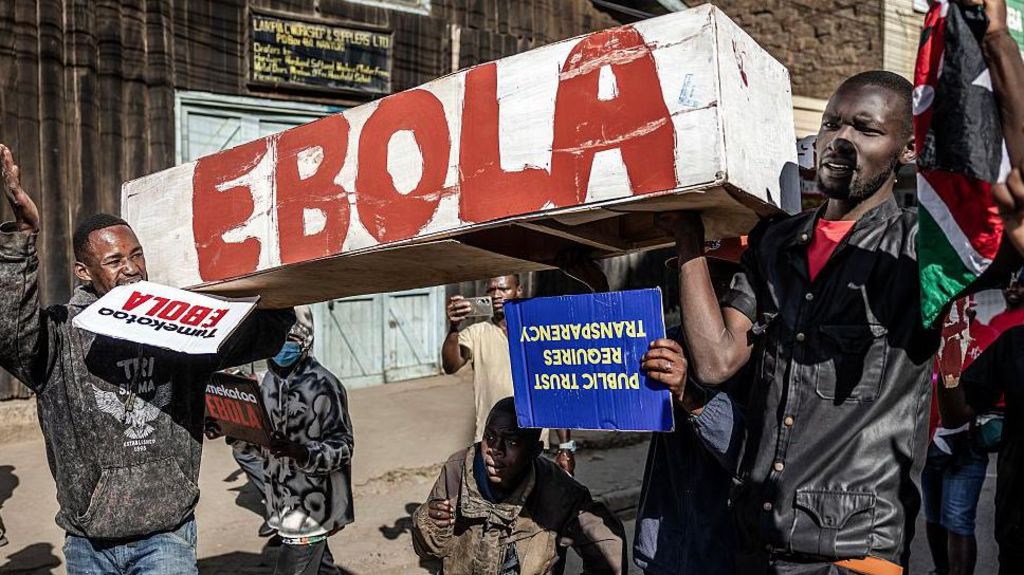
Fresh unrest has erupted in the central Kenyan town of Nanyuki, where local law enforcement deployed tear gas to disperse demonstrators gathering to oppose the planned construction of an Ebola quarantine facility exclusively for United States citizens. This demonstration marks the latest round of public pushback against the project, which has roiled local communities and sparked legal challenges since it was first announced.
Wednesday’s protest saw small clusters of demonstrators marching through Nanyuki, waving national Kenyan flags, holding hand-painted placards criticizing the government and project partners, and carrying a symbolic coffin marked with the word “Ebola” to underscore their fears of the virus. The group’s core demand is the full cancellation of the plan to build the 50-bed isolation centre. The demonstration comes just one week after two local residents were shot and killed during police operations to break up an earlier identical protest.
Public anger over the facility has centered on two core grievances: widespread concerns about the risk of cross-border Ebola transmission into Kenya, which has not recorded any confirmed cases of the current outbreak, and repeated criticism that the Kenyan national government has failed to provide transparent information about the facility’s operations, safety protocols, and long-term plans. Last month, Kenya’s High Court ordered an immediate halt to all construction work on the site, after a local human rights organization filed a legal petition arguing that the centre posed “grave and imminent risks” to local public health.
Despite the court ruling, satellite imagery analyzed by the British Broadcasting Corporation confirms that construction work has continued at the facility, which is being built on a local airbase. United States officials have confirmed the facility is intended to treat American citizens who contract Ebola during the ongoing outbreak in the neighboring Democratic Republic of the Congo, where the virus has killed more than 100 people out of 608 confirmed cases to date. The facility would be staffed entirely by American medical personnel. A US official told the BBC that Kenya was chosen as the site for three key reasons: its geographic proximity to the DRC outbreak epicenter, limited appropriate airport infrastructure in closer locations, and the need to ensure timely medical care for any affected Americans. The outbreak’s center in the Congolese city of Bunia sits roughly 780 kilometers from Nanyuki, with Uganda positioned between DRC and Kenya.
For local residents, the project has already had tangible negative impacts on daily life. Protester Priscilla Imani told Reuters that fear over the facility has kept visitors away from Nanyuki and the wider Laikipia County, harming local livelihoods. “Laikipia is not a dumping site and our voices must be heard,” Imani said in a statement to reporters.
Kenyan President William Ruto has publicly defended the plan, pushing back against growing opposition. Ruto explained that the Kenyan government received a formal request from the US to host the facility, and argued that turning down the request would be “inhuman.” He urged Kenyans against turning the public health issue into a political football, calling on political leaders to avoid what he described as “reckless” commentary surrounding the project. US officials remain confident that the project can move forward despite the legal challenge: last week, a US administration representative told reporters that the government is aware of the ongoing court case but remains “optimistic we can resolve objections.”