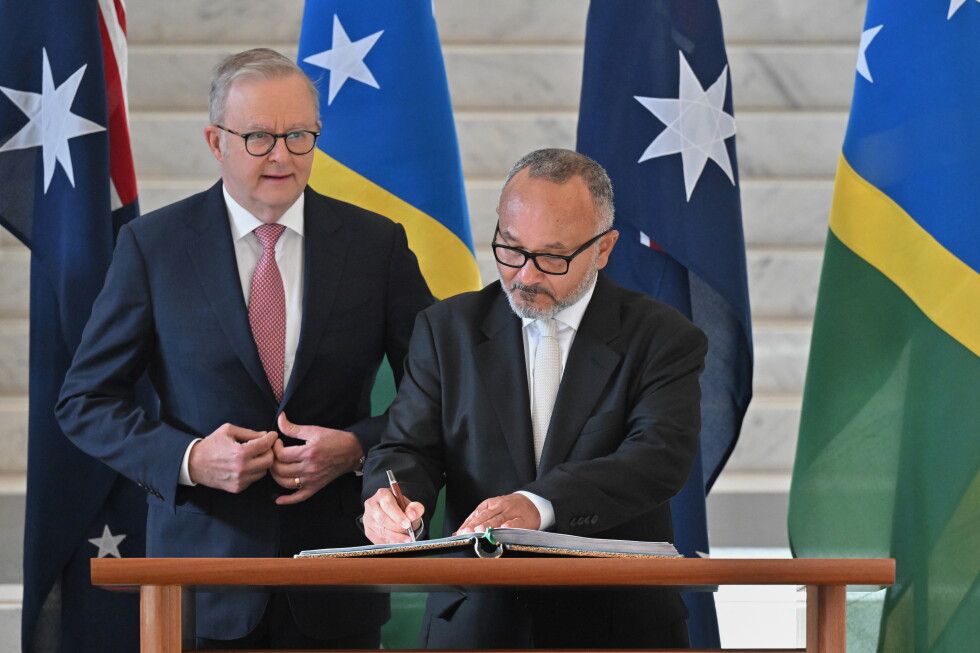
CANBERRA, Australia — On his first international visit since taking office, Solomon Islands Prime Minister Matthew Wale confirmed Wednesday that his incoming administration will launch a full review of the country’s classified 2022 security agreement with Beijing, a deal that sparked widespread regional and global geopolitical concern over potential Chinese military expansion in the South Pacific.
The bilateral security treaty, negotiated and signed under Wale’s predecessor Manasseh Sogavare, has drawn intense scrutiny from Western powers and regional nations including Australia and the United States since 2022. Critics have raised alarms that the pact could clear a path for the Chinese People’s Liberation Army Navy to establish a permanent military outpost in the strategically located South Pacific island nation, a shift that would reshape regional security dynamics.
Wale, who won a parliamentary vote to claim the prime ministership on May 15, had repeatedly demanded public transparency for the treaty’s full text during his election campaign. He told reporters Wednesday that he only gained access to a full copy of the agreement within the past few days, after replacing unnamed officials in key government posts.
“I haven’t completed a full detailed review, but I have been able to review the initial text,” Wale stated during a press conference in the Australian capital Canberra. “I have been reflecting deeply on this agreement. The treaty includes a binding nondisclosure clause, which means I cannot release its full text to the public immediately. However, a comprehensive review of this pact is on the table, alongside parallel reviews of all other security agreements the Solomon Islands holds with nations across the globe.”
The small island nation, which has a total population of just 700,000 and sits roughly 1,200 miles northeast of Australia’s northeastern coast, has been the center of competing geopolitical influence in the South Pacific in recent years. During Wale’s visit, he and Australian Prime Minister Anthony Albanese announced a landmark new agreement to negotiate a broad comprehensive strategic treaty that will upgrade the bilateral relationship, with coverage spanning both security cooperation and economic development partnership.
Wale’s predecessor had pushed back against Australian efforts to deepen bilateral ties, but the new prime minister framed the updated agreement as a full reset of the relationship. “We recognize there have been significant frictions in our bilateral ties over the past several years, and this reset addresses those issues,” Wale said.
Albanese made clear Australia’s position that it should be the Solomon Islands’ first-choice primary security partner, rather than China. “We have stated openly and clearly that Australia aims to be the preferred security partner for nations across our region, and we believe that regional security issues should be managed by the Pacific family,” Albanese told reporters.
Wale echoed that framing, noting that centering regional leadership for local security is “the direction we want to move in as a nation.”
Under the existing 2022 deal with China, Beijing has deployed police training instructors to the Solomon Islands to build local law enforcement capacity. The island nation does not maintain a standing military force, so its national police service carries a much broader set of security responsibilities than police forces in countries with dedicated military institutions.
The Solomon Islands first shifted its diplomatic recognition to Beijing from Taipei in 2019 under Sogavare’s administration, a move that delivered a major diplomatic win for China, which claims the self-governing island democracy of Taiwan as an inalienable part of its sovereign territory.