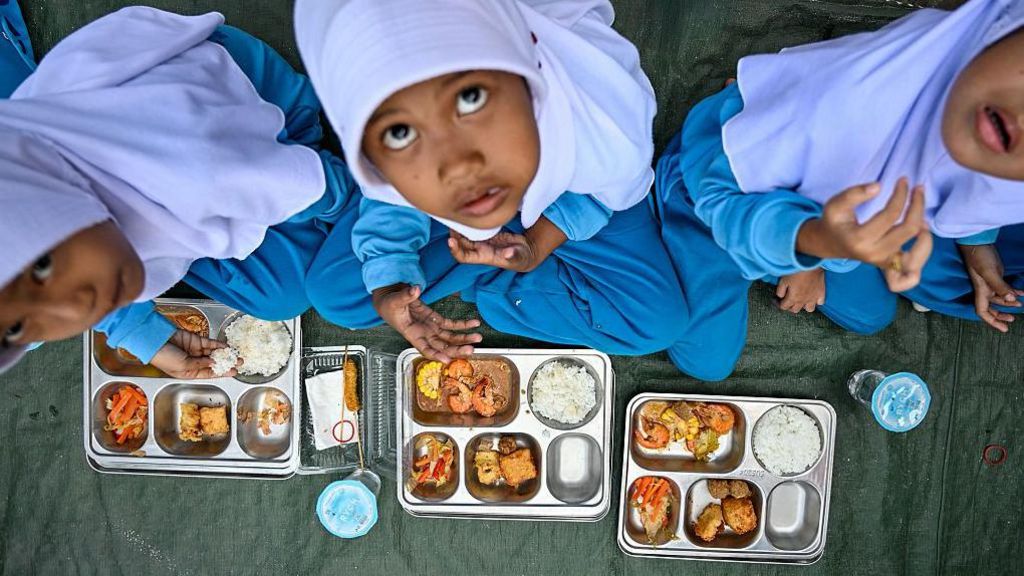
Indonesia’s flagship free school meals initiative, a cornerstone of President Prabowo Subianto’s 2024 presidential election platform, has been roiled by widespread public health incidents, corruption probes, and mounting political pressure, leading to the dismissal of the agency chief tasked with overseeing the multi-billion-dollar project.
The ambitious programme was designed to deliver daily free meals to 80 million school-aged children across the country, aimed at addressing childhood malnutrition and easing household financial burdens. But within months of its January 2025 launch, the initiative began to face cascading crises. As of April this year, local education advocacy group Network for Education Watch has linked at least 33,000 cases of food poisoning across the archipelago to the programme, forcing authorities to confront widespread public anger and demands for a full suspension of the scheme.
Last week, Indonesia’s anti-corruption commission formally filed a complaint over documented budget inconsistencies across hundreds of programme food preparation kitchens. Just seven days after that filing, on Wednesday, Prabowo moved to remove Dadan Hindayana, an entomologist who had served as head of the National Nutrition Agency, the governing body responsible for the free meals initiative. Hours before the dismissal was announced, officials from the Attorney General’s Office executed a raid on the National Nutrition Agency’s headquarters, blocking staff from accessing the building as investigators collected documents.
Dadan has been replaced by his former deputy, Nanik Sudaryati Deyang, a former journalist who worked as a member of Prabowo’s 2024 presidential campaign team. The leadership shakeup has drawn mixed reactions from the Indonesian public and policy analysts. While some welcomed the change as a necessary first step to address the programme’s failures, many critics have dismissed it as a superficial cosmetic fix that does not address deep-rooted structural flaws. “What the programme needs right now isn’t just swapping people, but a total overhaul of the concept and system. Without that, it’ll just keep being a source of problems,” Indonesian social media user Ahmad Arif wrote on platform X. Additional criticism has centered on Nanik’s lack of relevant professional experience: she has no background in nutrition or food safety management, a gap that has raised concerns about her ability to turn the troubled initiative around.
Beyond the public health crisis, Dadan also faced backlash for a series of controversial public statements, including a recommendation that all Indonesians drink two liters of milk per day and a proposal to incorporate insects and sago worms into the free meal menus. The programme itself has also drawn intense scrutiny over its enormous price tag, at a time when Indonesia is facing mounting economic headwinds including shrinking trade surpluses and a depreciating national currency. Just recently, authorities scaled back services from six days a week to five, a cut framed as a necessary response to global economic volatility spurred by the ongoing conflict between the U.S.-Israel alliance and Iran.
President Prabowo has not shied away from acknowledging the programme’s shortcomings. In a speech delivered last month, he admitted the scheme was beset “with many problems” and pledged to take firm action against any individuals found violating rules or abusing public authority. Even amid the scandals, however, the president maintains that the programme retains broad support among ordinary Indonesians. “Free nutritious meals are so important for our nation,” he said. “Everywhere I go, I meet ordinary people, farmers, saying, ‘sir, please don’t stop the free nutritious meals programme, this really helps my grandchildren to be able to eat’.”
Additional on-the-ground reporting for this story was contributed by Astudestra Ajengrastri in Jakarta.