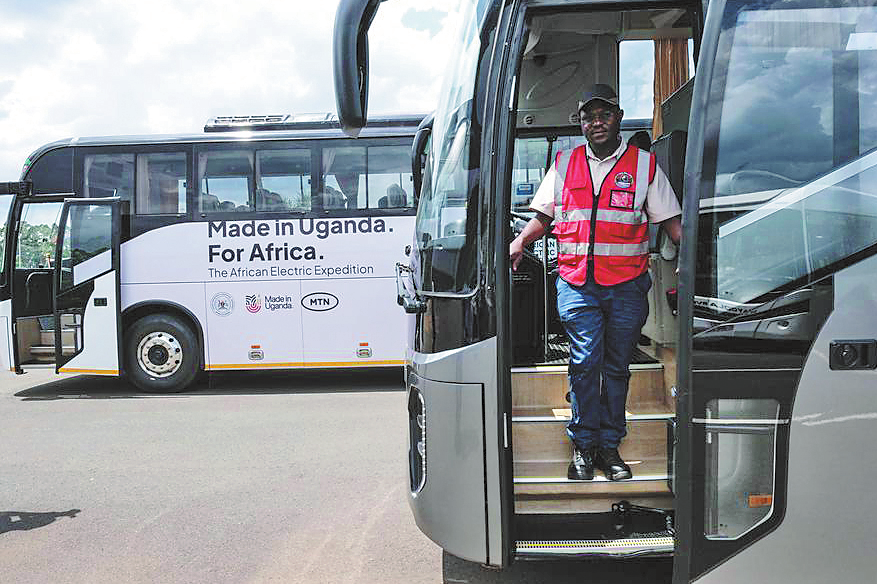
Across the bustling thoroughfares of Kampala, Uganda’s bustling capital, a quiet but transformative shift is reshaping the city’s daily transit landscape: sleek, domestically manufactured electric buses are now a regular part of urban mobility, pushing the East African nation’s ambitious push for low-carbon, sustainable public transportation forward.
The 40-seater electric buses, finished in a distinctive green-and-gray design, have captured public curiosity since their launch. Fitted with on-board WiFi, they let passengers stream content and share their travel experiences to social media in real time, turning ordinary commutes into shareable moments that have boosted the vehicles’ popularity among local residents.
Uganda’s foray into electric mobility is not a recent development. The country first marked its entry into the sector in 2016, when it unveiled the Kayoola electric bus – Africa’s first solar-powered electric vehicle, whose name translates loosely to “mass carrier” in local languages. Today, that early prototype has evolved into a full-fledged national initiative, led by domestic automotive manufacturer Kiira Motors Corporation (KMC) and its subsidiary E-Bus Xpress Kiira Ltd, which are spearheading efforts to scale electric mobility across the country.
During a recent media tour of KMC’s Kiira Vehicle Plant in Jinja, eastern Uganda, KMC managing director Ian Kyeyune announced that the fleet of electric buses operating on Kampala’s urban routes will expand from 16 to 45 within just one month. Looking ahead, the company has set a target to manufacture more than 1,500 electric buses over the coming 12 months, a milestone that aligns with Uganda’s national e-mobility strategy, which aims to put 15,000 electric vehicles on the country’s roads by 2030.
To clear the way for this green transition, Kampala’s municipal authorities have already begun overhauling urban traffic management. The city has eliminated curbside parking in dense downtown districts and introduced dedicated bus lanes, measures designed to cut through chronic congestion and prioritize public transit in a city where gasoline and diesel-powered private vehicles have long dominated road space. The national government is also encouraging growth in the sector by opening it up to private investment: under a new franchise framework, independent transport operators can own full fleets, while outside investors can purchase stakes in individual buses over fixed contract periods.
Beyond their environmental benefits, KMC technical leaders highlight that the electric buses deliver substantial economic advantages over traditional diesel-powered alternatives, from lower upfront procurement costs to reduced ongoing service and maintenance expenses. “We save over 60 percent of energy costs,” Kyeyune explained. “While an ordinary diesel taxi would spend 1,800 Ugandan shillings ($0.48) per kilometer, we only spend 800 shillings on energy.” Kyeyune added that lower operating costs mean private operators can recoup their initial investment in approximately three years, and the buses’ batteries can be repurposed for grid energy storage paired with solar power systems once they reach the end of their automotive lifespan.
The 12-year lifespan batteries currently used in the buses are sourced from Chinese suppliers, and KMC has built a close collaborative partnership with Chinese automotive firms to build domestic technical capacity in electric vehicle manufacturing. “We are working with a partner from China because their auto industry, in terms of electric vehicles, is the best in the world. We want to learn from the best,” said Richard Madanda, KMC’s director of production.
Uganda is already looking to expand its electric mobility footprint beyond its national borders. In late 2025, the country completed a pan-African demonstration expedition, where a single domestically built electric bus traveled 13,000 kilometers across five Southern and East African nations: Tanzania, Zambia, Botswana, Eswatini, and South Africa, showcasing the viability of Ugandan-built electric transit for markets across the continent.