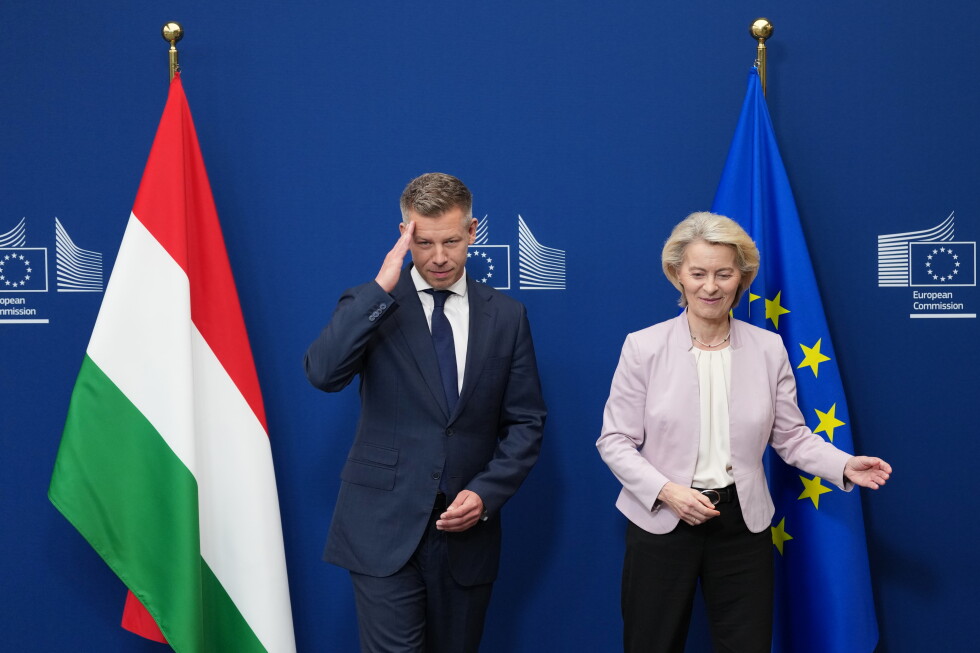
BRUSSELS — In a landmark meeting that signals a sharp shift in Hungary’s relationship with the European Union, newly inaugurated Hungarian Prime Minister Péter Magyar will sit down Friday for his first face-to-face talks with European Commission President Ursula von der Leyen, with the core goal of unlocking more than €10 billion in bloc funding frozen for years over democratic erosion concerns.
Magyar’s unexpected rise to power in April’s national election upended 16 years of nationalist rule under former Prime Minister Viktor Orbán, a leader who spent years openly clashing with Brussels’ top officials, regularly deriding von der Leyen and other EU leaders while systematically weakening Hungary’s domestic institutional checks and balances. Orbán’s tenure, marked by growing alarms over rising corruption and the collapse of judicial independence, led the European Commission to freeze billions in allocated Hungarian funding back in 2022. A year of incremental reforms under the previous administration eventually led EU officials to confirm last year that roughly €10.2 billion ($12.1 billion) could be released once outstanding commitments are met, a decision that gained new urgency after Magyar’s election win.
Magyar’s center-right Tisza Party secured a parliamentary supermajority in the April vote, clearing the way for the new government to push through sweeping, rapid overhauls of Hungarian policy. Both EU leadership in Brussels and the new Budapest administration have made unlocking the frozen funds a top policy priority, as the cash is seen as a critical lifeline to shore up Hungary’s stagnant, underperforming economy. The total frozen allocation breaks down into €10 billion in COVID-19 economic recovery funding and an additional €6.3 billion in EU cohesion funds, which are targeted at lifting lower-income regional economies across the bloc. Negotiating teams from both sides have prioritized unlocking the COVID recovery funds first, as the program is set to expire at the end of August, leaving a narrow window to finalize approval before the funds are permanently lost.
Magyar has been clear about the changes his administration is implementing to meet EU requirements: his government has moved forward to restore judicial independence, reinstate academic and media freedoms, and launch a sweeping anti-corruption campaign to address the longstanding concerns that led to the funding freeze. The prime minister has struck an uncharacteristically optimistic tone ahead of Friday’s talks, projecting confidence that the two sides will reach a final political agreement on releasing the funds. In a social media post published this week, Magyar confirmed the upcoming meeting, writing that the pair would finalize a political deal on releasing hundreds of billions of Hungarian forints in allocated funding that rightfully belongs to the country.
The meeting caps a months-long period of dramatic political change in Hungary, after a campaign that saw Magyar center his platform on repairing Hungary’s fractured relationship with the European Union to unlock critical economic support. For Brussels, a successful agreement would mark a major win for the bloc’s efforts to defend its rule of law standards across member states, while for Hungary, the released funds would deliver a much-needed boost to a struggling economy.