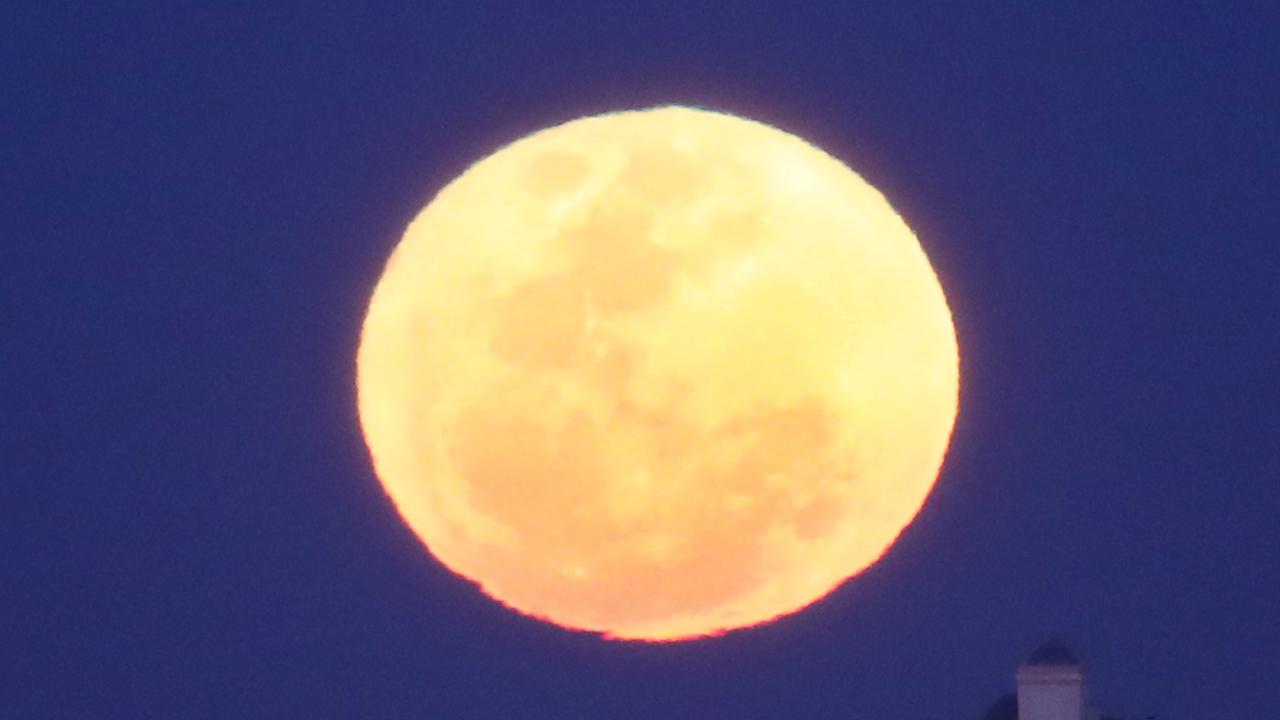
Skywatchers across Australia are preparing for a once-in-a-generation celestial treat this coming Sunday, May 31, as two rare lunar phenomena align to create a unique blue micromoon visible to the naked eye across the entire country.
This extraordinary event marks the rare convergence of two distinct astronomical occurrences: a blue moon and a micromoon. Unlike common misconceptions, a blue moon does not refer to a change in the moon’s color; instead, it describes the second full moon that occurs within a single calendar month. This quirk of astronomy arises because the moon’s 29.5-day orbital cycle does not perfectly align with the 30- or 31-day structure of the Gregorian calendar, creating an extra full moon roughly once every two to three years. This May will play host to two full moons, with Sunday’s event earning it the blue moon title.
Compounding the rarity of the event, this blue moon coincides with a micromoon, a phenomenon that takes place when a full moon falls close to the apogee – the farthest point of the moon’s elliptical orbit around Earth. Data from astronomy tracking site Time and Date notes that micromoons appear roughly 6% smaller than an average full moon, and more than 12% smaller than their counterpart, the supermoon, which occurs when a full moon falls near the closest orbital point, the perigee.
Laura Driessen, a postdoctoral researcher at the Sydney Institute for Astronomy, explained that while the size difference is subtle to the untrained eye, the brightness of the event will be unmistakable. “It’s tens of thousands of times brighter than the brightest star in the night sky,” Driessen told SBS News. She added that the human eye cannot pick up the small size difference between a micromoon and a typical full moon – the change is only noticeable when side-by-side photographs of the two events are compared. “It will look like a beautiful full moon to us,” she confirmed.
Unlike many rare celestial events that require specific viewing locations or specialized equipment, this blue micromoon will be visible from every region of Australia, with no telescope required. The best viewing window is any time after dark on Sunday when the sky is clear of cloud cover. Peak fullness falls at slightly different times across Australia’s time zones: 6:45pm AEST for New South Wales, Queensland, Victoria, the Australian Capital Territory and Tasmania; 6:15pm ACST for South Australia and the Northern Territory; and 4:45pm AWST for Western Australia.
For the best viewing experience, astronomy enthusiasts recommend looking toward an unobstructed eastern horizon around moonrise or just after sunset, when the moon will often take on a soft golden-orange glow as it sits low in the sky. While no equipment is needed, a pair of binoculars can help bring out sharper details of the moon’s craters and surface features for interested observers.
For those who miss this weekend’s event, the next blue moon will not grace Earth’s skies until December 31, 2028, making this a rare opportunity that astronomy fans across Australia are not keen to miss.