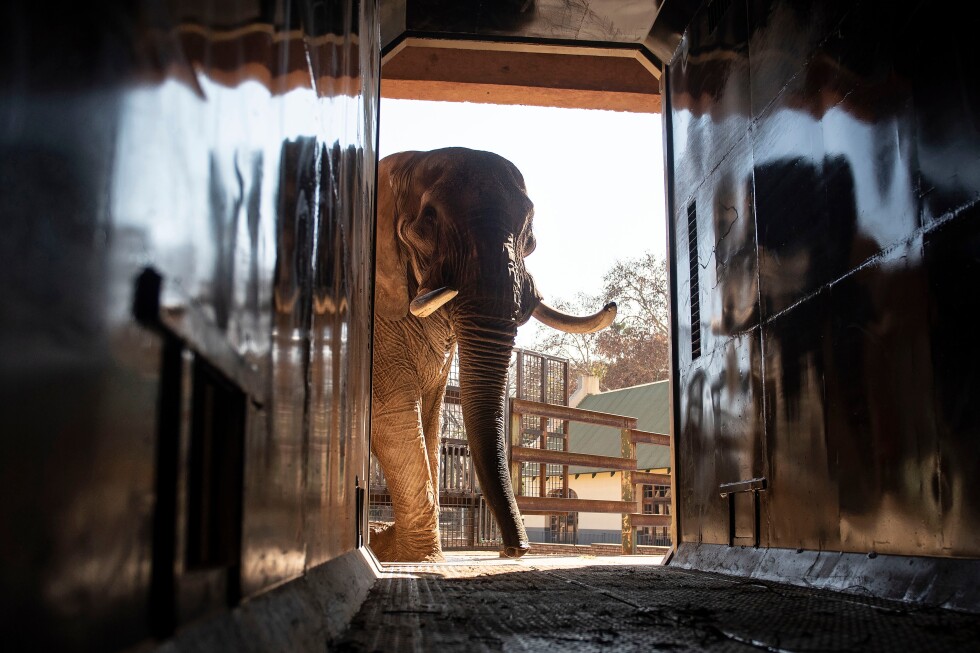
A landmark legal battle over the mental health of three captive elephants at Johannesburg’s public zoo is set to get a court hearing this week, pitting leading animal welfare advocates against city authorities in a case that could reshape animal protection standards across South Africa.
The dispute centers on three elephants — Lammie, Ramadiba and Mopane — held in the zoo’s enclosure. Animal welfare groups, including Animal Law Reform South Africa, argue that the confined space and lack of species-appropriate stimulation have left the animals clinically depressed, and they are demanding the elephants be transferred to a larger, semi-wild conservation park where their complex biological and social needs can be met.
David Bilchitz, board member of Animal Law Reform South Africa, one of the lead petitioners in the case, explained that the legal challenge focuses on whether South African state authorities are fulfilling their constitutional obligations to protect animal welfare. A core plank of the petitioners’ argument draws on a clause in South Africa’s Constitution that explicitly imposes a duty on governing bodies to safeguard animal well-being, and expert witnesses are set to testify in court to confirm the elephants’ poor psychological state.
Unlike their wild counterparts, who naturally live in large herds of 20 to 50 individuals and roam across vast expanses of terrain, the three zoo elephants are confined to an enclosure only slightly larger than a standard soccer pitch. Bilchitz noted the space lacks key features elephants require for natural foraging and stimulation, including mature trees to feed on and mud pools to bathe in.
“There is no doubt these animals are sad, depressed and deeply frustrated,” Bilchitz told the Associated Press. “They spend their days listless, standing around with nothing to engage them, and they’ve developed clear signs of psychological distress: repetitive rocking movements and other compulsive behaviors that are well-documented indicators of poor mental health in captive elephants.”
Officials at the publicly owned Johannesburg Zoo have pushed back against the claims, defending their care of the three animals. In an official statement, the zoo argued that coverage of the elephants’ condition has amounted to a “media scourge,” maintaining that the trio are in good physical health, well cared for by staff, and remain a popular attraction for visitors. The institution also warned that relocating captive elephants to semi-wild sanctuaries does not always result in positive outcomes for the animals.
The case is not entirely without precedent in South Africa. In 2024, an elderly bull elephant named Charley was successfully moved from another South African zoo to an extensive game reserve following advocacy from animal welfare groups. Charley had outlived all his herd mates in captivity, after spending 16 years performing in a circus, and experts confirmed he was suffering from profound loneliness. The zoo ultimately agreed to the relocation, allowing Charley to spend his final years in retirement in a more natural environment.
The outcome of this new case could set a transformative legal precedent for animal welfare regulation across South Africa, testing the scope of constitutional protections for animals kept in captivity and potentially forcing a re-evaluation of housing conditions for elephants and other large wild animals in the country’s public and private zoos.