Just one month before U.S. special forces removed Venezuelan leader Nicolás Maduro from power, a starkly different outcome played out for another former Latin American head of state: Juan Orlando Hernández, ex-president of Honduras, who had been convicted on nearly identical drug trafficking charges, walked free after receiving a full presidential pardon from former U.S. President Donald Trump.
Hernández had spent nearly four years behind bars at West Virginia’s maximum-security Hazelton Federal Correctional Institution, serving a 45-year sentence for his 2024 conviction on conspiracy charges linked to a transnational cocaine trafficking ring that moved 400 tonnes of the drug into the United States. Trump announced the pardon on his Truth Social platform on November 28, just 48 hours before Honduras’ general election. In the same post, Trump threatened to cut U.S. aid to Honduras unless his preferred candidate – Nasry Asfura of Hernández’s conservative National Party – won office. After a tightly contested race and delayed vote count, Asfura ultimately claimed victory.
In an exclusive interview with the BBC from his current residence in the U.S., Hernández described his sudden release as an extraordinary turnaround, saying he is “thankful and just trying to rebuild my life” after half a decade of incarceration. He has forcefully rejected claims that the pardon was granted for political reasons, aligned with Trump’s long-stated regional policy rooted in a reinterpretation of the Monroe Doctrine, which frames the Americas as Washington’s exclusive sphere of influence.
Most notably, Hernández pushed back hard against comparisons between his case and that of Maduro. Both right- and left-leaning sitting presidents were ultimately accused of large-scale drug trafficking, but Hernández secured Trump’s backing while Maduro faced forced removal. “My case is completely different,” he insisted, arguing that the entire criminal narrative around him was constructed by “leftist politicians in Honduras in tandem with left-wing politicians in Venezuela.” He claims upcoming evidence in Maduro’s upcoming U.S. drug trial will reveal that corrupt, drug-linked connections actually lie with members of Honduras’ left-wing Libre party, not his conservative administration.
The pardon granted Hernández unconditional legal clearance for all the charges he was convicted of, leading the U.S. Second Circuit Court of Appeals to dismiss his pending appeal as moot, since the conviction no longer carried legal weight. The Trump administration has framed the pardon as a correction of what it calls a wrongful prosecution carried out under the Joe Biden administration.
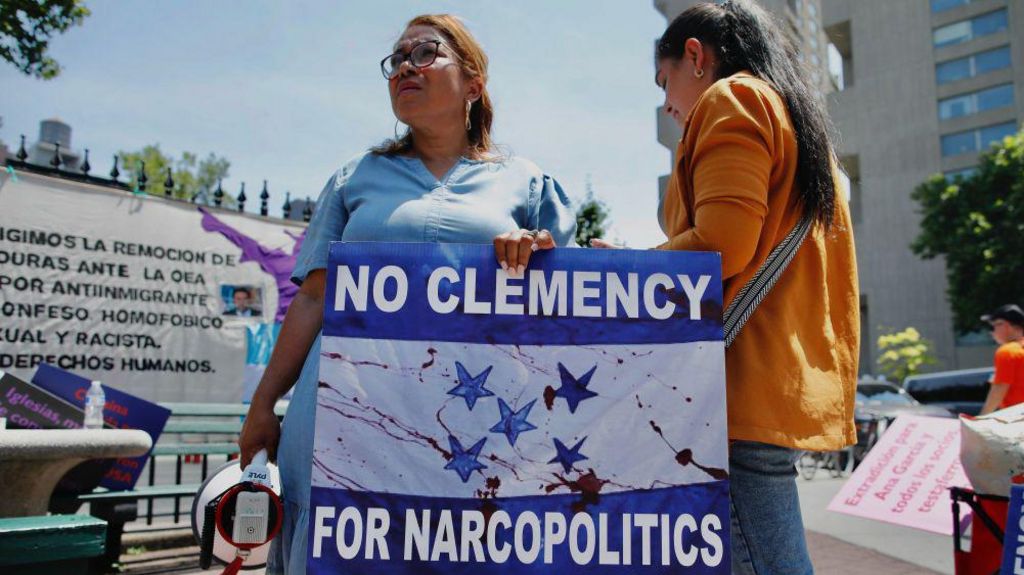
But for many Hondurans, the pardon does nothing to change their view of Hernández, who remains the most controversial Honduran president in recent memory, and was extradited to the U.S. in shackles to face trial. The decision sparked widespread protests both among Honduran communities in the U.S. and across Honduras, with demonstrators gathering outside the U.S. embassy in Tegucigalpa to condemn the move. “It’s a mockery for Honduras. This country doesn’t deserve that,” one local resident told Honduran television at the time.
At Hernández’s 2024 sentencing, U.S. District Judge P. Kevin Castel branded him a “two-faced politician” who leveraged his presidential authority and Honduras’ national security forces to protect drug traffickers who bribed his administration and funded his political career. Prosecutors alleged he turned Honduras into a narco-state, a particularly notable charge given the country’s long-standing role as a key transit point for South American cocaine bound for U.S. consumers.
Hernández has repeatedly denied all charges, pointing to a extradition law passed by his own administration – the same law that allowed his extradition to the U.S. for trial – as proof of his commitment to combating drug trafficking. He claims the law angered traffickers who ultimately coordinated to testify against him in retaliation.
Among the most damning evidence introduced at trial was an alleged quote attributed to Hernández, in which he reportedly told a senior Honduran trafficker: “We’re going to shove the drugs right up the noses of the gringos.” Prosecutors also claimed he accepted a $1 million bribe from infamous Mexican drug lord Joaquín “El Chapo” Guzmán. Pressed on these claims, Hernández dismissed them as “false and ridiculous,” noting that El Chapo was already known to U.S. law enforcement at the time of the alleged meeting and was never in Honduras. “If you look at El Chapo’s trial, he doesn’t even mention Juan Orlando Hernández,” he told the BBC.
He also rejected another key piece of prosecution evidence: handwritten ledger entries from a major Honduran trafficker that purportedly documented bribes paid to both him and his younger brother, Tony Hernández, a former Honduran congressman who is currently serving a life sentence in the U.S. for drug trafficking. Tony Hernández’s conviction two years before his brother’s trial was a core part of the prosecution’s case against Juan Orlando; Tony was secretly recorded meeting with a top Honduran trafficker, who later testified against both siblings, alleging a $250,000 bribe was paid for protection while Juan Orlando was running for president. When asked what Tony was doing at that meeting, Hernández acknowledged: “I ask myself the same question, it was a grave mistake.”
Hernández has framed the entire case against him as a “political operation” built on the testimony of witnesses motivated by revenge, reduced sentences and entry into witness protection programs. He claims the prosecution was backed by an international alliance of left-wing politicians, including Democratic leaders in Washington, targeting him as a conservative leader. He and his family echo Trump’s description of the case as a “horrible witch-hunt” carried out by a politicized Biden-era Department of Justice, arguing the pardon merely corrected a gross injustice.
However, multiple current and former officials from the Department of Justice, State Department and Drug Enforcement Administration who worked on the case told the BBC their investigation was conducted with full due process and no improper political interference. They emphasized that the investigation into Hernández began during Trump’s first term, and was not a Biden administration initiative. Ana María Méndez Dardón, Central America director at the Washington Office on Latin America research organization, confirmed the years-long investigation was built on solid evidence. “The conviction had strong evidence that supported finding Juan Orlando Hernández guilty as a drug trafficker,” she said. “There were many witnesses which exposed linkages with other transnational drug organisations, including El Chapo Guzmán. It was huge. And it goes beyond Juan Orlando Hernández as a former president and a former convicted drug trafficker.”
Five months after his release, Hernández has still not been reunited with his family in person. He remains facing outstanding corruption and misappropriation of state funds charges in Honduras, and his wife Ana García Carías has been subject to U.S. visa restrictions since his 2020 arrest. Hernández says his top priority is securing permission to return to Honduras to be with his family, and he has ruled out any return to politics: “I’m not interested [in returning to politics]. My interest is in my family. I’ll never get back those four years I lost. Even today, I still haven’t seen them.” With his former National Party colleagues back in power in Tegucigalpa, however, Hernández is growing increasingly hopeful he will be allowed to return home. If he does, he will face the massive challenge of convincing the Honduran public, many of whom are frustrated by corrupt political elites avoiding accountability, of his version of events.