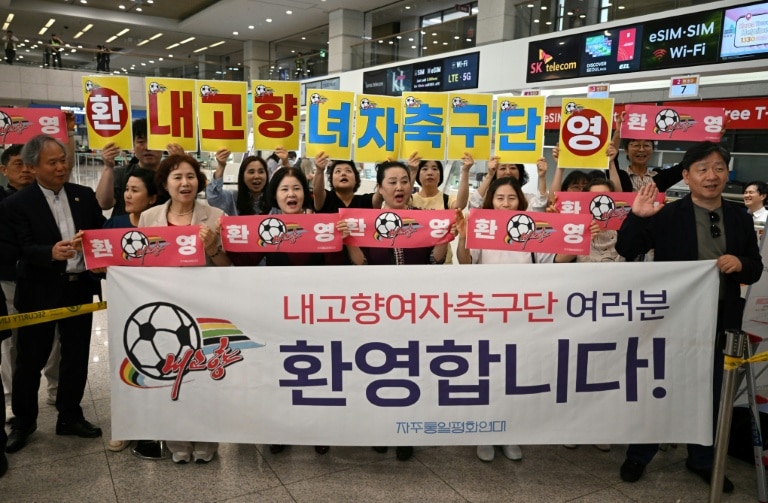
In a landmark moment for inter-Korean sports exchange after nearly a decade of separation, North Korea’s Naegohyang Women’s Football Club touched down in South Korea on Sunday, ahead of their semi-final appearance at the Women’s Asian Champions League. This visit marks the first time a sports delegation from the isolated country has traveled to its southern neighbor since 2016.
An Agence France-Presse correspondent on the ground at Incheon International Airport reported that the 39-member group, made up of players and coaching staff, stepped out of the arrivals gate clad in matching dark jackets and skirts, greeted by a crowd of cheering South Korean civic activists holding hand-painted welcome banners. “We welcome you!” the supporters shouted as the delegation walked along a security cordoned path, under close supervision from local law enforcement. After clearing the terminal, the team quickly boarded a chartered bus that departed under police escort to their accommodations.
Based in the North Korean capital Pyongyang, Naegohyang — whose name translates to “My Hometown” in Korean — will face off against host side Suwon FC Women this Wednesday in the tournament’s first semi-final match. Founded in 2012, the club claimed the top title in North Korea’s domestic top-flight league for the 2021-2022 season, and already holds a decisive 3-0 victory over Suwon from the group stage of last year’s competition.
The delegation traveled to South Korea via Beijing, and will stay at a hotel in Suwon, a city located roughly 30 kilometers south of Seoul. According to local South Korean media reports, organizers have arranged separate dining facilities and transportation routes for the two teams, a measure that will limit unplanned direct interaction between the North Korean and South Korean squads.
Public excitement around the historic match has surged across South Korea: more than 7,000 tickets to the game sold out within hours of going on sale. South Korea’s Unification Ministry, the government body responsible for inter-Korean relations, has even allocated public funding to South Korean civic groups organizing fan activities for both teams, framing the cross-border sports event as a rare, important opportunity to build connection between the divided Korean people. “This match offers a meaningful chance to boost mutual understanding between the two Koreas,” the ministry noted of its support.