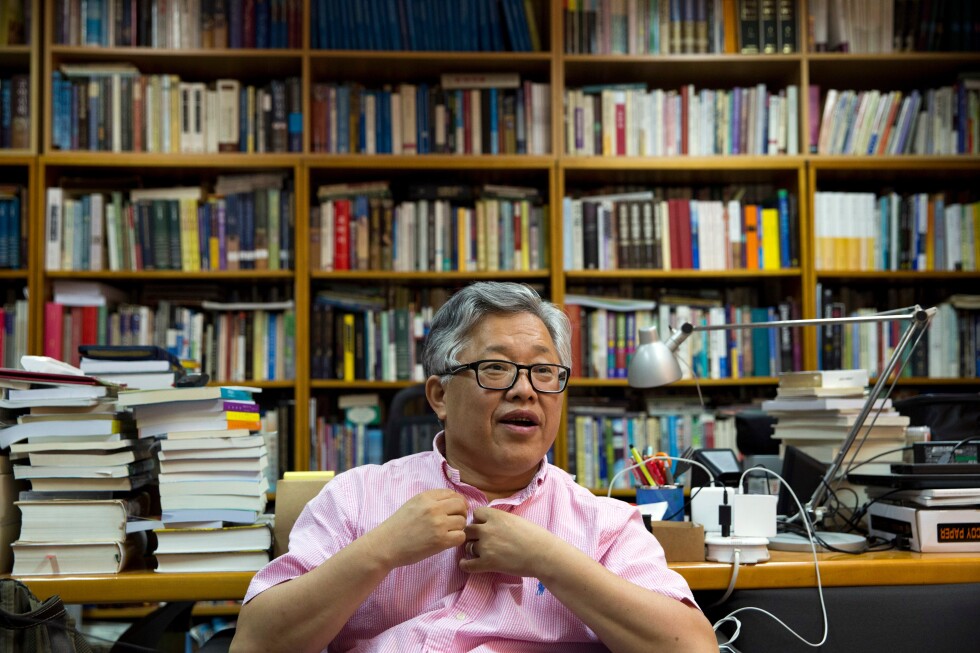
During a media briefing aboard Air Force One while returning from his official visit to China in November 2017, then-U.S. President Donald Trump disclosed that he had raised the cases of two high-profile detained individuals — underground church pastor Ezra Jin Mingri and imprisoned Hong Kong pro-democracy activist Jimmy Lai — with Chinese President Xi Jinping. Trump told reporters that Xi committed to giving serious consideration to Jin’s case, but characterized Jimmy Lai’s legal situation as a far more complex issue that would be difficult to resolve.
Jin, the leader of Beijing’s Zion Church, one of China’s largest unregistered house churches that operates outside of state-sanctioned religious frameworks, was taken into custody in October 2017. His detention was widely interpreted by international observers as part of a broader, escalating crackdown on unapproved religious practice across the country. “He said he’s gonna strongly consider the pastor,” Trump confirmed to reporters traveling with him.
In contrast to the tentative openness around Jin’s case, Trump noted that Xi described Jimmy Lai’s situation as a particularly “tough one.” Lai, a 78-year-old former media tycoon and founder of the now-shuttered pro-democracy outlet Apple Daily, has remained a vocal critic of the Chinese Communist Party and Beijing’s policies toward Hong Kong for decades. He was ultimately convicted in February 2021 on charges of conspiracy to collude with foreign forces and publication of seditious material under the sweeping 2020 National Security Law imposed by Beijing on Hong Kong, and sentenced to 20 years in prison. His prosecution and the shutdown of his newspaper came in the wake of large-scale anti-government protests that roiled Hong Kong in 2019, and the crackdown that followed has effectively silenced most organized dissent in the former British colony.
Despite the very different outlooks Trump outlined for the two men, the families of both Jin and Lai have publicly expressed gratitude to the Trump administration for bringing their cases to the highest levels of diplomatic discussion. Grace Jin Drexel, Jin’s daughter, called the development nothing short of miraculous in a written statement to the Associated Press. “We could not be more grateful to President Trump and his skillful administration for pressing the case!” she wrote, adding that the family and supporters were “overjoyed” by the news.
Claire Lai, Jimmy Lai’s daughter, also thanked Trump for his administration’s commitment to advocating for her father’s release even amid Trump’s cautious assessment of the case. “He has earned his reputation as liberating the unjustly detained and I am confident he and his administration will be the ones to free my father,” she said in a message to the AP. She framed potential release of her father as a critical opportunity for Xi to demonstrate good will to the international community, calling it the only just and honorable course of action.
Human rights activists have long noted that under Xi Jinping’s leadership, Beijing has grown increasingly unwilling to release high-profile detainees detained over dissent or human rights-related activities. The most prominent recent example came in 2017, when Nobel Peace Prize laureate Liu Xiaobo died of liver cancer in a Chinese hospital despite repeated calls from Western governments to allow him to travel abroad for life-saving treatment.
International observers widely view Jimmy Lai’s case as a symbolic marker of the erosion of civil liberties in Hong Kong, a outcome that runs counter to the autonomy and protections Beijing promised the territory under the 1997 handover agreement from British rule. Foreign governments including the United States and United Kingdom have repeatedly raised concerns about Lai’s detention and prosecution, though the Hong Kong government has repeatedly maintained that his conviction had no connection to press freedom, framing it as a standard criminal matter. Just days before Trump’s comments, China’s foreign ministry reaffirmed its position that Lai was a key organizer of anti-China activities intended to destabilize Hong Kong, and that all affairs related to Hong Kong are strictly China’s internal business, off-limits to foreign interference.
This report was compiled from contributions from Tang reporting out of Washington, with additional reporting from AP journalist Emily Wang in Washington.