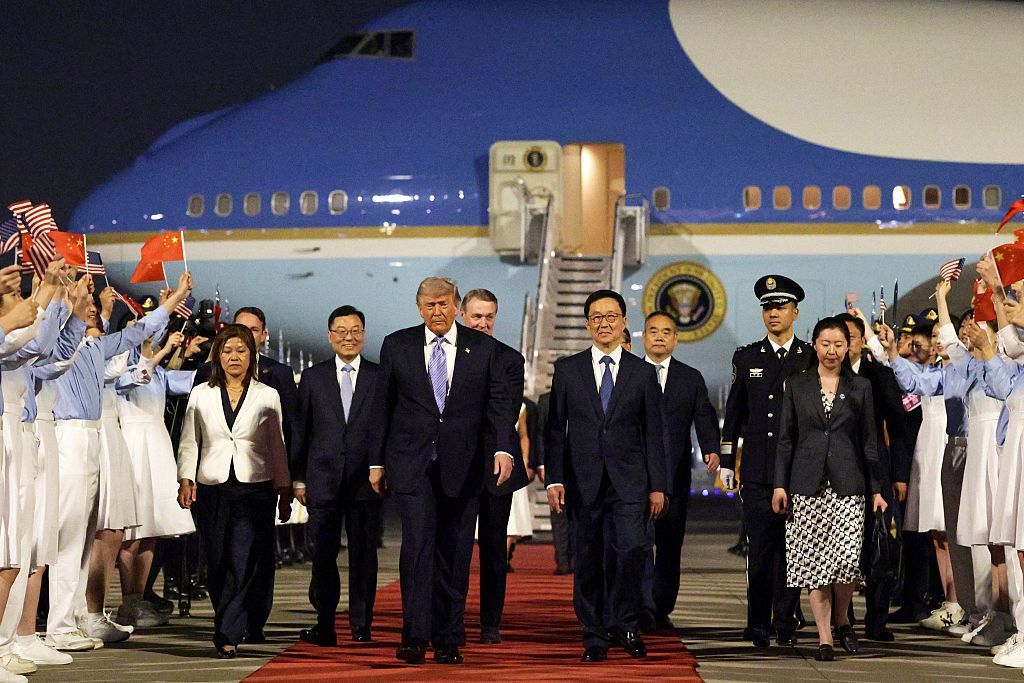
On the evening of May 13, U.S. President Donald Trump touched down in Beijing, stepping off Air Force One to a formal, high-level welcome that set the tone for two days of critical bilateral discussions with Chinese President Xi Jinping. The arrival, marked by a red carpet laid across the airport tarmac, saw Trump greeted by China’s Vice President Han Zheng — a gesture widely interpreted as a deliberate show of respect from Beijing, a step up from the lower-ranking official who welcomed Trump during his last visit to China in 2017.
Joining the U.S. delegation at the welcome ceremony were Trump’s son Eric Trump and a roster of prominent American technology industry leaders, including Tesla CEO Elon Musk and NVIDIA founder Jensen Huang. Ahead of his landing, Trump shared his priorities on social media, noting that his first official request to Xi would be to push for greater market access in China for American businesses. “I will be asking President Xi, a Leader of extraordinary distinction, to ‘open up’ China so that these brilliant people can work their magic, and help bring the People’s Republic to an even higher level,” Trump wrote.
The visit, originally planned for March, was postponed due to the ongoing U.S.-Israel military campaign in Iran, a conflict that has sent shockwaves through global energy markets and remains the top item on the bilateral agenda. China maintains a decades-long strategic alliance with Iran and is Tehran’s largest trading partner, relying heavily on Iranian crude oil imports. The conflict has effectively halted these shipments, as commercial vessels are unable to safely traverse the Strait of Hormuz, and the U.S. is pushing Beijing to use its considerable economic and political leverage to pressure Tehran to end hostilities.
Beyond the Iran crisis, a range of thorny bilateral issues will be on the negotiation table. Cross-strait tensions over Taiwan loom in the background, as the Trump administration has taken an inconsistent approach to the island: it has approved a major arms package for Taipei while simultaneously downplaying commitments to defend Taiwan in the event of conflict with Beijing. On trade, Trump is expected to press China to ramp up purchases of American agricultural goods, while Chinese negotiators will push for the U.S. to roll back punitive tariffs on thousands of Chinese imports. Tech competition between the two global powers will also feature heavily in talks, a longstanding point of friction that has intensified in recent years.
This meeting comes at a pivotal moment for both sides. Since Trump’s last visit to China in 2017, China has adopted a more assertive stance on global and regional affairs, while Trump faces growing domestic and international scrutiny over his administration’s handling of the Middle East conflict. The outcome of these talks carries significant implications for global economic stability, security cooperation, and the future of U.S.-China relations.