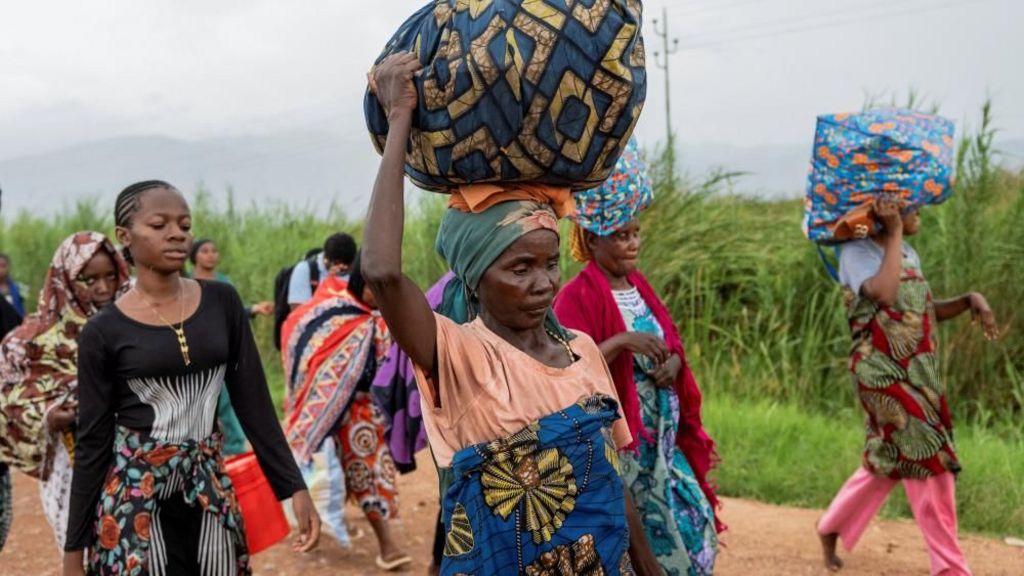
Years of simmering conflict in the resource-rich eastern region of the Democratic Republic of the Congo have erupted into one of the world’s most devastating unaddressed humanitarian crises, with a new bombshell investigation from leading global human rights watchdog Human Rights Watch (HRW) exposing systematic atrocities against civilians during the weeks-long occupation of the key lakeside city of Uvira.
The investigation, the first comprehensive on-the-ground account of abuses during the occupation, documents extrajudicial summary executions, widespread sexual violence, targeted attacks on children, and mass civilian displacement, with direct blame placed on both the M23 rebel movement and uniformed troops from neighboring Rwanda.
M23 forces, long alleged by Western powers and United Nations experts to be militarily backed by Rwanda, seized Uvira – a strategic port city on the shores of Lake Tanganyika that serves as a gateway to Burundi, a key Congolese military ally – in December 2024. The capture came just days after then U.S. President Donald Trump brokered a high-profile peace deal between Congolese President Felix Tshisekedi and Rwandan President Paul Kagame, designed to de-escalate years of fighting in the unstable region.
Over 130 local residents who remained in or fled Uvira during the occupation were interviewed by HRW investigators, who collected firsthand testimony corroborating 53 documented civilian executions carried out during door-to-door search raids across residential neighborhoods. The victims included 46 men, one woman, and five minor boys. Multiple witnesses described watching family members and neighbors killed in cold blood. One survivor recalled, “I wasn’t hit so I just ran to the lake. I saw my brother, his wife, and two of his children fall,” after M23 fighters opened fire on his household. Another witness described seeing fighters execute his neighbor with a point-blank gunshot to the head.
Beyond extrajudicial killings, HRW verified eight separate accounts of gang rape and sexual assault committed by M23 fighters and Rwandan soldiers, with many survivors describing brutal violence against their families for attempting to intervene. In one account, a woman told investigators that after uniformed men sexually assaulted her, they shot and killed her husband when he tried to stop the attack. Another survivor recalled Rwandan soldiers threatening to murder her if she did not comply with their demands, while a third survivor described fighters debating whether to kill her before deciding to assault her instead.
Children were not spared from the violence, the report confirms. Multiple children were shot and killed after being falsely accused of being pro-government informants. One 12-year-old boy survived a execution attempt, HRW says, after fighters shot him and stabbed his leg with a bayonet to confirm he was dead before leaving him for dead. Investigators also located three unmarked mass graves in Uvira, including one on a site previously controlled by United Nations peacekeeping forces.
The Rwandan government has long rejected all claims that it provides military support to M23 or deploys its own troops inside Congolese territory, and neither the Rwandan government nor M23 leadership responded to HRW’s requests for comment on the specific allegations outlined in the report, nor to separate requests for comment from the BBC.
Following intense regional and international diplomatic pressure, M23 withdrew from Uvira in January 2025, allowing Congolese government forces to retake control of the city. By that point, tens of thousands of residents had already fled their homes to escape the violence.
HRW says the pattern of documented abuses – which also include widespread abductions, enforced disappearances, and forced recruitment of local residents – meet the international legal definition of war crimes. The organization is calling for immediate international accountability measures to be brought against all parties responsible for the violence.
This report is only the latest to highlight the catastrophic scale of the ongoing humanitarian disaster in eastern DRC. A separate 2025 analysis from the United Nations Children’s Fund (UNICEF) found that more than 35,000 cases of sexual violence against children were recorded across the country in the first nine months of 2025, the vast majority in the North and South Kivu provinces, where M23 controls large swathes of territory. The persistent fighting has displaced nearly two million people in South Kivu province alone, according to UN figures, leaving millions more facing acute food insecurity and limited access to basic medical and humanitarian services.