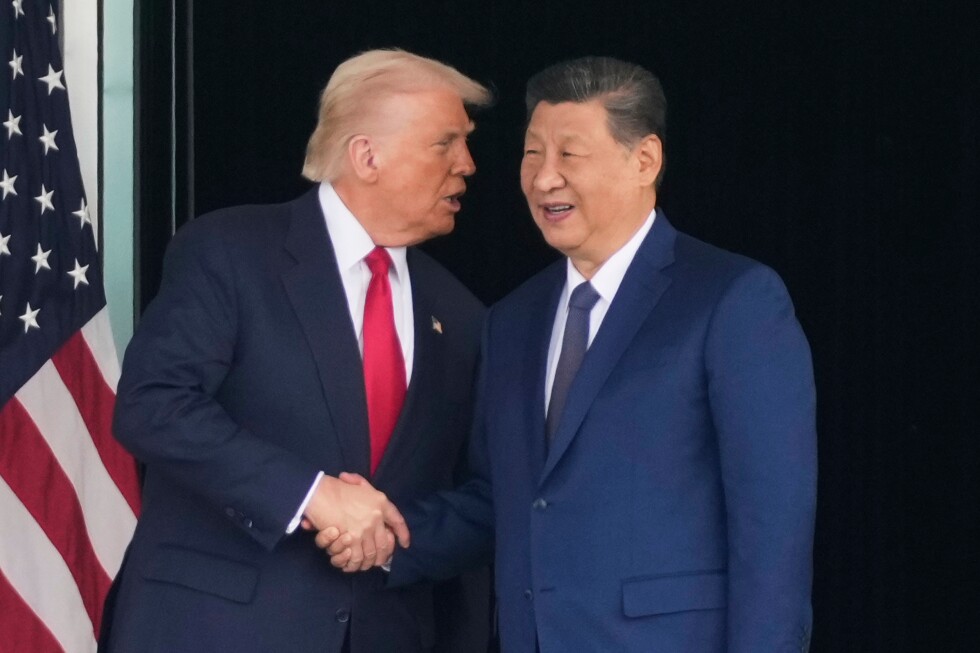
As U.S. President Donald Trump prepares to depart Washington for a high-stakes summit with Chinese leader Xi Jinping in Beijing on Tuesday — the first of potentially four scheduled meetings between the two leaders this year — he has struck an upbeat tone about bilateral economic ties, framing the world’s two largest economies as reaping growing mutual benefits from trade while downplaying escalating frictions over rare earth minerals, tit-for-tat tariffs, and cutting-edge technologies like artificial intelligence.
“We’re doing a lot of business with China and making a lot of money,” Trump told reporters last week. “We’re making a lot of money — it’s different than it used to be.”
The summit’s core agenda centers on preserving stability in the bilateral economic relationship, with analysts and administration officials signaling that only incremental policy announcements are expected. The temporary trade truce reached by the two leaders during an October meeting in South Korea last year is widely projected to be extended, and China is reportedly preparing to unveil new purchase commitments for key U.S. exports including soybeans, beef, and commercial aircraft from Boeing. U.S. officials have also publicly floated the creation of a new bilateral Board of Trade to sustain ongoing dialogue on economic issues.
Brett Fetterly, managing principal at global consultancy The Asia Group who specializes in China policy, notes that many within the Trump administration view stable, continued engagement as a more critical outcome than a sweeping immediate policy deal. “The outcome that matters more than any set of deliverables is stability and space for continued engagement, both to build domestic resilience and to facilitate future deal-making,” Fetterly explained.
Yet even as diplomatic preparations frame the summit as a step toward smoother relations, deep-seated competition continues to shape the bilateral relationship, with multiple flashpoints ranging from lingering tariff disputes to the AI arms race and the ongoing Iran war capable of upending fragile progress. Official trade data also undermines Trump’s optimistic framing of growing U.S. gains from trade with China: U.S. Census Bureau figures show China purchased nearly $50 billion less in American goods last year than it did in 2022, a drop driven in part by Beijing’s pause of soybean purchases during a 2024 flare-up of trade tensions. The Trump administration has made expanding Chinese imports of U.S. goods a core priority to support American farmers and manufacturers and narrow the 2024 bilateral trade deficit, which hit $202 billion.
Wider trade shifts have also reshaped economic ties in recent years: for the first time, the United States now imports more goods from Taiwan than from mainland China, a shift largely driven by surging demand for AI-related semiconductors and server hardware from the self-governing island that Beijing claims as its own. Analysis by Chad Bown, senior fellow at the Peterson Institute for International Economics and co-author of *How to Win a Trade War*, shows China’s share of total U.S. goods imports has plummeted from 22% at the start of Trump’s first term in 2017 to just 7.5% in the first three months of this year, as both sides have rerouted trade through third-party economies and U.S. firms have shifted electronics supply chains to Vietnam and India.
The proposed new bilateral Board of Trade lies at the center of U.S. negotiating priorities for the summit. U.S. Trade Representative Jamieson Greer told Chinese Vice Premier He Lifeng during an April 30 call that the body would focus on facilitating trade in non-sensitive goods — such as agricultural products, but excluding advanced semiconductors and other technology deemed critical to national security — and streamline dispute resolution to help boost U.S. exports to China. The initiative also offers the Trump administration a politically and legally viable alternative to large-scale tariff hikes, after the U.S. Supreme Court ruled that Trump lacked the authority to unilaterally impose the sweeping 145% tariff increases on Chinese goods he enacted last year, and a federal court recently deemed the replacement temporary tariffs illegal last week.
Administration officials confirmed that both sides will need to secure domestic approval to launch the board, which would oversee tens of billions of dollars in annual trade. The U.S. is also pushing for a parallel bilateral investment forum to facilitate cross-border financing of commercial operations. A 17-member delegation of major U.S. corporate CEOs, including Tesla’s Elon Musk, Apple’s Tim Cook, and Boeing’s Kelly Ortberg, will accompany Trump on the trip, the White House confirmed.
Despite the push for dialogue, fundamental misalignment of priorities between Washington and Beijing threatens to limit progress at the summit. Trump has framed the bilateral trade imbalance as the core issue to resolve, betting that the U.S. can retain its technological lead in artificial intelligence. By contrast, Xi’s administration frames a rapidly shifting global landscape shaped by climate change and the Iran war as an opportunity to expand global market share for Chinese clean energy technologies including solar panels and electric vehicles.
“Washington and Beijing are competing at different levels and different domains, with different theories of victory,” explained Michael Sobolik, senior fellow for U.S.-China relations at the conservative Hudson Institute. “President Trump leveraged tariffs not as a weapon against China but as leverage to secure a trade deal. Xi Jinping is angling to win a cold war with the United States.”
The ongoing U.S.-Israel conflict in Iran has also created a new inflection point in global energy that deepens structural divides, according to Ali Wyne, senior research and advocacy adviser on U.S.-China relations at the International Crisis Group. The Trump administration is betting on continued global reliance on fossil fuels, while China frames recent energy price spikes triggered by Strait of Hormuz shipment disruptions as validation of its long-term strategy to lead the global green energy transition. “The structural frictions between the United States and China, they are growing in number and severity,” Wyne noted.
Beneath the upbeat diplomatic rhetoric ahead of the summit, a host of unresolved flashpoints continue to threaten bilateral stability. These include China’s near-total global dominance of rare earth mining and processing — critical inputs for consumer electronics and clean energy technology — which the Trump administration is working to break through years of new investment and alternative supply chain partnerships. The U.S. also continues to push sweeping restrictions on Chinese access to cutting-edge AI semiconductors produced by U.S. firms including Nvidia and AMD. Other sticking points include China’s growing global dominance as an auto exporter, with Chinese vehicle exports rising 21% last year and Chinese EV manufacturers undercutting global competitors on price. The administration is also pursuing new tariffs on Chinese goods under a 1974 Trade Act national security provision, after earlier tariffs were struck down by the courts, targeting excess industrial capacity and alleged forced labor practices. Most recently, U.S. sanctions on a Chinese oil refinery and dozens of Chinese tankers and shipping firms for transporting Iranian crude have sparked a public backlash from Beijing, which has demanded international actors ignore the penalties, and the two countries are also locked in a dispute over Panama Canal management.