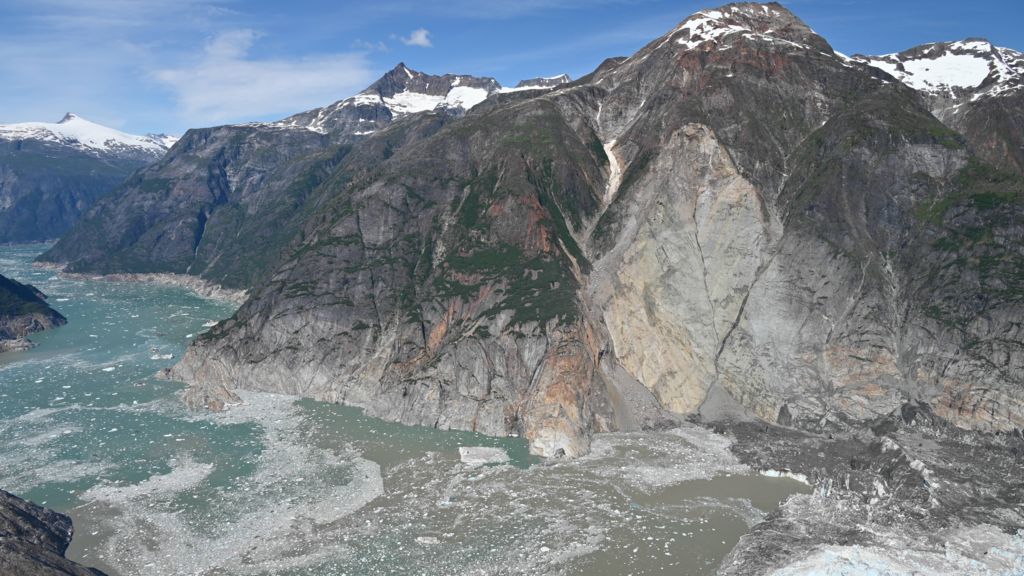
In August 2025, a catastrophic natural event unfolded in a remote Alaskan fjord that has now emerged as a stark warning about the growing dangers of climate change in glacial regions. A massive section of a mountainside near South Sawyer Glacier in Tracy Arm Fjord, southeast Alaska, collapsed into the water following a series of minor seismic events, triggering a near-500-meter-tall megatsunami – the second such event ever recorded in human history, and the second massive megatsunami to strike Alaskan waters after the 1958 Lituya Bay disaster that claimed the top spot.
New analysis published in the peer-reviewed journal *Science* has laid bare the full scale of the collapse, which saw an estimated 64 million cubic meters of rock plunge into the fjord in less than 60 seconds. To put that volume in perspective, the mass of rock that fell is equal to 24 of Egypt’s iconic Great Pyramids of Giza. The sheer force of the impact sent the enormous wave surging through the narrow, cliff-lined fjord, leaving a trail of widespread destruction in its path. Uprooted trees were scattered across mountainsides and hurled into the ocean, while large swathes of the shoreline were stripped bare of all soil and vegetation, leaving exposed, scarred rock in their wake.
Remarkably, what made this event even more extraordinary was how close it came to causing mass casualties among tourists. Tracy Arm Fjord is one of Alaska’s most popular cruise ship destinations, drawing thousands of visitors every summer who come to witness the region’s dramatic glacial landscapes and icy scenery. Crucially, the landslide and subsequent megatsunami struck in the early hours of the morning, when no cruise ships were transiting the fjord. Researchers describe the outcome as a catastrophic close call that could have ended very differently.
“We know that there were people that were very nearly in the wrong place,” said Dr. Bretwood Higman, an Alaskan geologist who led on-site fieldwork after the event. “I’m quite terrified that we’re not going to be so lucky in the future.”
Unlike the more widely known open-ocean tsunamis triggered by large underwater earthquakes – such as the 2011 Japan tsunami that traveled thousands of miles and devastated coastal communities – megatsunamis are triggered when large volumes of rock or debris slide into enclosed bodies of water like fjords. These events are typically localized and dissipate much more quickly than open-ocean tsunamis, but they can produce waves hundreds of meters high that cause immediate, devastating destruction in the affected area.
Alaska is already uniquely vulnerable to these events thanks to its combination of steep mountain slopes, narrow glacial fjords, and frequent seismic activity. But the new research confirms what many earth scientists have long suspected: climate change-driven glacier melt is drastically increasing the risk of these catastrophic rock collapses and subsequent megatsunamis.
By combining on-site field surveys, seismic monitoring data, and high-resolution satellite imagery, the research team was able to reconstruct the full chain of events that led to the 2025 disaster. Dr. Stephen Hicks, a researcher at University College London and co-author of the study, explained that retreating glaciers had long acted as a natural support structure for unstable cliff faces. “The glacier was previously helping to hold up this piece of rock, and so when the ice retreated, it exposed the bottom of the cliff face, allowing that rock material to suddenly collapse into the fjord,” he said.
Hicks and his colleagues, who have studied Alaskan tsunami hazards for decades, warn that the risk of future events is growing alongside increasing human activity in these remote, dangerous landscapes. “More people are now going to remote areas – often these tourist cruises are going to see the natural beauty of the area to actually learn more about climate change – but they are also dangerous places to be,” he noted.
Dr. Higman’s research confirms that the frequency of these events is rising far faster than many expected. “At this point, I’m pretty confident that these are increasing not just a little bit, but increasing a lot,” he said. “Maybe in the order of 10 times as frequent as they were just a few decades ago.”
In response to the new findings and growing safety concerns, the scientific community is calling for expanded hazard monitoring systems across all high-risk regions of Alaska. Already, some major cruise companies have announced they will reroute ships away from Tracy Arm Fjord indefinitely, amid ongoing fears of another catastrophic event.