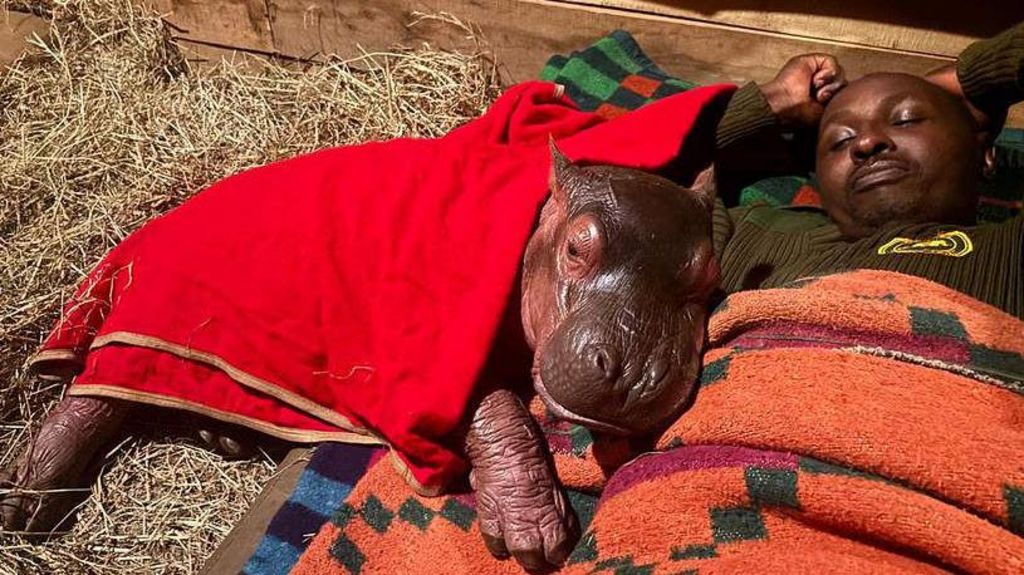
Over the weekend, a moving and dramatic wildlife rescue operation unfolded on the shores of a Kenyan lake, where rescuers intervened to save a newborn hippo calf that had been left stranded next to its mother’s deceased body.
The tiny calf, now named Bumpy, is estimated to be only a few days old, having lost his mother under circumstances that conservation teams are still clarifying. Initial investigations from the Kenya Wildlife Service (KWS) suggest the mother hippo may have died of natural causes. But experts from the Sheldrick Wildlife Trust (SWT), the conservation charity that now cares for Bumpy, have put forward another plausible explanation: hippo society regularly sees infanticide by competing males, and the mother may have lost her life in a territorial battle while defending her vulnerable calf.
By the time conservation teams arrived at the scene, the mother hippo’s body had already been decomposing for more than 24 hours. Extracting the unweaned calf from the water presented unexpected logistical hurdles. The distressed newborn refused to leave his mother’s side, clinging tightly to her corpse even as rescuers approached. Faced with this difficult situation, the KWS team made the painful decision to use the decomposing body as an anchor to safely reach and retrieve Bumpy, a choice that prioritized saving the calf’s life despite the emotional weight of the decision.
After the rescue was completed, Bumpy was first transported to a specialized wildlife nursery in Nairobi, Kenya’s capital. For his first night in human care, keepers wrapped him in a soft blanket and provided him with regular milk feedings, catering to the tiny calf’s every need. SWT teams noted that from the moment he arrived, Bumpy was clearly starved for comfort and social connection, and has stayed nearly glued to his assigned keepers ever since.
Soon after his initial stabilization, Bumpy was airlifted via helicopter to SWT’s Kaluku Wildlife Sanctuary, located near Tsavo East National Park. This protected facility is designed to raise orphaned wildlife until they are old enough and strong enough to be released back into their natural wild habitat. At his new home, Bumpy spends most of his days submerged in a calm pool along the Athi River, but he is never left alone. A keeper stays with him around the clock, whether joining him in the cool water or staying beside him on the riverbank. According to sanctuary updates, Bumpy is an inherently affectionate young hippo, and he is most content when curled up on or pressed against his caretakers, a bond that has been captured in heartwarming shared photos.
Bumpy is not the only young orphaned hippo at Kaluku Sanctuary; he joins another calf that is almost a year old, though the two are currently housed in separate enclosures as they acclimate to their surroundings. Both animals are on track to be released into the wild once they reach full maturity, where they will join existing wild hippo populations. Wildlife experts explain that in their natural habitat, hippo calves stay closely bonded to their mothers for multiple years, nursing for at least 12 months and remaining dependent until they reach sexual maturity, making Bumpy’s early orphanhood an especially challenging situation.
The Sheldrick Wildlife Trust, the organization leading Bumpy’s care, was founded in 1977 and has earned global recognition for its work rescuing and rehabilitating orphaned elephants and rhinos, successfully reintegrating hundreds of animals back into wild African ecosystems. This rescue of Bumpy is part of the trust’s expanded work protecting vulnerable native wildlife across Kenya, giving newborn animals that would otherwise not survive a second chance at life in the wild.