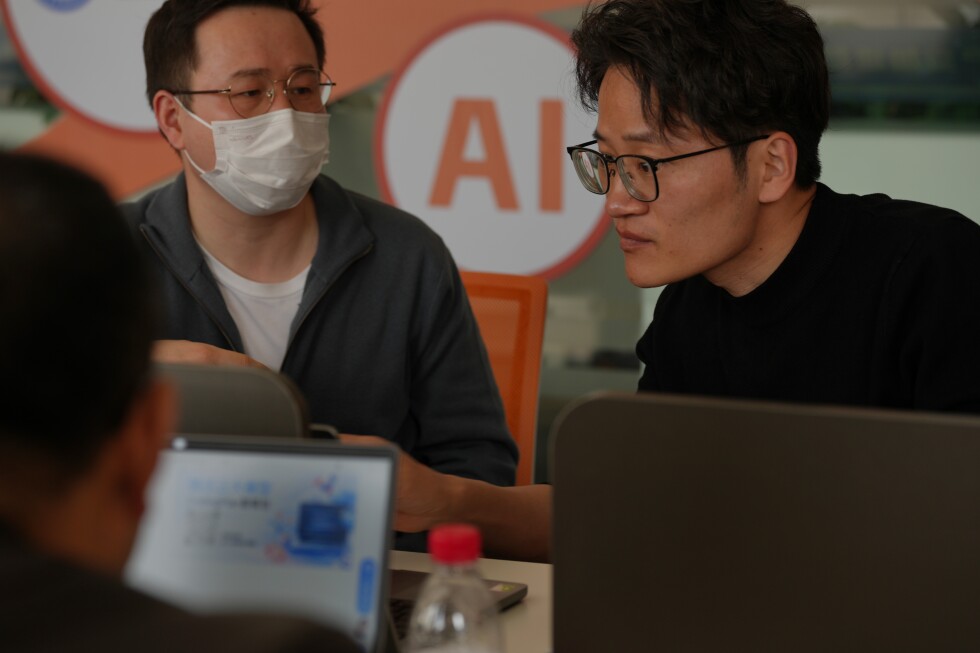
Across major Chinese cities from Beijing to Shenzhen, crowds of ordinary people and business professionals are gathering in droves to access hands-on support installing cutting-edge artificial intelligence tools, highlighting a sweeping, rapid shift toward mass AI integration in the world’s most populous nation. More than a year after Chinese AI developer DeepSeek stunned global tech circles with its high-performance advanced model, China has evolved into the world’s largest live testing environment for widespread consumer and enterprise AI use. While U.S.-built AI models still hold an edge in raw computational power, Chinese users and companies have embraced the technology at an unprecedented pace, embedding it into nearly every sector of daily life and economic activity.
As global AI integration accelerates across workplaces and personal routines, Chinese residents are leveraging generative AI tools for an extraordinary range of routine tasks, from travel planning and food delivery to ride-hailing and professional workflow optimization. Official data from the China Internet Network Information Center reveals that as of December 2024, over 600 million of China’s 1.4 billion people were active generative AI users — marking a 142% year-over-year surge in adoption. The recent boom in demand for agentic AI tools such as the popular OpenClaw, which can autonomously complete complex multi-step tasks, has driven a corresponding spike in AI data consumption. According to OpenRouter, an AI gateway platform that tracks usage across models, the weekly share of AI data tokens (the core units of processed AI data) consumed by Chinese-developed models has now surpassed that of leading U.S. models.
The trend of mass AI adoption cuts across all demographics, from working professionals to retirees. Sixty-four-year-old Jason Tong, a retired IT engineer based in Shanghai, has used domestic AI chatbots including Doubao and Kimi for daily queries since their launch, and recently began using an AI-powered personalized blood glucose monitoring service. Tong has found the tool’s fast, customized health advice invaluable, and he views widespread AI integration as an inevitable technological shift. “Just as carriages were eventually replaced by trains, this is bound to happen,” he explained.
Chinese AI-integrated products, from smart cars with voice-activated planning capabilities to humanoid robots with advanced cognitive functions, have also seen major technical leaps in recent months. Lizzi Lee, a fellow at the Asia Society Policy Institute’s Center for China Analysis specializing in technology and economics, notes that global AI competition is rapidly shifting from standalone model development to building full integrated ecosystems. “Chinese users are basically acting as real-time testers at scale,” Lee observed.
Leading Chinese technology giants including Tencent, Alibaba and Baidu are now locked in a race to commercialize AI at scale. Tencent has already integrated OpenClaw into WeChat, China’s ubiquitous super-app that combines messaging, food delivery, mobile payments and dozens of other daily services into one platform, while Alibaba has embedded agentic AI into its internal business and merchant workflows.
OpenClaw, which was originally developed by Austrian software engineer Peter Steinberger in 2023, has exploded in popularity in China thanks to its ability to connect multiple digital tools to complete complex end-to-end tasks. For Zhao Yikang, a college student in Macao, the tool has transformed both his academic work and professional internship at a Zhuhai real estate agency, where he uses it to automatically generate promotional content and manage social media accounts. Zhao highlighted the tool’s low cost and high efficiency: he recently asked OpenClaw to build a fully functional website for his upcoming post-graduation photo services business, and the project was completed in 10 minutes for less than 0.70 U.S. dollars. “AI can understand things in a second,” Zhao said. “You just need to act as a commander and tell it what to do.”
While Chinese regulators issued temporary warnings over potential data security risks as OpenClaw installations skyrocketed, that has done little to dampen public enthusiasm for the tool. Across the country, domestic businesses are increasingly setting internal mandatory targets to scale AI adoption to boost operational efficiency. Janet Tang, a technology partner and managing director at global consultancy AlixPartners, notes that China’s unique market landscape offers an unmatched range of use cases for AI testing. Wang Xiaogang, co-founder of leading Chinese AI firm SenseTime and chairman of ACE Robotics, echoed that sentiment: “The industry is developing very fast and the people, they are very open and they are eager to try the AI in a lot of scenarios.”
Chinese policymakers have actively supported the AI boom, investing heavily in talent development and subsidizing low-cost electricity to power energy-intensive AI computing infrastructure. In the national five-year plan running through 2030, Beijing has pledged to deliver an average annual growth rate of at least 7% in national research and development spending, with AI as a core priority. A national “AI Plus” strategy lays out a roadmap to integrate artificial intelligence into every major sector from healthcare to education to public administration: a court in Shenzhen reported that it processed 50% more cases in 2024, in part thanks to AI tools that streamline judicial workflows.
However, U.S. export controls on advanced semiconductors remain a key bottleneck for China’s AI advancement. Samm Sacks, a senior fellow at New America focusing on Chinese technology policy, explained that U.S. restrictions on cutting-edge AI chips have slowed the expansion of Chinese chipmaking capacity and remain the biggest vulnerability for many Chinese AI research labs. Even so, Sacks added, the restrictions have also forced greater coordination across China’s domestic tech supply chain, uniting design, manufacturing and end-user adoption around a homegrown innovation agenda. “Over time this dynamic could fuel, not foil, China’s ambitions,” Sacks said.
The impact of that growing domestic coordination is already visible: when DeepSeek launched its highly anticipated V4 AI model preview last month, the system is partially powered by chips from Chinese tech giant Huawei, reducing the country’s dependence on leading U.S. chipmakers such as Nvidia. A recent report from Stanford University’s Institute for Human-Centered AI concluded that the performance gap between top U.S. and Chinese AI models has “effectively closed.”
While U.S. policymakers and leading AI firms including OpenAI and Anthropic have accused Chinese AI startups of intellectual property theft, Chinese officials have rejected those claims as unsubstantiated. Even with ongoing U.S. export controls and China’s domestic internet censorship regime, analysts believe the gap between the two global AI powers will continue to narrow. Lian Jye Su, chief analyst at global research firm Omdia, noted that barriers such as the Great Firewall have only had limited impact on AI development, as the technology has already been tested, integrated and scaled within China’s regulated domestic internet ecosystem. “It won’t be long before China moves from fast follower to parallel innovator,” Su predicted.