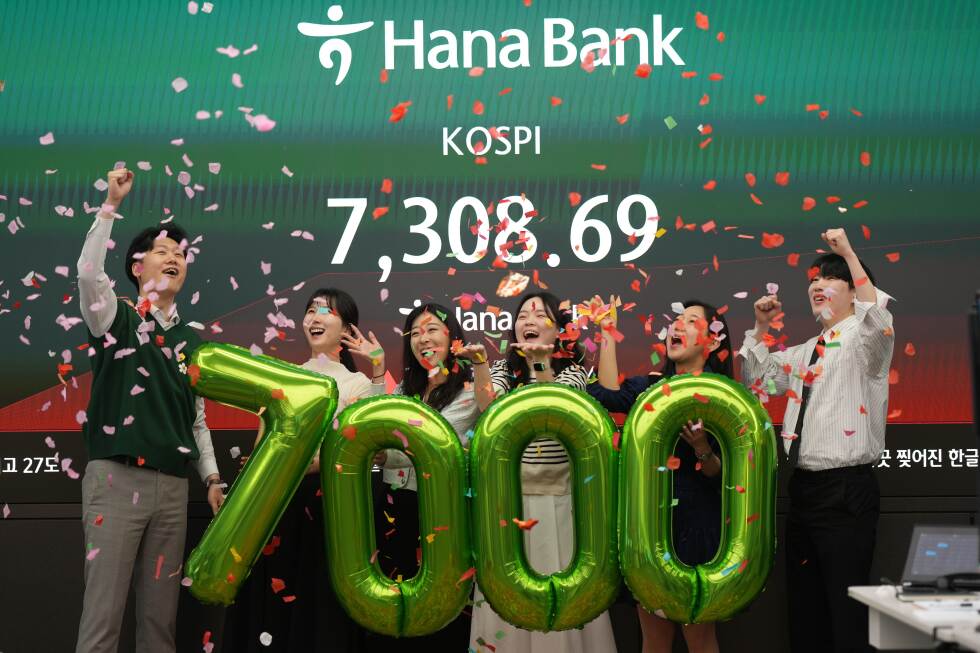
Global equity markets surged across multiple regions this week, led by a historic rally in South Korea’s benchmark index fueled by twin tailwinds: booming investor optimism around artificial intelligence-driven chip demand and growing hopes for de-escalation of the U.S.-Iran conflict.
When South Korean markets reopened Wednesday following a one-day national holiday, the Korea Composite Stock Price Index (Kospi) skyrocketed nearly 7% to hit an all-time closing high of 7,398.34. The rally was anchored by outsized gains in the country’s two leading semiconductor manufacturers, which supply the high-performance chips critical to powering generative AI and large language model applications. Samsung Electronics, the world’s largest memory chip producer, saw its share price jump almost 13% in early trading, while rival SK Hynix notched a 10% gain.
Market sentiment got an additional boost from geopolitical developments: Iranian officials confirmed they would travel to China for diplomatic talks ahead of the scheduled summit between former U.S. President Donald Trump and Chinese President Xi Jinping. This diplomatic movement helped ease fears of prolonged disruption to global energy supplies, pulling oil prices lower after the sharp volatility triggered by the outbreak of the U.S.-Iran war.
The upward momentum extended across most Asian markets, even as several major exchanges including Tokyo remained closed for public holidays. Australia’s S&P/ASX 200 climbed 1.0% to 8,766.80 in morning trading. Hong Kong’s Hang Seng Index added 0.7% to reach 26,081.52, while China’s Shanghai Composite Index rose 1.0% to 4,152.68.
In global energy markets, oil prices extended the downward correction that began Tuesday, erasing the sharp spikes recorded earlier in the week as conflict erupted. Benchmark U.S. crude fell $1.37 to settle at $100.90 per barrel, and international benchmark Brent crude dropped $1.50 to $108.37 a barrel. Even with the decline, prices remain far higher than the pre-conflict level of roughly $70 a barrel. U.S. military officials have confirmed an unofficial ceasefire is currently in effect, though significant uncertainties persist. U.S. forces are currently working to re-open shipping lanes through the Strait of Hormuz, the critical chokepoint that carries roughly a third of the world’s seaborne oil exports out of the Persian Gulf, to allow commercial tanker traffic to resume.
The rally extended to U.S. markets as well, with all three major Wall Street benchmarks closing at record highs. The broad S&P 500 index gained 0.8% to close at 7,259.22, surpassing its prior all-time high set just the previous week. The Dow Jones Industrial Average added 0.7% to finish at 49,298.25, and the tech-heavy Nasdaq Composite climbed 1% to hit a new record of 25,326.13.
U.S. economic data released alongside the rally painted a mixed picture. One report showed service sector growth slowed unexpectedly in the most recent month, with some businesses reporting that the ongoing Middle East conflict has started to dampen consumer spending. A separate labor market report offered more encouraging news, showing U.S. employers posted slightly more job openings at the end of March than analysts had forecast, signaling continued resilience in the national job market.
In foreign exchange markets, the U.S. dollar edged marginally lower against the Japanese yen, falling to 157.88 yen from 157.89 yen in the prior trading session. The euro appreciated slightly, rising to $1.1720 from $1.1693.
AP Business Writer Stan Choe contributed reporting from New York.