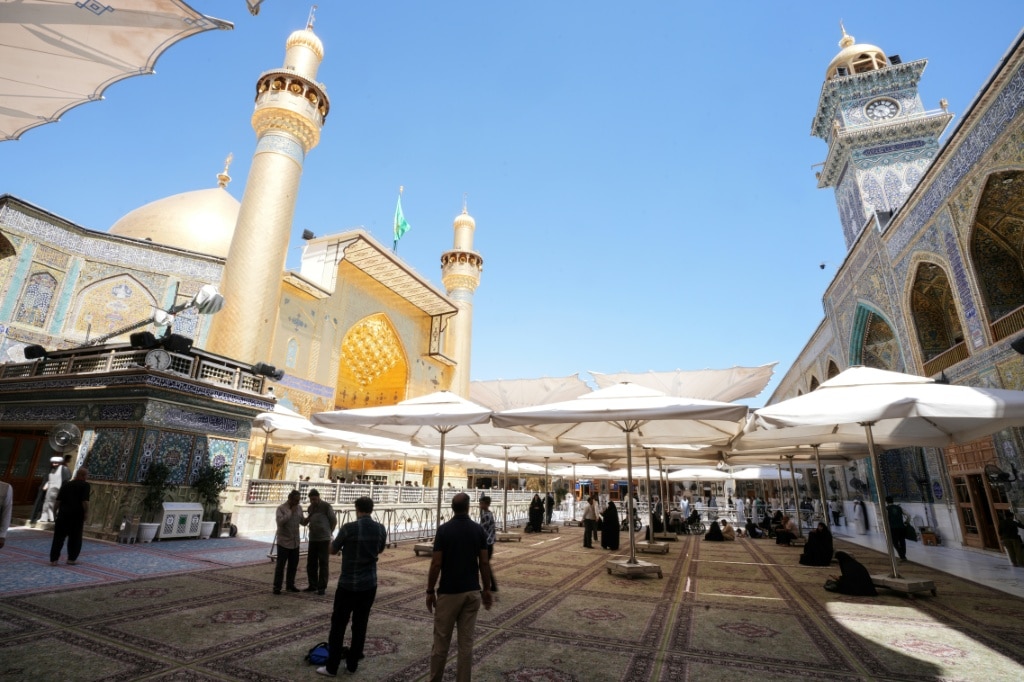
The echoes of multilingual pilgrim chatter that once filled the vast courtyards of Imam Ali’s iconic golden-domed shrine in Iraq’s Najaf have fallen silent. Months of escalating regional conflict sparked by U.S.-Israeli strikes on Iran in late February have effectively halted the annual flood of Shia worshippers that sustains the local economy, leaving business owners, workers and hoteliers reeling from an unprecedented collapse in tourism revenue.
For decades, millions of Shia Muslims from across the globe – Iran, Lebanon, Gulf Cooperation Council states, India, Afghanistan and beyond – make the spiritual journey to Iraq’s two holiest sites: Najaf, home to the burial place of Imam Ali, the Prophet Mohammed’s son-in-law and first Shia Imam, and Karbala, 80 kilometers north, where the Prophet’s grandsons Imam Hussein and Abbas are interred. For local communities, religious tourism is not just an industry – it is the backbone of daily livelihood.
Seventy-one-year-old Abdel Rahim Harmoush, a jeweler who has operated a stall in Najaf’s old market near the shrine for 38 years, recalled the days when the market was so packed with foreign visitors that navigating the aisles was nearly impossible. “Iranians used to keep everyone busy: the jeweller, the fabric merchant, the taxi driver. Now there are none,” he said. Without a swift return of pilgrim crowds, Harmoush warned, the sector faces total economic ruin: small business owners will be unable to cover rent and taxes, day laborers will go without work, and transportation workers will be left stranded without passengers.
The crisis has hit the hospitality sector particularly hard. Of Najaf’s 250 hotels, 80 percent have already shut their doors, according to Saeb Abu Ghneim, head of the city’s hotel association. More than 2,000 hotel employees have been laid off or placed on unpaid leave. Fifty-two-year-old hotel owner Abu Ali told reporters he was forced to let go five of his six staff members, leaving just one employee to manage nearly 70 empty rooms. “How can I pay salaries if there is no work?” he asked.
Even currency exchangers, who once navigated nonstop lines of foreign visitors converting dinars, now sit idle. Twenty-eight-year-old Moustafa al-Haboubi said he now gets just one or two customers a day, spending most of his work hours scrolling through his phone or chatting with nearby neighbors. “There are no pilgrims now, Iranian or otherwise,” he said.
The collapse of the sector comes even after a fragile ceasefire took effect on April 8 and Iraq reopened its airspace to commercial traffic. Only a tiny trickle of domestic pilgrims visit on weekends, with almost no international worshippers returning to the sacred sites. The situation is identical in Karbala, where Israa al-Nasrawi, head of the city’s tourism committee, described the ongoing crisis as a “catastrophe.”
Tourist numbers in Karbala have dropped by roughly 95 percent, forcing hundreds of hotels to close and leaving dozens of tour operators completely out of work. Akram Radi, a tour manager with 16 years of experience in the sector, said his company once served up to 1,000 visitors a month, and now operates at just 10 percent capacity. “I might have to close and look for another job,” he said.
For Iraq, the collapse of religious tourism deals a major blow to the non-oil sector, which has long sought to diversify the country’s oil-dependent economy. The industry had only just recovered from widespread shutdowns during the COVID-19 pandemic, when mosques and shrines were closed to visitors for months. After decades of persistent conflict that have gutted other parts of Iraq’s tourism industry, religious tourism remained one of the few reliable sources of income and employment for millions of people in the country’s southern holy cities – and today, that future hangs in the balance.