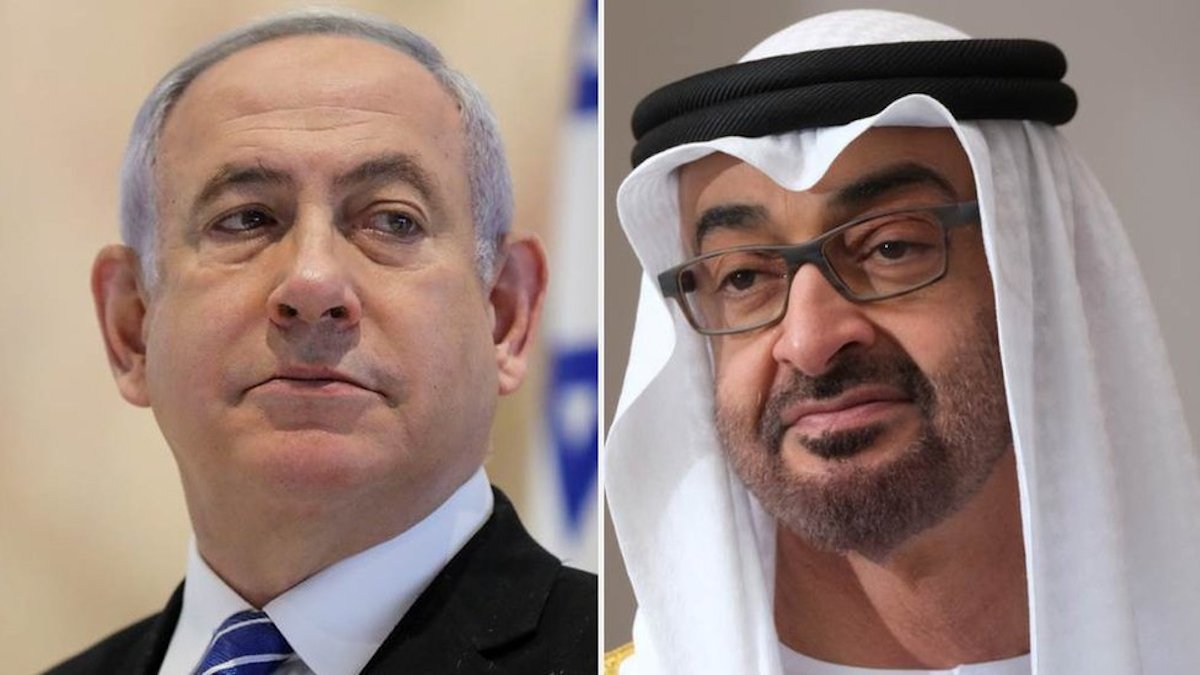
Five and a half years have passed since the Abraham Accords were signed in a ceremony on the White House South Lawn, where celebratory triumphalism overshadowed a far more sober underlying reality. While the normalization agreement between Israel and the United Arab Emirates marked a meaningful breakthrough in regional relations, it never delivered the long-promised “dawn of a new Middle East” that U.S. diplomats touted that day. A cascade of escalating regional crises – from the October 7 attacks, the devastating Gaza war, an Israeli targeted strike on Hamas leaders in Doha, and most recently the 12-day cross-border conflict with Iran that brought an Israeli Iron Dome battery to Emirati soil – has rendered the original optimistic Washington narrative increasingly unsustainable.
Today, policy analysts and Israeli strategists are consumed by one core question: Can the UAE-Israel partnership reorient the entire Middle East’s balance of power? This analysis argues that question itself is rooted in the same flawed assumption that has undermined U.S. Middle East policy dating back to the Carter administration: the belief that a bilateral alignment between two U.S.-aligned states can replace the hard, messy work of building a durable regional order, and that carefully choreographed diplomatic publicity can override the underlying realities of power distribution across the region.
To evaluate the Accords fairly, one must start by separating tangible progress from overstated hype. The economic and security ties forged between the two states are not empty rhetoric. In 2024, bilateral trade hit $3.2 billion and continues an upward trajectory. Israeli tech firms have established permanent headquarters at Abu Dhabi Global Market, while Emirati sovereign capital has become a major investor in Israel’s high-tech sector. Defense cooperation has also moved well beyond symbolic gestures: when UAE’s defense conglomerate Edge Group acquired Elbit Systems’ Hermes 900 drones, it marked the first substantive industrial defense partnership between the two nations, rather than just an exchange of friendly press statements. Most notably, during the 2026 conflict with Iran, Israeli military personnel operating an Iron Dome defense system from Emirati territory represented a genuinely unprecedented development: an Israeli forward defensive posture in the Persian Gulf, made possible only by the strategic opening created by the Accords.
These are meaningful tactical achievements, but they do not add up to a strategic transformation of the region. To claim otherwise is to ignore both the fundamental constraints shaping Emirati foreign policy and the structural regional realities that no single bilateral partnership can erase.
First, the UAE itself is a small federation of seven emirates with a population majority made up of expatriate workers, whose long-term security still ultimately relies on U.S. extended deterrence. For more than a decade, Emirati leaders have judged Washington to be an increasingly unreliable security patron, so they have systematically pursued hedging strategies across major global powers – building closer ties with Beijing, Moscow, New Delhi, and most consequentially, pursuing quiet tactical reconciliation with Iran. The decision to normalize relations with Israel was always a pragmatic calculation: it gave Abu Dhabi a useful counterweight to Iranian regional expansion while unlocking significant economic benefits. It was never, despite optimistic rhetoric in press releases and Negev Forum communiques, a decision to subordinate Emirati grand strategy to Israeli interests. When Sheikh Mohammed bin Zayed traveled to Doha just hours after Israel’s strike on Hamas leaders there, he was not betraying the Accords. He was simply demonstrating that the Accords were never meant to be the sole organizing principle of UAE foreign policy – and no rational Gulf leadership would ever allow them to become so.
This leads to the second structural reality: Arab Gulf states have never sought, and do not want, to be junior partners in an Israeli-led regional order. The ideological project of an “Abraham Alliance,” championed by former Israeli Prime Minister Benjamin Netanyahu and embraced by American neoconservatives eager to anoint any new regional alignment as transformative, assumes a level of Emirati deference to Israeli strategic priorities that Abu Dhabi has never accepted. The UAE swiftly and clearly condemned the October 7 attacks, but it has also maintained an open humanitarian corridor for Gaza, publicly denounced what it calls Israeli violations of international law, pulled Israeli participation from the Dubai Airshow, and warned that any Israeli annexation of the West Bank would cross a permanent red line. These are not the actions of a satellite state. They are the measured moves of a small state carefully hedging its bets in an unstable neighborhood, exactly as small states have always done.
Third, the future of the Accords is inextricably tied to Saudi Arabia, the most powerful Arab Gulf state. Without Riyadh joining the Abraham framework, the agreement remains a useful but limited diplomatic win. With Saudi participation, it would amount to a genuine regional reordering. But Saudi Arabia’s core condition for normalization – that Israel must create a credible path to an independent Palestinian state – has only hardened in the wake of the Gaza war. Israel’s current ruling coalition relies on far-right political partners who openly and proudly advocate for permanent annexation of the West Bank, making it impossible to deliver the political commitments Saudi Arabia demands. This is not a problem that can be fixed with clever diplomatic maneuvering, nor is it merely a question of personality – though Netanyahu’s personal credibility across the Gulf is widely reported to be severely diminished. It is a fundamental clash of incompatible strategic objectives, one that a potential second Trump administration, for all its focus on dealmaking, will find far more intractable than the first Trump administration did.
Finally, the broader regional environment has not shifted in the direction the Accords’ original architects predicted. While Iran has been weakened by the collapse of its Axis of Resistance and U.S. strikes on its nuclear program, it remains a major regional power that cannot be simply dismissed from the regional order. Turkey has expanded its influence across post-Assad Syria, while Qatar – whose ties to Hamas Israeli leaders have long sought to punish – has emerged from the Gaza war with its diplomatic standing strengthened, not diminished. Qatar now hosts key U.S.-brokered ceasefire negotiations and summits that have repeatedly set the terms for potential conflict resolution. The much-hyped regional realignment promised by the Accords has actually produced a more crowded, more complex regional system, not a simpler, more pro-Western order.
So what can the UAE-Israel partnership actually achieve? Quite a lot, when judged by realistic, modest standards. It can act as a platform for cross-border technology transfer, intelligence sharing, and joint commercial development. It has given Israel a level of regional integration that would have seemed unthinkable just 20 years ago. It helps the UAE diversify its non-oil economy and modernize its defense industrial base. It provides a mutual hedge against Iranian assertiveness without forcing either side into a formal alliance that neither can afford to accept. These are not small achievements. For two pragmatic states navigating a volatile neighborhood, they represent real, tangible gains.
But they are not a transformation of the regional balance of power. Instead, they are a pragmatic adaptation by two states to a new multipolar Middle East, where American hegemony has receded, core disputes over Palestinian self-determination remain unresolved, and regional actors increasingly take responsibility for managing their own security and order. These adaptations are important, and they should be welcomed. But they should never be confused with the grand strategic reordering they have so often been described as.
As realist geopolitical thought has long held, history does not easily bend to the press conferences of great powers. The Middle East’s fundamental fault lines – the unresolved Palestinian question, Iran’s regional role, decades of Sunni-Shia division, the stalled progress on Saudi-Israeli normalization, and the gradual rebalancing of U.S. regional commitments – will shape the future regional order far more than any single bilateral partnership, however valuable that partnership may be. To expect anything more is to mistake the choreography of diplomatic spectacle for the hard substance of geopolitics. It is a mistake Washington has made many times before. There is no clear reason for it to make the same mistake again.