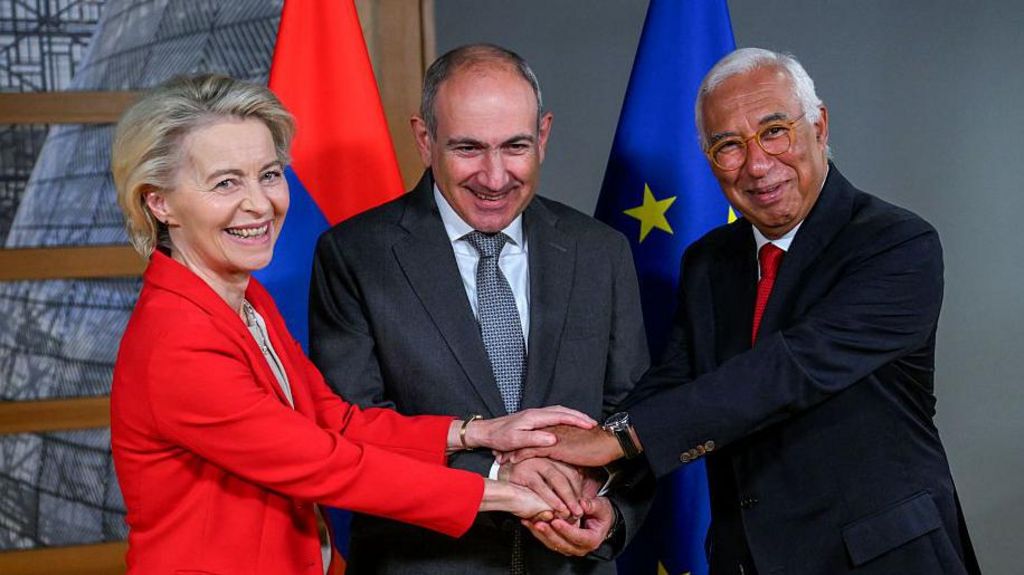
In a seismic shift for the geopolitics of the South Caucasus, dozens of European leaders are set to gather in Yerevan this week for two back-to-back summits that mark a historic turning point for Armenia – a small nation of under 3 million that has long stood as Russia’s closest ally in the region. The unprecedented gathering, which will open Monday with the European Political Community (EPC) summit bringing together more than 30 European leaders plus Canada’s prime minister, will be followed Tuesday by the first-ever bilateral summit between the European Union and Armenia, attended by European Commission President Ursula von der Leyen and European Council President António Costa. This high-profile European presence in Yerevan carries profound symbolic weight: Armenia remains a member of Russian President Vladimir Putin’s Eurasian Economic Union, and Russia still maintains a permanent military base on Armenian territory. The country also remains heavily reliant on Russian energy, buying natural gas at a heavily discounted rate that Putin explicitly highlighted during Armenian Prime Minister Nikol Pashinyan’s April 2025 visit to the Kremlin. At that meeting, Putin noted Russia charges Armenia just $177.50 per 1,000 cubic meters of gas, compared to the $600 price tag for European buyers, calling the gap substantial and meaningful. What brought a country long anchored in Russia’s geopolitical orbit to the point of hosting the entire continent’s top leaders? The turning point came in 2023, when a devastating war with neighboring Azerbaijan upended all long-standing security assumptions for Yerevan. When Azerbaijan launched a rapid military operation to take full control of the disputed Nagorno-Karabakh region, displacing more than 100,000 ethnic Armenian refugees, Russian peacekeepers stationed on the ground took no action to stop the offensive. Earlier incursions by Azerbaijan into internationally recognized Armenian territory also drew no response from the Russia-led Collective Security Treaty Organization, the regional security bloc designed to protect its member states. “We realised that the security architecture that we are in was not working,” explained Sargis Khandanyan, chairman of the Armenian National Assembly’s foreign relations committee, in comments to the BBC. Long before the 2023 war, the EU had already begun building ties with Yerevan: in 2022, Brussels brokered a preliminary border recognition deal between Armenia and Azerbaijan, and deployed a civilian monitoring mission to the border to oversee compliance. Khandanyan said the on-the-ground presence of European officials fundamentally shifted how Armenian citizens viewed closer ties with the bloc, creating clear public demand for deeper integration. By March 2025, that public and political momentum translated into action: Armenia’s parliament passed a formal law launching the official accession process for EU membership. Parallel to its shifting alignment with Europe, Armenia’s peace process with Azerbaijan has also accelerated dramatically. In August 2025, the two countries’ leaders signed a landmark peace accord at the White House aimed at ending decades of open conflict. As part of the deal, they unveiled the Trump Route for International Peace and Prosperity, a major cross-regional connectivity corridor that will run along Armenia’s border with Iran, linking the South Caucasus directly to European consumer and business markets. Yet for all this progress, significant risks and headwinds remain. The Armenian-Azerbaijani peace process remains fragile, and Europe’s growing embrace of Yerevan has already carried tangible diplomatic costs. Just last week, Azerbaijan’s parliament voted to suspend all formal ties with the European Parliament in response to a resolution calling for the right of return for displaced Nagorno-Karabakh Armenians and the release of Armenian detainees held in Baku. For its part, Moscow has made its irritation with Armenia’s pro-European shift impossible to miss. During Pashinyan’s April visit to the Kremlin, the Russian leader openly pushed back on Yerevan’s EU accession ambitions, noting that membership in the Eurasian Economic Union – a Russian-led customs union – and the EU are mutually exclusive. “It is not possible to be simultaneously in a customs union with both the European Union and the Eurasian Economic Union,” Putin stated. “It is simply impossible by definition.” In the lead-up to this week’s summits, Moscow has already taken tangible punitive measures: just days before the EPC gathering, Russia banned imports of Armenian mineral water. Armenian analysts say such moves fit a consistent pattern of hybrid pressure from Moscow: pro-EU policy moves or official visits to Brussels are often followed by delays for Armenian cargo trucks at the Georgian-Russian border, large-scale cyberattacks targeting government infrastructure, and coordinated disinformation campaigns. Just weeks ago, the EU approved an expanded two-year civilian mission to Armenia designed to counter these Russian threats: the mission will focus on countering disinformation, cyberattacks, and illicit financial flows, particularly ahead of Armenia’s June 2026 parliamentary elections. The mission is modeled on a similar deployment to Moldova ahead of its 2025 elections, where pro-EU incumbent forces retained power. Artur Papyan, founder of CyberHUB-AM, an Armenian organization that monitors the country’s information and cyber space, says the pattern of Russian interference is clear and consistent with tactics seen in other pro-European post-Soviet states including Moldova, Romania, and Ukraine. In January 2026 alone, his organization documented a large-scale cyberattack on WhatsApp that compromised hundreds of thousands of Armenian accounts – a platform widely used by senior government officials. In a separate incident, hackers created a fake Signal account impersonating EU Ambassador to Armenia Vassilis Maragos, sending invitations to a fake Armenia-EU relations conference that fooled even experienced civil society workers. Investigations traced the attack to IP addresses based in Zelenograd, a city northwest of Moscow that is a major hub for Russian digital intelligence operations. In the 48 hours leading up to the Yerevan summits, Papyan said his team recorded multiple spikes in coordinated Telegram posts pushing a single narrative: that hosting the summits pushes Armenia past a point of no return with Russia, and that harsh retaliation from Moscow is inevitable. Alain Berset, secretary general of the Council of Europe, who will attend this week’s summits, warned that while Armenia’s democratic institutions have made significant progress, they remain under sustained pressure from foreign interference. Berset identified foreign meddling, coordinated disinformation, and online political polarization as the top threats ahead of June’s parliamentary elections, noting that while Yerevan has some legal frameworks to counter these threats, they are not yet scaled to match the sophistication of the attacks. While European leaders are arriving in Yerevan with promises of expanded civilian support and a roadmap for visa liberalization for Armenian citizens within two years, Brussels has offered no firm timeline for membership, no binding defense commitments, and no plan to replace the discounted Russian gas that still powers Armenia’s economy. Without these concrete guarantees, Armenia’s delicate balancing act between its historic alliance with Russia and its new pro-European course remains far from settled.