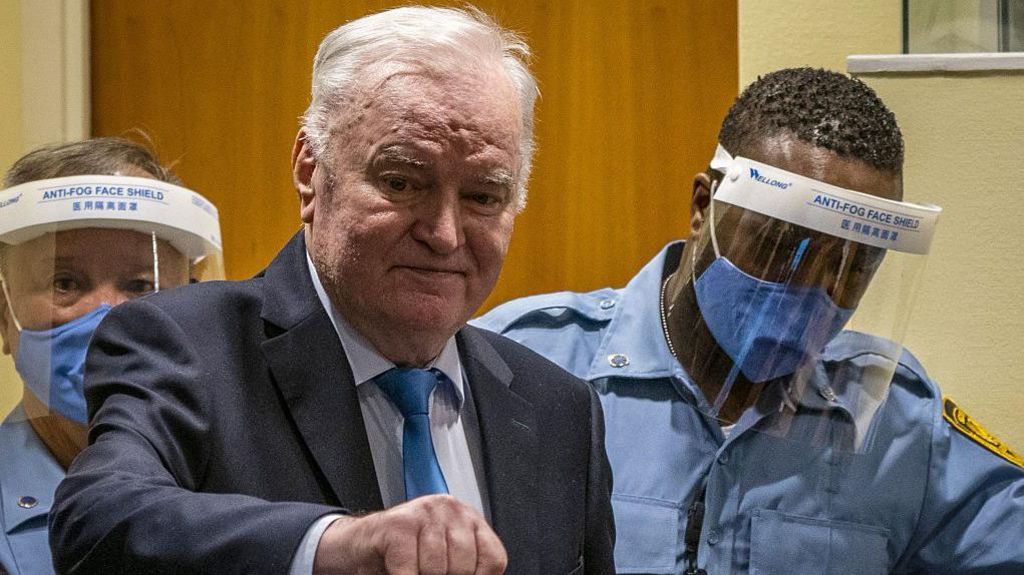
Eighty-four-year-old convicted Bosnian Serb war criminal Ratko Mladic, infamously known as the “Butcher of Bosnia”, is at the center of a high-stakes legal battle before a United Nations tribunal, as judges prepare to rule on a desperate appeal for his early release on humanitarian grounds.
Mladic’s path to a cell in The Hague has been decades in the making. First indicted for atrocities during the 1992-1995 Bosnian War, he evaded capture for 16 years after disappearing in 1995, and was only tracked down and arrested in rural Serbia in 2011. He has remained in UN detention ever since, going on trial at the international tribunal in 2012 before receiving a life sentence in 2017 on charges of genocide, war crimes, and crimes against humanity. That conviction was upheld on appeal in 2021.
The gravity of Mladic’s crimes is well-documented. As commander of Bosnian Serb forces during the breakup of the former Yugoslavia, he oversaw a campaign of ethnic cleansing across Bosnia and Herzegovina, a nearly four-year siege of the capital Sarajevo that killed more than 10,000 civilians, and the 1995 Srebrenica massacre, where 8,000 Bosniak men and boys were systematically executed.
Now, Mladic’s legal team argues the 84-year-old’s declining health makes continued detention unnecessary and cruel. In a formal submission to the tribunal Friday, his lawyers outlined a rapid deterioration of his condition: Mladic has long been confined to a wheelchair or bed, and recently suffered a suspected stroke during a phone call with his son that left him nearly unable to speak. Two independent doctors who have evaluated Mladic have concluded his condition is critical, with a high risk of imminent death.
The defense is pushing for immediate provisional or conditional release to a Serbian-language hospital or hospice, an ask widely interpreted as a bid to allow Mladic to return to Serbia to spend his final days. Serbian Justice Minister Nenad Vujic has confirmed the Serbian government is prepared to provide all required assurances to the UN court to facilitate the transfer.
Mladic’s legal team argues that the current UN detention unit and its on-site prison hospital lack the capacity to provide adequate end-of-life care for the former general. They maintain that keeping Mladic behind bars now constitutes cruel and inhumane punishment, and no longer serves the original goals of his conviction.
In response to the request, presiding judge Graciela Gatti Santana ordered an independent medical evaluation of Mladic’s health, with final findings due Friday. The assessment is tasked with evaluating the adequacy of his current care, confirming his diagnosis and prognosis, and outlining available treatment options.
But the appeal has drawn fierce pushback from Bosnian victim and survivor groups, who reject the claim that this is a purely humanitarian request. They argue Mladic’s release bid is nothing more than a calculated legal tactic, pointing to multiple failed attempts by his defense team to secure his freedom in recent months: A similar release request was rejected in July 2025, and an application for temporary release to attend a family member’s memorial was also turned down last November.
As the international tribunal weighs its decision, Mladic’s son Darko told Serbian media that there has been no recent change to his father’s condition, and he plans to visit him in the prison hospital next week. The ruling on the release bid, which will close one of the most high-profile chapters of international war crime prosecutions stemming from the Yugoslav Wars, is now imminent.