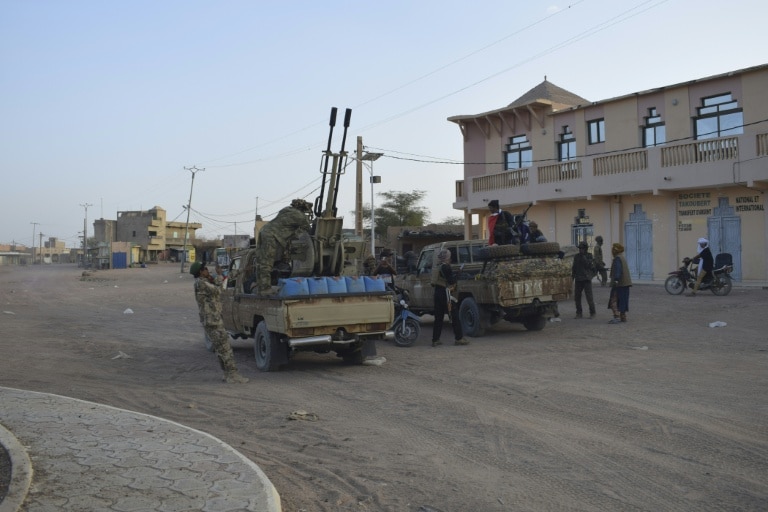
In a shocking escalation of instability in West Africa, coordinated unprecedented attacks across Mali carried out by an unlikely partnership of Al-Qaeda-linked jihadists and Tuareg separatists have left the country’s military leadership reeling, marking the first full-scale implementation of an alliance struck between the two rival groups one year ago. The assault, which resulted in the death of Mali’s defense minister and the capture of the strategic northern town of Kidal, has thrown the Sahel region’s already fragile security landscape into new turmoil.
The joint operation was officially claimed Saturday by the Group for the Support of Islam and Muslims (JNIM), Al-Qaeda’s regional affiliate in the African Sahel, which fought alongside the Azawad Liberation Front (FLA), a 2024-founded ethnic Tuareg separatist movement pushing for full independence of Mali’s northern Azawad territory. Alongside seizing Kidal — a town Malian government forces backed by Russian paramilitary fighters had captured from rebel groups in November 2023 — the militants targeted government outposts in multiple major population centers and even launched strikes on the outskirts of the capital, Bamako. In addition to Defense Minister Sadio Camara, the head of Mali’s intelligence service Modibo Kone was wounded in gunfire during the attacks, and junta leader Assimi Goita has not been seen or made any public statement since the offensive began. Security sources also confirmed joint JNIM-FLA operations in the northern town of Gao, where government forces repelled the assault but the militant alliance retains a significant presence in surrounding areas.
While the two groups hold fundamentally divergent core objectives, regional security experts emphasize their cooperation is rooted in a shared, urgent enemy: the military junta that has ruled Mali since a 2020 coup, and its Russian paramilitary backers, the current Africa Corps force that has replaced the earlier Wagner Group mercenaries. This is not the first time Tuareg separatists and Sahel jihadists have aligned: a 2012 alliance saw the two capture major northern hubs before their partnership collapsed into open conflict, with jihadists ousting the separatists from seized territory. For years after that split, relations remained deeply hostile, culminating in direct armed clashes between FLA and JNIM along the Mauritanian border in April 2024. But by the end of 2024, the two groups negotiated a new power-sharing partnership, according to Wassim Nasr, a jihadist movement researcher at the Soufan Center think tank.
The terms of the new deal outline clear compromises from both sides: FLA has agreed to accept the application of sharia law in jointly held territory, and requires judicial appointments to receive approval from both organizations. In exchange, the agreement divvies up administrative control: the FLA will govern captured urban centers, while jihadists will oversee rural areas. The partnership also includes critical military knowledge sharing: Nasr notes that JNIM has agreed to share its specialized expertise in building and deploying improvised explosive devices (IEDs) and mortar fire, capabilities the FLA had long struggled to develop independently. Saturday’s offensive marks the first time the full terms of this agreement have been put into operational practice, Nasr explained.
Jean-Herve Jezequel, Sahel project director at the International Crisis Group, pointed out that the coherence of the alliance depends entirely on its unifying opposition to the current Malian regime. “JNIM pursues a political-religious agenda, centred on the establishment of sharia law and the rejection of foreign forces, whilst the FLA champions a territorial and autonomist agenda, centred on Azawad,” Jezequel explained. “This convergence is based above all on the existence of common adversaries, namely the Malian authorities and their Russian partners.”
For the Tuareg people, a historically nomadic ethnic group spread across Mali, Niger, Algeria, Libya and Burkina Faso, the push for autonomy stems from decades of documented political and economic marginalization, particularly in the Kidal region. Their alignment with JNIM reflects a growing desperation to reverse military gains made by the junta and its Russian allies over the past two years.
Experts note that the alliance’s strategic objectives do not include an immediate push to capture Bamako and seize full national power. Instead, their near-term goal is to reassert control over northern Mali’s traditional rebel strongholds. The capture of Kidal, Nasr explained, was achieved by pinning Malian army forces in central Mali, delivering a paralyzing blow to junta leadership in the capital, and consolidating gains in the north. Going forward, the alliance may expand its offensive into central Mali to increase pressure on the junta, with the broader goal of accelerating the regime’s collapse and forcing regime change in Bamako.
Jezequel added that the group’s strategy focuses on steadily eroding the junta’s legitimacy and capacity through sustained security pressure, rather than a direct assault on the capital, which would be logistically difficult in the short term. Unlike the 2012 alliance that fractured almost immediately, experts say the current partnership may prove more durable, though its long-term future remains uncertain. The true test of the alliance, Nasr argued, will come when the groups move into the post-offensive phase of governing captured cities like Kidal — a test that has yet to begin.