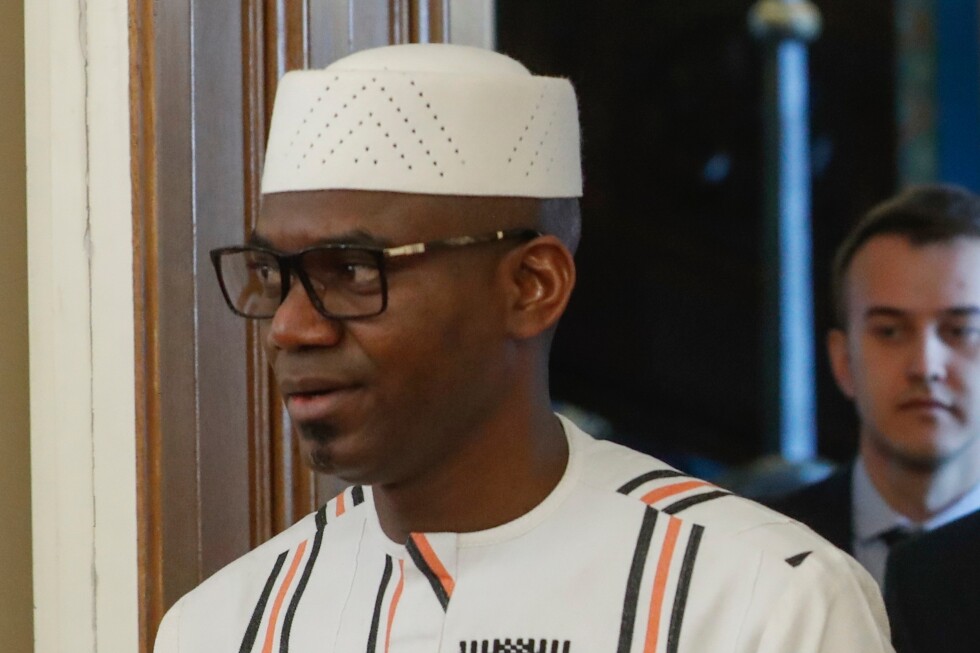
In a devastating wave of coordinated assaults across Mali that has shaken the junta-led West African nation and its key security ally Russia, the country’s top defense official has been killed, and a strategically important northern stronghold has fallen into separatist hands. Official announcements confirmed the death of General Sadio Camara, Mali’s Minister of Defense, over the weekend, marking one of the most significant losses for the country’s military leadership amid its decade-long battle against Islamist insurgency and separatist unrest.
The multi-front attacks unfolded across the country Saturday, targeting locations ranging from the capital Bamako to multiple remote towns and military bases. According to an official statement released via the Malian defense ministry’s Facebook page and broadcast on state television by government spokesman General Issa Ousmane Coulibaly, Camara’s residence was breached by a suicide car bomber and a team of armed assailants. The statement detailed that Camara engaged directly in a firefight with the attackers, neutralizing multiple assailants before suffering fatal injuries that led to his death after evacuation to a local hospital. The government extended official condolences to Camara’s family following the confirmation of his death.
By Sunday, authorities stated that the initial wave of attacks had concluded, but critical uncertainties remained, most notably over territorial control of Kidal, a key northern city that separatist forces claim to have seized. A new, united front of separatist fighters and al-Qaida-linked militants carried out the coordinated operations, a rare collaboration that security analysts describe as an unprecedented escalation of the country’s long-running conflict.
The separatist faction, the Tuareg-led Azawad Liberation Front (FLA), confirmed its joint operation with Jama’at Nusrat al-Islam wal-Muslimin (JNIM), the al-Qaida-affiliated insurgent group that has waged war against the Malian government for more than a decade. FLA spokesperson Mohamed El Maouloud Ramadan announced Saturday that Malian government forces and troops from Russia’s Africa Corps had completed a peaceful withdrawal from Kidal, declaring the city “free.” Late Sunday, Malian armed forces chief General Oumar Diarra confirmed the withdrawal in a state television address, noting that Malian troops had repositioned to Anefis, a city roughly 100 kilometers south of Kidal.
Kidal, which has long been the symbolic heart of the Tuareg separatist movement, was captured by Malian forces and Russian mercenaries in 2023, a victory that was framed as a major milestone for the ruling junta and its Russian partnership. Its recapture by the alliance of separatists and insurgents thus represents a sharp symbolic and strategic setback for the Bamako government.
Wassim Nasr, a senior research fellow at the Soufan Center security think tank and a leading expert on Sahel security, noted that this open collaboration between separatist and jihadi forces, paired with coordinated national-level attacks and a public call for Russia to end its support for the junta, is a historic first for the conflict. “This coordination, conducting attacks all over the country at the same time, the united push by the two groups and the call for the Russian military to leave was a first,” Nasr explained. Beyond military gains, he added, the collaboration extends to the political level, as both groups openly acknowledged their joint effort.
In the wake of the attacks, Malian authorities implemented a three-night curfew for the Bamako district, running from 9 p.m. to 6 a.m. daily. To date, the government has only confirmed 16 wounded people, a mix of civilian and military personnel, and stated that multiple attackers were killed. No full civilian or military death toll has been released to the public.
The attack has drawn widespread regional condemnation, with the Economic Community of West African States (ECOWAS) issuing a statement calling for unified action across the region to counter the growing extremist threat. “We call on all states, security forces, regional mechanisms and populations of West Africa to unite and mobilize in a coordinated effort to combat this scourge,” the regional bloc said.
The assault also underscores the growing instability across the Sahel, following a series of military coups that have seen the ruling juntas of Mali, Niger and Burkina Faso abandon long-standing security partnerships with Western nations and turn to Russia for counter-insurgency support. Despite this shift, security across the region has deteriorated sharply, with militant attacks reaching record highs in recent years. Both government forces and Russian mercenaries have also been repeatedly accused of extrajudicial killings of civilian populations suspected of collaborating with insurgents. Earlier this year in 2024, an al-Qaida-linked group claimed responsibility for coordinated attacks on Bamako’s international airport and a military training camp in the capital that left dozens of people dead.
Ulf Laessing, a Sahel analyst with the Konrad Adenauer Foundation, noted that the coalition of separatists and JNIM is unlikely to seize control of Bamako in the near future, due to widespread local opposition to the alliance. Even so, the attacks deliver a major blow to the credibility of Russia’s security engagement in Mali. “The attacks are a major blow to Russia as the mercenaries had no intelligence about the attacks and were unable to protect major cities,” Laessing said.