For months, whispers and official silence shrouded the alleged Independence Day coup plot that targeted Nigeria’s sitting government last year. This week, the first public proceedings have finally lifted the veil, exposing new details of what prosecutors describe as an elaborate conspiracy to overthrow President Bola Tinubu, bringing long-unanswered questions into the public domain.
The plot was scheduled to unfold on October 1, 2025, Nigeria’s 65th Independence Day, when the nation was set to mark decades of freedom from British colonial rule. The annual celebratory parade, scheduled to be attended by President Tinubu, was abruptly canceled at the eleventh hour, with government and military officials offering no public explanation for the last-minute change. It was not until January 2026 that the military made a sparse, short statement confirming that 16 unnamed senior military officers would face court-martial over the alleged plot, finally confirming publicly that an attempted takeover had been foiled.
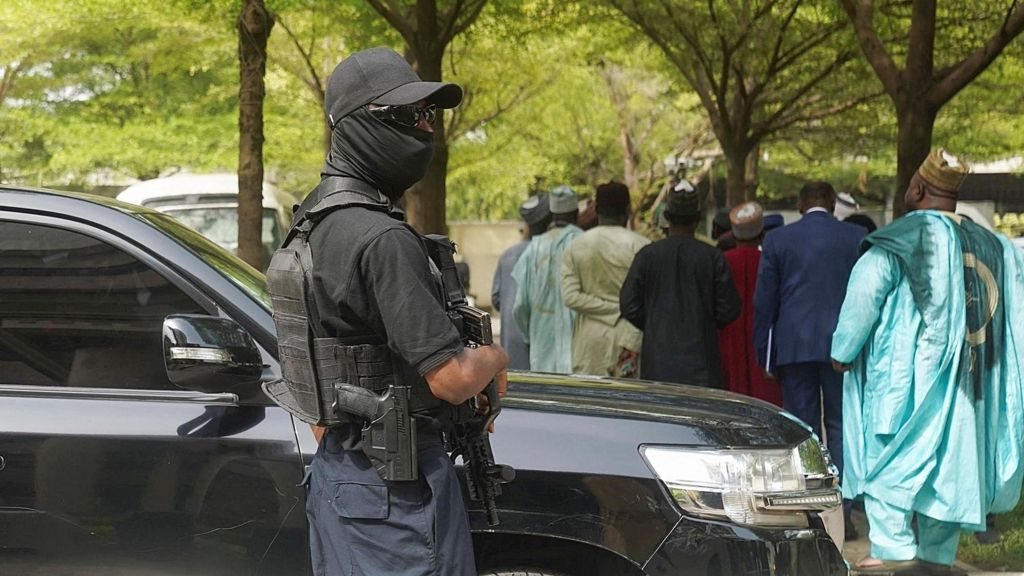
Now, court documents filed by state prosecutors at the Federal High Court in Abuja, the nation’s capital, have named the alleged mastermind of the conspiracy and laid bare the plotters’ strategy to destabilize the country ahead of their power grab. Six individuals, all civilians – including one serving police inspector and multiple retired military personnel – are facing trial in the High Court, as civilians are ineligible to be tried before military tribunals. All six have pleaded not guilty to 13 charges ranging from treason and terrorism to money laundering. While they are not believed to be the top leaders of the conspiracy, their open trial is expected to shine a light on a plot that investigators say drew participants from across all branches of Nigeria’s security forces.
Nigeria has a long history of military coups, but has maintained uninterrupted civilian rule since 1999. In recent years, however, a wave of successful military takeovers across neighboring West African nations, paired with rising economic hardship in Nigeria and widespread accusations of a political system rigged to favor a small elite, has fueled persistent speculation that the country could be next.
Court documents identify Colonel Mohammed Ma’aji, a 50-year-old Muslim born in western Niger State, as the plot’s chief strategist. Ma’aji spent much of his early military career deployed in the oil-rich Niger Delta, climbing the military ranks during the mid-2000s at the height of regional oil militancy, when heavily armed militant groups attacked oil infrastructure and kidnapped foreign workers for ransom. During this period, he built close professional ties to Timipre Sylva, a prominent oil businessman and former governor of Bayelsa State who helped broker a 2009 ceasefire and amnesty deal with militant groups in the region’s creeks. Multiple newspaper reports confirm Ma’aji coordinated security for Sylva during his unsuccessful 2015 campaign for a second term as governor, a relationship that investigators say is at the core of the alleged coup plot.
Though Sylva, 67, has not been formally indicted in this week’s filings, his name appears on seven of the 13 charges, each entry marked with the notation “still at large.” A former oil minister during the final term of President Muhammadu Buhari, who left office in 2023, investigators allege Sylva was the plot’s key financier, bankrolling the effort to oust Buhari’s elected successor, Tinubu. A member of the ruling All Progressives Congress (APC), Sylva notably declined to back Tinubu’s 2023 presidential campaign.
After the Independence Day parade was canceled, investigators raided Sylva’s Abuja residence. His spokesman has repeatedly denied any involvement, claiming the coup allegations and a separate arrest warrant for corruption are politically motivated. Sylva is currently in the United Kingdom for what his spokesman says is medical treatment, and has promised to return to clear his name – a step he has not yet taken.
Prosecutors allege the conspiracy required substantial funding to secure equipment and buy influence, with charges noting six accused civilians received payments ranging from 2 million naira ($1,500) to 50 million naira ($37,000), which they “reasonably ought to have known forms proceeds of an unlawful act… terrorism financing.”
Beyond financial details, a serving military investigator who spoke to the BBC on condition of anonymity shared the full scope of the plotters’ plans. The conspirators intended to storm Aso Rock, Nigeria’s heavily fortified presidential villa in Abuja, on the morning of October 1, leveraging insider intelligence gathered from co-conspirators already embedded at the compound. One of the indicted civilians, Zekeri Umoru, worked as an electrician at the villa, giving the plotters critical insight into the site’s layout and security protocols.
After seizing control of the villa, the plotters planned to immediately detain President Tinubu and other top government leaders. The investigator further alleged the conspirators intended to assassinate Tinubu, Vice President Kashim Shettima, Senate President Godswill Akpabio, and House Speaker Tajudeen Abbas. Authorities got wind of the plot in the days leading up to Independence Day, however, and made the first arrests before the plan could be executed. Concerns over the plot’s scale and penetration of security forces led the military to cancel the Independence Day parade, with investigations and additional arrests continuing in the months after.
Investigators say the conspirators also procured a fleet of sport utility vehicles to reach key strategic targets, including airports and other sensitive government sites. Of the 16 senior military officers arrested in connection with the plot, 14 are from the army, spread across multiple divisions, with one from the navy and one from the air force.
One of the most high-profile names among the six indicted civilians is Sani Abdulkadir, a popular Islamic cleric from Zaria in Kaduna State. Abdulkadir was reported missing by his family in late 2025 after he traveled to Abuja to inquire why his bank account had been frozen, sparking public outcry over his disappearance. It was only revealed months later he had been taken into security custody. On Monday, a Federal High Court judge ordered his release, awarded him more than $3,500 in damages for proven human rights violations, and ordered security agencies to issue a formal apology. Just 24 hours later, prosecutors named him as a coup conspirator and ordered him re-detained, noting court records show he received $1,500 from a plot leader. Contrary to early speculation that he was recruited to spread radical Islam to destabilize the country, the investigator said Abdulkadir was brought on as a “spiritual ‘prayer-warrior’ for the operation” – a common role for clerics in northern Nigeria, where community leaders regularly offer prayers for supporters undertaking major endeavors.
Earlier in 2026, an investigation by Nigerian newspaper Premium Times identified 40 total suspects, the vast majority serving military officers. Last week, the government inaugurated a closed-door military tribunal to try more than 30 of the accused officers, a decision that has drawn questions about transparency. One name that appears on leaked suspect lists but has not been brought into open court is Stanley Amandi, a popular Nollywood actor and director better known by his stage name “Stan K.” In January, the Actors Guild of Nigeria (AGN) confirmed to BBC Pidgin that Amandi, from the eastern city of Enugu, was arrested in September 2025 over allegations he was hired to serve as the plot’s propagandist. A legal source close to the investigation said Amandi was tapped to use his existing media connections and film production experience to build public support for the coup after the takeover.
AGN leader Emeka Rollas Ejezie said the organization has reached out to Nigeria’s domestic spy agency, the Department of State Services (DSS), to arrange access for Amandi’s lawyer, wife, and doctor. The DSS has stated Amandi is not in their custody, and is instead being held by military intelligence, which has declined to comment on his detention or whereabouts. Amandi has not been able to respond to the allegations against him, and the AGN continues to push for confirmation of his location.
The six defendants in the open High Court trial were remanded to DSS custody this Wednesday, with their next court date set for April 27 to hear bail applications. The limited details that have emerged so far have shaken Nigeria, where the last successful military coup took place in 1993 under General Sani Abacha. For many Nigerians, the trial offers the first chance to learn full details of what analysts say is the most serious coup attempt since the return to democracy in 1999 – a worrying development for a region that has already seen a string of military takeovers in recent years.