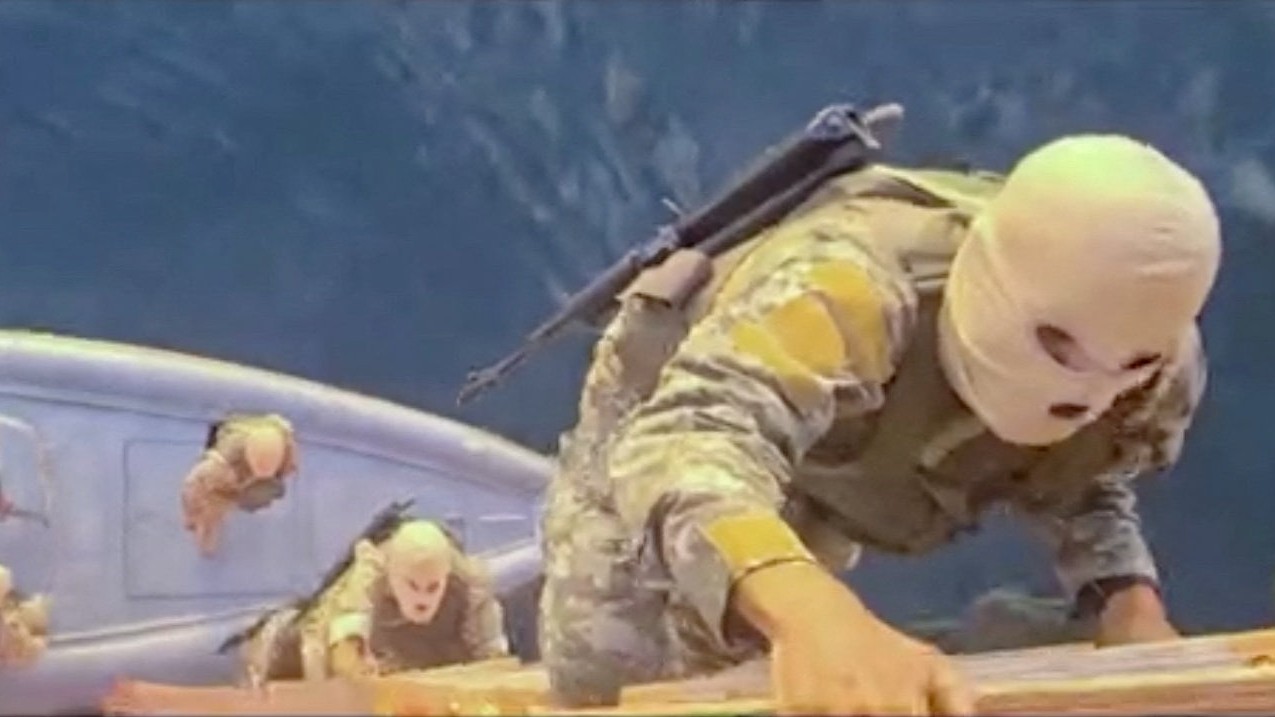
In the wake of the United States’ imposition of a naval blockade against Iranian ports, hard-line political and media voices within Iran have drawn up aggressive proposals to counter the move, including seizing international vessels in the strategically critical Strait of Hormuz and pushing Yemen’s Houthi movement to shut down the equally vital Bab el-Mandeb Strait.
These calls came just hours after former US President Donald Trump made a Wednesday announcement of a unilateral extension to a ceasefire on offensive operations targeting Iran. On that same day, Tehran-based conservative newspaper Kayhan dedicated its front page to the provocative headline “The response to the US naval blockade is to close the Bab al-Mandeb Strait,” and ran a full editorial written by its editor-in-chief Hossein Shariatmadari, a political figure long known to have close ties to Iran’s late Supreme Leader Ali Khamenei.
In his editorial, Shariatmadari argued that the Islamic Revolutionary Guard Corps (IRGC), Iran’s elite paramilitary force, should maintain a continuous blockade of the Strait of Hormuz, the narrow waterway through which roughly a fifth of the world’s oil supplies pass daily. He further called for Iran to seize cargo from international shipping to collect what he framed as rightful compensation for war damages caused by the US and Israel.
“Given the inaction of the UN Security Council and the United Nations’ clear dependence on arrogant global powers, it is our legal right to collect the compensation we demand through seized assets,” Shariatmadari wrote. He added, “We should seize US-owned vessels currently located in the Strait of Hormuz, and confiscate US-owned oil and goods transported even on non-US flagged vessels as compensation for our losses.”
Hard-line principlist lawmaker Seyyed Mahmoud Nabavyan echoed Shariatmadari’s aggressive tone, dismissing any suggestion that the US naval blockade could be addressed through ongoing diplomatic negotiations. “Talking with the Washington is pure harm,” Nabavyan stated, adding, “Lifting the naval blockade is our undeniable right, and we will achieve that by force regardless. This matter has no connection to negotiations.”
Concurrent with these statements, the IRGC confirmed it had intercepted three vessels traversing the Strait of Hormuz on Wednesday, seizing two of the craft that were attempting to pass through the strategic waterway.
Beyond geopolitical tensions with the US and Israel, a separate controversy has been roiling domestic discourse around BBC Persian in recent months, with growing criticism that the outlet’s coverage unfairly favors supporters of Reza Pahlavi, the son of Iran’s deposed former Shah. Critics claim the BBC Persian television channel and its digital platforms have given outsize visibility to monarchist opposition voices, who have publicly backed US and Israeli military action against the Iranian government.
The wave of criticism reached a new peak last week after independent media researcher Mazdak Azar published the results of a study analyzing BBC Persian’s coverage of January’s anti-government protests in Iran, which were violently suppressed by Iranian security forces. Azar examined roughly 4,500 user-generated videos of the protests shared on Persian-language social media platforms, finding that only 17 percent of these clips included pro-Pahlavi slogans. By comparison, nearly 30 percent of protest-focused videos broadcast by BBC Persian featured such pro-monarchist messaging.
Azar noted that his study is limited to social media content, but stressed that many of BBC Persian’s television news and analytical programs have framed Pahlavi as a leading public figure behind the nationwide protest movement. This alleged amplification of Pahlavi aligns with a previous report from Israeli newspaper Haaretz, which revealed that after the 12-day war in June 2025, Israeli Prime Minister Benjamin Netanyahu’s government sponsored a covert campaign that used fake Persian-language social media accounts to inflate perceptions of Pahlavi’s popularity among the general Iranian public.
In another development tied to the recent conflict, the targeted assassinations of two senior Iranian establishment figures—Ali Larijani and Kamal Kharrazi—have sparked widespread speculation about Israel’s strategic motives for the killings. Larijani was a central leader in Iran’s national security apparatus and previously led the country’s nuclear negotiations with world powers. Kharrazi served as Iran’s foreign minister between 1997 and 2005, and remained an influential senior foreign policy advisor to the former supreme leader long after leaving cabinet.
Iranian reformist newspaper Etemad published a report highlighting the two men’s longstanding roles in past Iran-US negotiations and their potential influence on any future diplomatic talks. The outlet argued Israel likely targeted the pair, who it described as “diplomatic strategists,” to weaken Iran’s negotiating position and reduce the likelihood of any future nuclear or security agreement between Tehran and Washington.
“Beyond their formal institutional positions, the two men were symbols of ‘wise conservatism’ and ‘strategic realism’ for Iran,” Etemad wrote. The paper described Larijani as a unique “bridge” capable of translating the Iranian government’s policy positions into language more accessible to Western governments, while Kharrazi acted as a “compass” for Iranian foreign policy—a trusted advisor whose backing was critical for any major diplomatic push toward new negotiations. Etemad concluded that the assassinations were deliberately intended to eliminate the core “think tank” that would guide any future Iran-US talks.
For many Iranians, the most searing reminder of the war’s human cost is the death of seven-year-old Makan Nasiri, who was killed on the first day of the conflict in a US double-tap strike targeting the Shajarah Tayyiba school in Minab. Makan has become a national symbol of the dozens of children and school staff killed in the attack.
Due to the extreme intensity of the airstrike, only fragmented body parts were recovered from the rubble for most victims. Makan is the only victim whose remains were never found—all that was recovered from the site was one of his shoes and torn pieces of his favorite blue sweater. In an interview with Sharq daily, Makan’s mother described the 15 hours she and other families spent digging through the debris searching for surviving children.
“Many people were trapped under the rubble, but not a single child came out alive. We stayed there from 11:30 in the morning until 2:30 the next day. Everyone that was pulled out was already dead… most were in pieces,” she said.
Official casualty figures published by Sharq put the total death toll from the strike at 156 people, including 120 school students, 26 female teachers, seven visiting parents, one school bus driver, one local clinic worker, and a six-month-old unborn child. In recent days, Persian-language media outlets have widely shared a personal home video showing gentle moments from Makan’s life with his family, amplifying public grief across the country.
This piece is a compilation of reporting from Iranian press outlets, and has not been independently verified for accuracy by Middle East Eye, the original publisher of this press review.