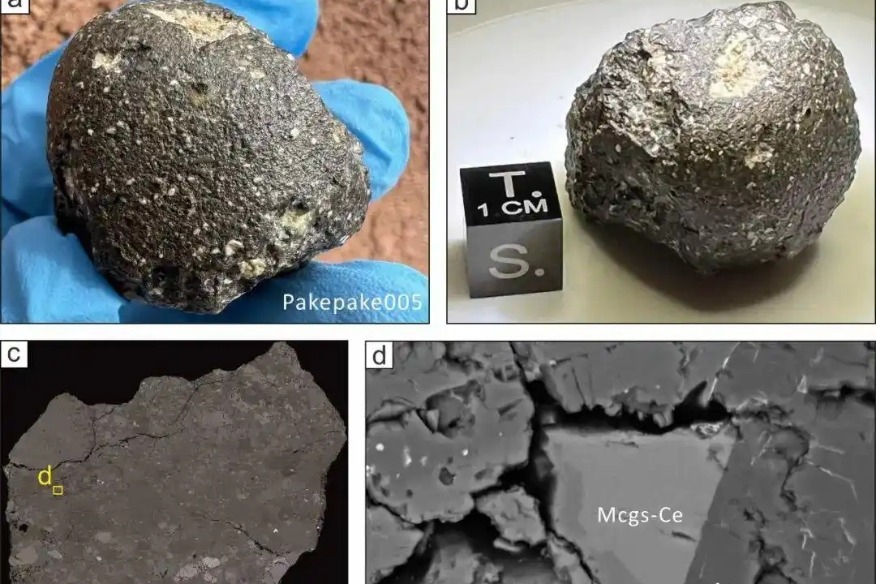
In a landmark breakthrough for planetary science, Chinese researchers have confirmed the discovery of a previously unknown lunar mineral from the first lunar meteorite ever recovered within China’s borders, a finding that pushes global lunar material knowledge to new heights. This newly recognized substance, now the 11th confirmed lunar mineral documented across the world, brings China’s total count of identified lunar minerals to four — tying the country with the United States for the highest number of lunar mineral discoveries globally.
Officially named Magnesiochangesite-(Ce), the new mineral has received full formal approval from the International Mineralogical Association’s Commission on New Minerals, Nomenclature and Classification, the globally recognized governing body that verifies and formalizes the naming of all newly identified minerals. Geochemically classified as a rare-earth-bearing phosphate, Magnesiochangesite-(Ce) displays distinct physical traits that set it apart from other known lunar materials: it is colorless, transparent, and carries a bright glass-like luster. It is characteristically brittle, forms distinctive shell-like fractures when broken, and emits visible fluorescence when exposed to ultraviolet light, properties that helped researchers isolate and confirm its identity.
The mineral was extracted from Pakepake 005, the 44-gram spherical lunar meteorite recovered by Chinese researchers in 2024 from the Taklamakan Desert, located in Xinjiang Uygur Autonomous Region. The stone’s dark outer fusion crust, a signature feature of meteorites formed when friction superheats the rock’s surface during its high-speed passage through Earth’s atmosphere, confirmed its extraterrestrial origin before detailed analysis began.
Wang Yanjuan, a doctoral graduate at the Chinese Academy of Geological Sciences and the lead researcher who first identified the new mineral, emphasized the far-reaching scientific value of the finding. “This discovery provides critical mineralogical evidence that helps us unpack the moon’s origin and long-term evolutionary history, and it expands the overall boundaries of human understanding of the material composition of our solar system,” Wang explained. She added that analysis of the mineral’s unique crystal structure and precise chemical composition is already yielding new insights into ancient lunar volcanic activity, as well as the geochemical processes that drive rare-earth element separation during planetary formation. Even beyond planetary science, Wang noted that the mineral’s unusual luminescent properties could inform the development of innovative new luminescent materials for industrial and commercial use.
A key enabling factor behind this discovery, researchers note, is China’s domestic development of high-precision scientific instrumentation. Che Xiaochao, an associate researcher at the Planetary Science Research Center of the Institute of Geology under the Chinese Academy of Geological Sciences, explained that the analysis of the rare meteorite sample relied on a domestically developed high-resolution secondary ion mass spectrometer. Unlike traditional analytical methods that require dissolving or altering valuable samples, this instrument uses a tightly focused ion beam to map surface composition at the microscopic level without damaging the specimen. “This process is analogous to doing a CT scan of the rock,” Che explained. “Without altering or dissolving the sample, we can accurately capture its internal chemical information and precisely measure nearly all elements and isotopes it contains.” Che also highlighted that the technology has broader cross-sector applications, including use in semiconductor manufacturing and new energy materials development.
Yang Zhiming, director of the Institute of Geology, stressed that access to advanced, domestically controlled instrumentation is foundational to advancing cutting-edge research on rare extraterrestrial samples. He added that the same domestic high-resolution instrument has already been used to analyze lunar samples collected by China’s Chang’e 6 mission, as well as other samples from the country’s first domestic lunar meteorite recovery. The breakthrough, Yang noted, underscores the critical importance of developing and mastering core scientific equipment and analytical techniques domestically to expand global and national planetary research capabilities.