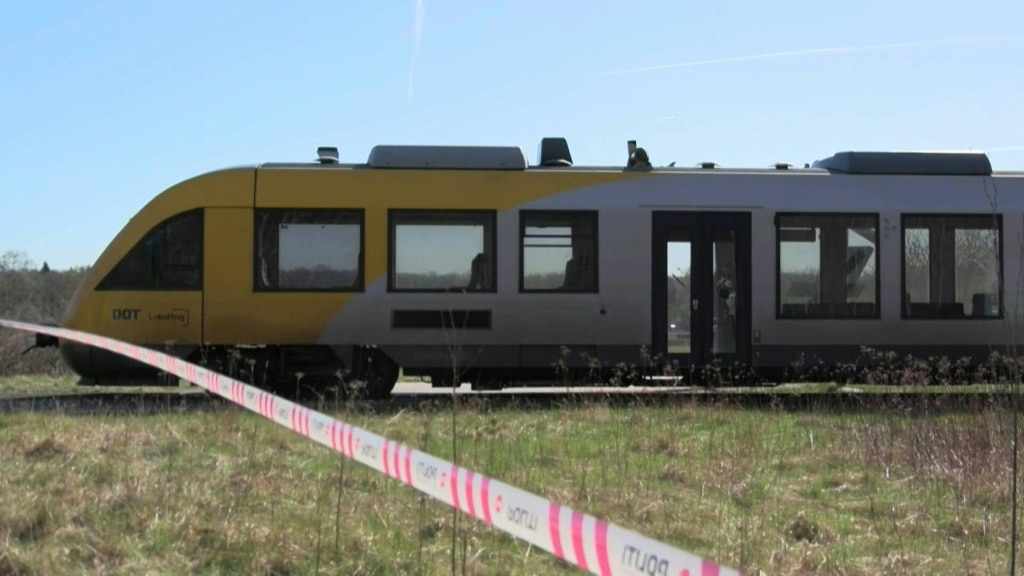
A devastating head-on collision between two commuter trains just outside Denmark’s capital Copenhagen early Thursday has left 17 people injured, with five of those casualties in critical condition, according to the country’s emergency response authorities. The crash unfolded shortly after 6:00 a.m. local time near a rural level crossing, in a forested area approximately 40 kilometers north of Copenhagen, close to the small town of Hillerod, falling within Gribskov Municipality.
As of the initial briefing hours after the incident, investigators have not released any confirmed details on what triggered the collision, with multiple probes now ongoing to piece together the sequence of events. Anders Damm-Hejmdal, chief physician for Copenhagen’s emergency medical services, confirmed the breakdown of casualties to reporters on the scene: “A total of 17 people were injured. Of them, five were deemed to be in critical condition at the scene.”
Local police confirmed they received the first emergency alert about the collision at 6:29 a.m. local time (0429 GMT). Visual footage from the crash site shows the yellow and grey front ends of both trains crumpled and smashed inward, with nearly all windshield and side window glass shattered across the carriages. Remarkably, both trains and all their attached cars remained upright on the railway tracks. In total, 38 passengers and crew were on board the two trains combined.
Emergency responders quickly mobilized a large fleet of ambulances and police vehicles to the remote site, and all passengers were evacuated within hours. All injured people have now been transferred to nearby hospitals for treatment, with some airlifted by medical helicopter according to Gribskov Mayor Trine Egetved. Rescue operations wrapped up roughly three hours after the crash, though official accident investigators remain on site to collect evidence and reconstruct the incident.
Morten Kaare Pedersen, a senior local police official, told reporters that no conclusions on the cause would be released until evidence gathering is complete. “We are in the process of gathering the necessary information about the course of events,” he said. “So there are, and will continue to be for quite some time, a lot of investigations underway.”
Damm-Hejmdal added that the number of critically injured patients could shift in the coming hours, noting that casualty statuses are dynamic in the immediate aftermath of major trauma incidents. “Initially it is difficult to get an overview of the exact injuries,” he explained at a press conference held nearly four hours after the crash. “You can imagine two trains colliding. That causes a lot of different injuries, people get thrown around.”
Mayor Egetved expressed her profound shock at the incident, noting that the commuter route is relied on daily by local workers and students. “I have been deeply upset and shocked,” she wrote in a post on Facebook. “This train is used by many residents of Gribskov, workers and students.”
Denmark has long held a reputation for strong rail safety standards, but this collision marks the third serious train incident in the country in less than five years. A 2019 fatal collision left eight people dead and 16 others injured, and in August 2022, an express train struck a farm truck at a level crossing, killing one person and injuring 27 more.