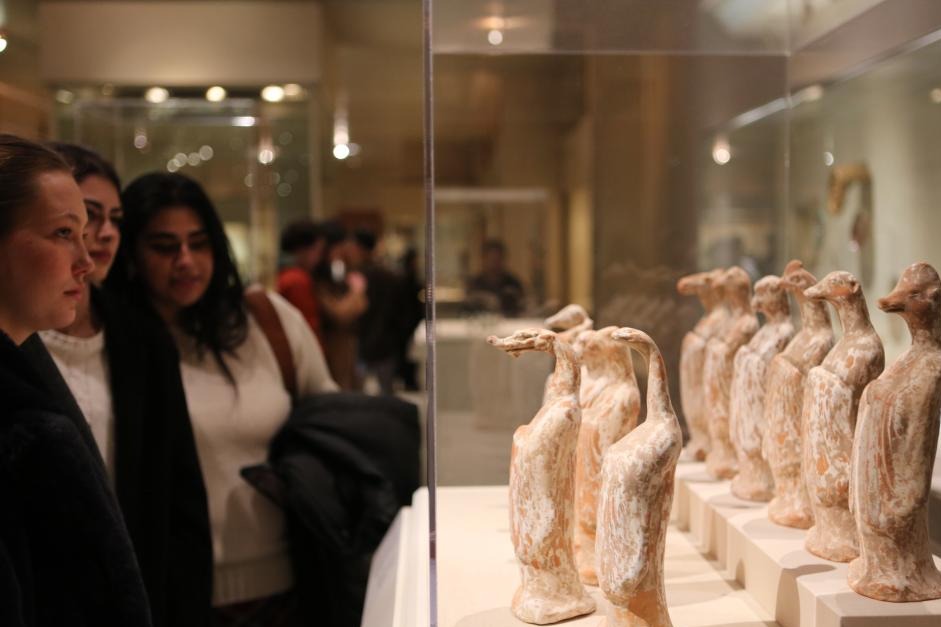
Against a backdrop of rising geopolitical friction between the world’s two largest economies, cultural and museum institutions on both sides are quietly working to sustain open lines of communication, building tangible connections that deepen mutual understanding between the Chinese and American people.
The grassroots push for cross-border cultural exchange traces its origins to a deeply personal journey for Tina He, founder of the H Foundation for the Arts. As a university student, He traveled back to her ancestral hometown of Fuzhou, where a walk through the historic Three Lanes and Seven Alleys district — widely celebrated as an open-air museum of Ming and Qing dynasty architecture — left an indelible mark on her. Wandering the preserved lanes, she encountered the enduring legacies of Lin Zexu, Yan Fu, and Bing Xin, three iconic figures whose work and lives fundamentally shaped the course of modern China. That experience planted the seed for a career dedicated to sharing Chinese cultural heritage with global audiences.
In 2016, that vision became a formal institution when He established the Cultural Foundations of Zhendai He, named in honor of her great-grandfather, a prominent 20th-century Chinese poet and classical scholar. Speaking at the foundation’s 10th anniversary forum earlier this year, He emphasized that the organization’s mission extends far beyond simply establishing an administrative body. “It is not merely about creating an institution, but rather about undertaking a legacy of continuity, carrying these cultural values forward into a new era,” she explained.
Over the past decade, the foundation has pursued a two-way exchange model that benefits creative communities on both sides of the Pacific. It has supported emerging and established Chinese artists in securing exhibition opportunities at major American cultural institutions, including the Los Angeles County Museum of Art, bringing contemporary Chinese creative practice to mainstream US audiences. At the same time, it facilitates residencies and exhibitions that introduce contemporary American artists to cultural hubs in China, most notably Jingdezhen in Jiangxi province, the centuries-old historic center of Chinese porcelain production, where visiting creators can engage with local artisans and audiences.
“By building this kind of bridge, we promote cultural exchange between China and the United States,” He noted.
The critical role of museums and cultural institutions as neutral, accessible spaces for cross-cultural dialogue took center stage at a recent forum hosted by the foundation, which brought together leading scholars, museum administrators, and cultural leaders to explore how public and private cultural organizations can strengthen people-to-people ties between the two nations.
Daryle Williams, dean of the College of Humanities, Arts and Social Sciences at the University of California, Riverside, noted that American public cultural and academic institutions are constantly evolving to reflect the changing makeup of the communities they serve. “We really want to look at how the Chinese American history is,” Williams said. “Now we’re considering Asian American, Pacific Islander experiences as an integral part of our community that’s evolved over time.”
Leading curators from top American museums echoed the forum’s core theme, emphasizing that museums serve as global stewards of humanity’s shared cultural legacy, making them uniquely positioned to foster cross-cultural understanding.
Jason Sun, curator of Chinese art at New York’s Metropolitan Museum of Art — the most visited art museum in the world — pointed out that Chinese art has occupied a central place in the Met’s narrative of global civilization for decades. Through landmark, carefully curated exhibitions, the Met has introduced millions of American audiences to defining chapters of Chinese history and artistic development. Sun explained that these exhibitions do more than showcase the depth and richness of Chinese civilization; they also illuminate the centuries-long history of exchange and interaction between East and West, demonstrating that all civilizations have grown and evolved through mutual learning. “Through museums, one can understand a country’s culture and history, and thereby understand the country itself,” Sun said.
Similar perspectives were shared by Claire Lyons, curator of antiquities at the J. Paul Getty Museum in Los Angeles. Lyons noted that the Getty has maintained long-standing collaborative partnerships with Chinese cultural institutions, and her team sees enormous untapped potential for even deeper cooperative work in the coming years. The Getty’s China-focused programming has explored topics ranging from Qing Dynasty porcelain trade and export, highlighting hundreds of years of maritime and commercial exchange between China and global markets, to landmark exhibitions showcasing the ancient artistic heritage of the Mogao Caves in Gansu province. These projects do more than allow visitors to appreciate the artistic beauty of Chinese cultural treasures; they also draw attention to the painstaking work of cultural heritage preservation that sustains these sites for future generations.
For Emily Zhang, program director of the H Foundation for the Arts, the work of building these cultural connections has grown even more important in an era defined by rapid technological change. As artificial intelligence and digital tools reshape nearly every aspect of daily life, Zhang argued that human connection and cross-cultural understanding have only grown in urgency, rather than becoming less important. “In a world where technology becomes more powerful, what matters more and more is our community,” she said. “It’s not just about what we can do, but how we understand each other and how we stay connected. That is exactly what arts and culture can do.”