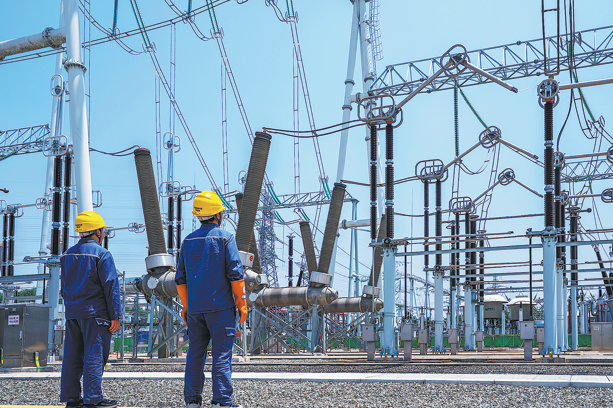
As the China-Laos 500-kilovolt interconnection project nears full commercial operation, it is delivering far more than cross-border energy connectivity — it is building enduring people-to-people bonds between the two neighboring nations through targeted skills training and community investment.
Few embody this dual impact as clearly as Fenta Sisoulath, a technical staff member at Electricite du Laos Transmission Company (EDL-T). Stationed at the Namor 3 Substation in northern Laos, Fenta now fills a newly created role: lead mentor to 21 recently hired Lao technicians, guiding his local colleagues through the complex mechanics and operational protocols of the advanced cross-border energy system.
For Fenta, this full-circle professional journey began with a life-changing opportunity: a regional scholarship funded by China Southern Power Grid (CSG), designed to support young students from Lancang-Mekong Cooperation countries pursuing energy-related higher education. Seven years ago, he became one of the first Lao students admitted to the program, heading to Kunming, the capital of China’s Yunnan Province, to study electrical engineering.
The early days of his studies presented steep challenges. Arriving with limited proficiency in Mandarin Chinese, Fenta struggled to navigate dense, technical coursework packed with specialized engineering terminology. There were points when he questioned whether he could complete the program, he recalled, never imagining he would one day work in the national power sector. Today, he stands as a critical bridge between the two countries, passing on hard-won technical expertise while strengthening cultural connections between China and Laos.
From the earliest construction phases of the interconnection project, both project partners prioritized localized employment and inclusive professional development. To date, the initiative has hired more than 500 Lao workers across all phases of development and operation, from on-site construction teams to central control room staff, placing local employees side-by-side with Chinese engineers at every step of the cross-border infrastructure project.
As bilateral energy cooperation has deepened, Laos’ domestic power sector workforce has expanded significantly, with growing numbers of Lao professionals stepping into key technical and senior managerial roles. By 2025, the share of local employees at EDL-T had climbed to 85 percent, marking major progress in building long-term local capacity for the Lao energy industry.
Beyond the original scholarship program that supported Fenta and dozens of other students, CSG has rolled out a full suite of capacity-building initiatives, including specialized professional courses and on-the-job practical training. As bilateral cooperation continues to grow, CSG has announced plans to further expand its regional training system. In 2026 alone, the company expects to host 27 international training programs across 28 separate sessions, expecting to reach nearly 590 trainees from ASEAN member states — with Lao participants making up a large proportion of attendees.
The project’s commitment to local development extends far beyond energy infrastructure and workforce training, addressing unmet needs in local community services. Xie Min, deputy general manager of EDL-T, noted that inclusive community investment, particularly in education, has been a core pillar of the bilateral partnership from the start.
During construction surveys, project teams discovered that multiple rural primary schools in remote northern Lao border regions lacked basic teaching facilities. In response, EDL-T funded construction of a new primary school campus in Namor Tai village, located near the Namor 3 Substation along the China-Laos border. Spanning 3,185 square meters, the new campus opened to students in December 2025, providing dramatically improved learning environments for local children.
“Our core goal from the start has been to cultivate homegrown talent for Laos’ national development and its growing power sector,” Xie explained. “What matters most is that this expertise will contribute to long-term progress for Lao society.”
As the 2026 first semester approaches, the new school stands ready to welcome its young students — representing a lasting investment in Laos’ future, one that will outlive the infrastructure project itself and deepen the connection between the two neighboring nations for generations.