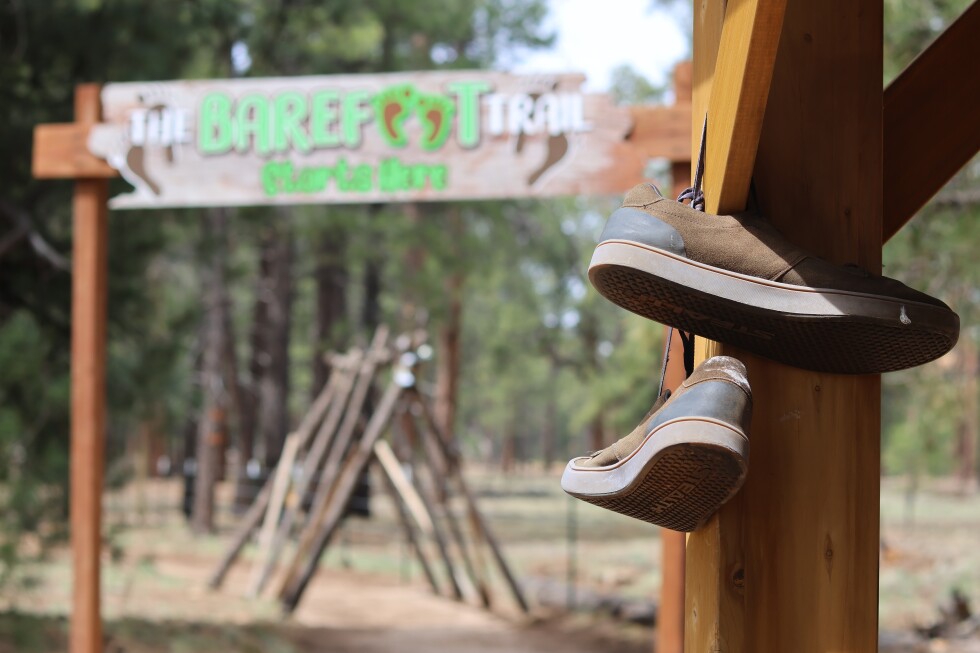
Thousands of kilometers apart, two very different hiking trails share one unusual, intentional feature. In Germany’s scenic Black Forest, waterlogged path steps sink into ankle-deep mud that demands slow, careful footwork. Across the Atlantic in northern Arizona’s ponderosa pine woodlands, hikers must navigate just as deliberately across a line of tree stumps repurposed as stepping stones. What unites these two pathways is a simple premise: they are built for visitors to explore without socks or shoes.
Barefoot trails have popped up across every inhabited continent, designed to invite people to engage more deeply with the natural world through direct sensory experience. Feeling cool mud squish between toes, stepping across soft pine needles, exploring quiet meditation nooks, testing scent stations and navigating dark sensory rooms transforms an ordinary daily walk into a fully immersive, grounding activity. Beyond the sensory experience, podiatrists and long-time barefoot walking advocates note that walking shoeless across varied natural surfaces may offer tangible benefits for both emotional well-being and long-term foot health.
The modern barefoot trail movement is rooted in more than a century of wellness philosophy. While theories about the perks of going barefoot have surged in popularity among runners, athletes, environmental advocates and mental health wellness circles in recent decades, the core idea dates back to the 1800s. Sebastian Kneipp, a 19th-century German Catholic priest and an early pioneer of naturopathic medicine, championed regular nature exposure, hydrotherapy and barefoot walking as a form of gentle exercise. He argued that barefoot walking boosts circulation, supports overall immune function and improves whole-body health, famously recommending walks across dewy grass or even snow, and once referred to conventional shoes as “foot-bending machinery.”
Kneipp’s wellness philosophy inspired the creation of barefoot paths across the European continent, where many trails are still referred to as Kneipp paths, and later spread to a smaller but growing community of enthusiasts in the United States. In Asia, a parallel tradition of reflexology trails, built from smooth stones, pebbles and natural grass, is designed to stimulate pressure points on the soles of the feet, a practice rooted in traditional East Asian medical therapy. This article is part of the Associated Press’s ongoing *Be Well* coverage series, which focuses on topics including holistic wellness, fitness, nutrition and mental health.
Germany’s Park mit allen Sinnen — translated as “Park with All Senses” — sits within the Black Forest, a 6,000-square-kilometer region that has become a global hub for wellness tourism, where visitors come to breathe crisp mountain air, soak in natural thermal baths and book spa treatments that use native regional plants and herbs. The park charges a small admission fee for access to its 1-kilometer barefoot trail. According to the park’s official website, wandering shoeless across the trail’s wide range of different surfaces “is ideal for exercising your back and spine, and at the same time, it’s a perfect foot reflexology massage in the fresh air.”
In the United States, Leah Williams, owner of The Barefoot Trail park near Flagstaff, Arizona, launched her own 1-kilometer manicured barefoot trail just off Route 66 two years ago, following a family trip to Europe. Williams runs the park through a nonprofit charitable foundation, and requires tickets for entry. Raised with the tradition of barefoot outdoor activity — her German-born mother encouraged her to play barefoot in the forests and creeks around Seattle as a child, a habit Williams carried into adulthood and passed down to her own children — Williams first fell in love with the concept of a formal barefoot trail during a trip to a Belgian path while her family was living in the Netherlands.
“I loved everything about it. I saw all ages, and I loved seeing older people at the park because you don’t see that here in the United States,” Williams said. “I thought, ‘Wow, when I get back to the United States, I’m going to build one of these parks myself.’” Today, she also develops educational programming for schools, summer camps and youth programs that bring children to explore the trail. “Being good stewards of nature is really our job as human beings, and we have taken 13 acres of land at our park for our community enjoyment … for local, statewide and regional enjoyment,” Williams said, speaking emotionally about the project.
Unlike a standard hike, barefoot trails offer a uniquely sensory experience that most people never get in regular daily life. For most people who do not regularly walk barefoot outdoors, exposing the soft soles of the feet to a range of textures, temperatures and surfaces takes time to get used to. “You should see people’s faces when they start walking,” Williams said, chuckling at the memory of first-time visitors’ reactions. While most barefoot trail operators strongly encourage shoeless walking to get the full experience, it is never required. Visitors with diabetes, neuropathy or other chronic foot conditions are fully welcome to keep their shoes on at both the Arizona and German parks.
Many trails are intentionally designed to engage all five senses, not just the sense of touch. At Germany’s Park mit allen Sinnen, a “Quiet Please” sign marks the entrance to a dedicated meditation cave, where a long wooden bench faces tall windows looking out over the forest, and soft calming music plays through hidden speakers. In other sections of the park, visitors can squeeze red rubber bulbs to release the scents of papaya and apricot, or place their hands into a sealed box lined with wild boar fur to feel the texture.
The barefoot trail movement has expanded far beyond Germany and the United States today. Across Europe, Austria, Denmark, France, Hungary, Switzerland and the United Kingdom all host a growing network of barefoot trails, though many small local paths are not marketed to tourists, so first-time visitors may need to search for trails using local language terms like “barefoot path” to find them. In East Asia, Hong Kong, Singapore and Japan all have public parks with permanent pebble reflexology trails, where smooth stones are set into concrete to offer a foot massage and pressure point stimulation during walks.
In the United States, informal barefoot hikes along existing trails and small dedicated wellness parks are slowly growing in number, but formal barefoot parks remain relatively rare. That is why Williams is working to expand her nonprofit barefoot trail concept to other parts of the country. Her foundation recently received 20 acres of land in Lawrence, Kansas, a college town, to develop a second barefoot park integrated into a new mixed commercial and residential development. “It’s about integrating those natural environments into people’s daily lives and providing those safe spaces for people to enjoy,” Williams said.
This report was compiled from on-the-ground reporting by Mumphrey in Flagstaff, Arizona.