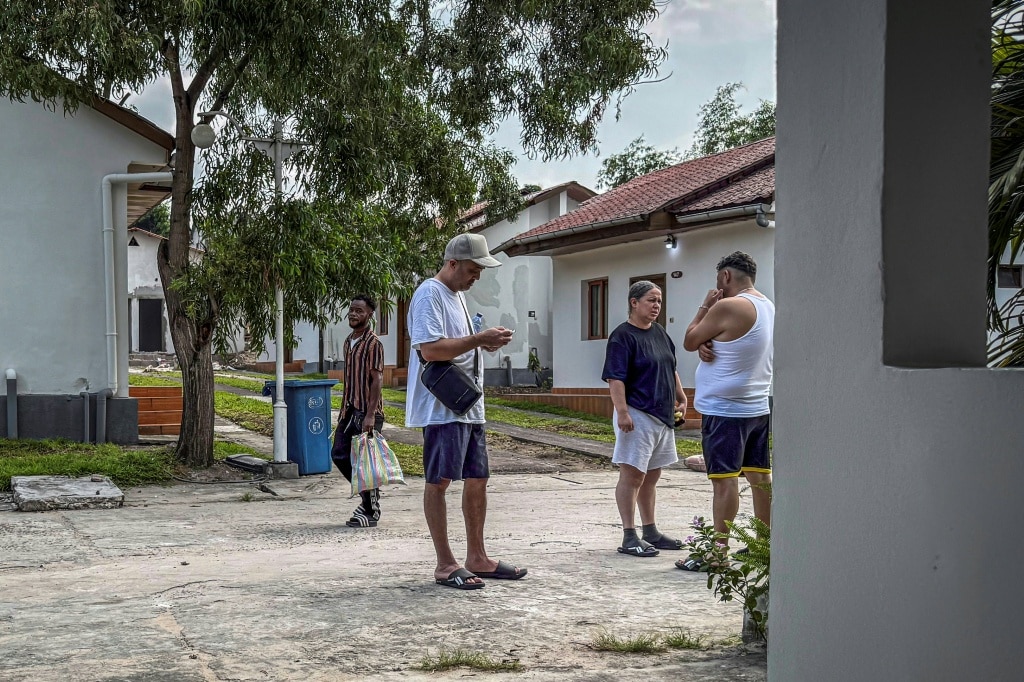
For a group of Latin American asylum seekers who once sought safety in the United States, the past five days confined to a locked accommodation complex near Kinshasa’s international airport have become a nightmare none of them anticipated.
The 15 South American migrants, the first contingent transferred to the Democratic Republic of the Congo under a controversial U.S. third-country deportation scheme, detailed their harrowing experience to Agence France-Presse this Wednesday, starting with the brutal 27-hour transcontinental flight where they were restrained in shackles from takeoff to landing.
Thirty-year-old Colombian migrant Gabriela, who like most of the group wears a plain white t-shirt and bears visible tattoos, spoke on behalf of the stranded group to summarize their desperate situation. “I never agreed to come to Congo. I’m terrified here, and I don’t speak a word of the local language,” she explained, adding that she only learned her final destination one day before U.S. authorities expelled her from the country.
The DRC, one of at least seven African nations that have accepted deported migrants under the U.S. policy alongside Cameroon, Equatorial Guinea, Eswatini, Ghana, Rwanda and South Sudan, is ranked among the 15 poorest countries globally, located thousands of kilometers from the migrants’ home countries in the Americas. The scheme, which typically includes U.S. financial and logistical backing for host nations, has long operated with little transparency, and host governments have released almost no information about what happens to migrants after they arrive on African soil.
Under current arrangements, the International Organization for Migration (IOM) takes over administrative responsibility for migrants once they receive short-term visas, and the organization says it can facilitate assisted voluntary return for any migrant who requests the service. But for the 15 migrants now stuck in Kinshasa, a sprawling megacity home to more than 17 million people, daily life inside the closed airport-area compound is marked by uncertainty and deteriorating health.
The compound, made up of rows of small, plain white-walled structures, is the migrants’ only home at present, and they are prohibited from leaving the premises. Police and military vehicles are posted outside the gate, and unidentified private military personnel have also been spotted on site. None of the South American migrants speak French, the DRC’s official language, cutting them off from any ability to interact with the outside world even if they were allowed to leave.
The group says they have each received roughly $100 in assistance from IOM officials, but are denied access to outside visitors. Multiple migrants have fallen ill since arriving, Gabriela reported, including herself. “We’ve had fevers, vomiting and severe stomach issues, but we’re just told this is normal and we have to adapt,” she said. While some have received basic over-the-counter medication, no licensed healthcare worker has come to the compound to examine any of the sick migrants.
Four of the migrants confirmed they received seven-day short-stay visas that can be extended for up to three months, but they have been warned that all official support will be cut off once the initial week-long period ends, leaving them to survive on their own in a country where they have no connections, work permits, or language skills. Gabriela says authorities have pressured the group to accept voluntary repatriation, telling them they will be left destitute if they refuse. “They’ve backed us into a corner. This is inhumane and unfair,” she said, her distress visible during the interview.
Outside the compound walls, Kinshasa’s chaotic, overcrowded urban landscape tells the story of just how high the stakes are for the stranded migrants. Potholed roads lined with crumbling buildings see constant streams of honking minibuses and private cars, most of the city’s population lacks consistent access to running water or electricity, and World Bank data shows nearly 75 percent of all Congolese citizens live below the international poverty line.
Twenty-five-year-old Hugo Palencia Ropero, another Colombian migrant who spent five months in U.S. detention before being deported to the DRC, acknowledged that basic amenities are provided inside the compound: three meals a day, daily room cleaning, and security on site. Even so, he shares Gabriela’s overwhelming fear. “I’m more afraid of being here in Africa than I ever was back in Colombia,” he said. “If our seven-day visas run out and we don’t get any more help, things will become impossible for us, especially since we can’t work legally here.” Ropero added he would accept any travel document available just to leave the DRC as soon as possible.
The arrival of the Latin American deportees has already sparked widespread backlash among Congolese civil society and on local social media, with many criticizing the government for agreeing to take in vulnerable migrants at a time when most of the country’s own population struggles to meet basic needs.