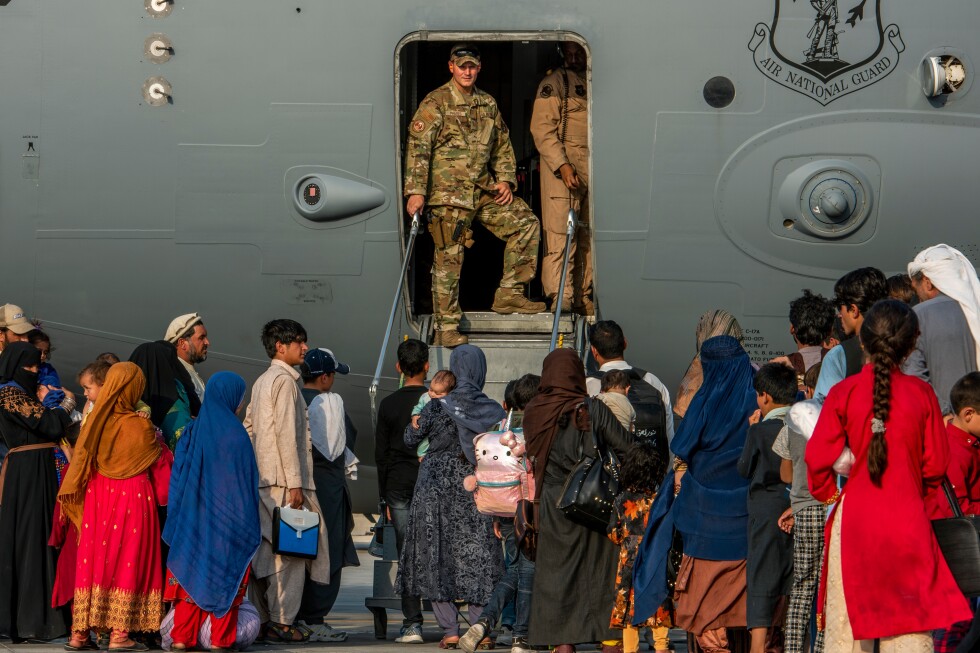
More than a year after former U.S. President Donald Trump halted his predecessor’s Afghan refugee resettlement program as part of sweeping immigration restrictions, controversial negotiations have emerged to relocate roughly 1,100 vulnerable Afghan evacuees stuck at a U.S. military base in Qatar to the Democratic Republic of Congo, multiple sources confirm.
The group trapped at Camp As-Sayliyah in Doha includes Afghans who served alongside U.S. forces as interpreters and Special Operations support staff, as well as immediate family members of more than 150 currently serving American military personnel. They have been in limbo at the Qatari base for a full year, after the Trump administration’s executive order paused the resettlement pathway that thousands of vetted evacuees had already waited years to access. While the Doha base was originally planned only as a temporary transit hub for refugees bound for the U.S., it has become a long-term holding facility for this group.
The #AfghanEvac coalition, a prominent advocacy organization working to support Afghan resettlement, has confirmed that Congo is under consideration as a third-country resettlement destination. Shawn VanDiver, a U.S. Navy veteran and leader of the coalition, said Wednesday that U.S. officials had informed advocacy groups of ongoing bilateral discussions between Washington and Kinshasa about accepting the stranded refugees. The U.S. State Department has acknowledged it is exploring options for voluntary third-country resettlement but declined to confirm which countries are involved in the talks.
Critics warn that the proposal offers evacuees no genuine choice: the only alternatives on the table are resettlement in Congo or forced return to Taliban-controlled Afghanistan, where Afghans who assisted the U.S. during the 20-year war face near-certain reprisal and death. “You cannot call a choice voluntary when the two options are Congo and the Taliban, civil war or an oppressor who wants to kill you,” VanDiver stated during a virtual press briefing. “That is not a choice. That is a confession extracted under duress.”
Multiple former U.S. officials and refugee advocates have raised urgent alarms about the safety risks of sending vulnerable Afghan allies to Congo. The United Nations has classified eastern Congo as facing one of the world’s most severe ongoing humanitarian crises, after decades of persistent conflict between government forces and armed rebel groups backed by neighboring Rwanda. Over 70% of Congo’s humanitarian aid was previously supplied by the U.S., and aid workers have documented preventable deaths in conflict zones following Trump administration cuts to American aid and trade support. Congo has also previously participated in controversial, multi-million dollar deals with the Trump administration to accept third-country deportees from the U.S. — a practice that has drawn widespread international criticism.
Sean Jamshidi, an Afghan American U.S. military veteran who has served deployed in Congo, shared the deep concerns shared by many evacuee family members. His own brother is among the group stranded in Doha, and could be relocated to the African country. “I saw the security situation and what it looked like there. I saw the displacement camps… I stood in places where the United Nations has counted the dead,” Jamshidi said. “I’m telling you, as someone who has been in uniform, the Democratic Republic of the Congo is not a place you send vetted Afghan allies and their children to live.”
For the evacuees trapped at the Doha base, uncertainty remains the only constant. Negina Khalili, an Afghan former prosecutor who fled Afghanistan during the 2021 U.S. withdrawal, has waited for updates on her father, brother, and stepmother since they arrived at the base in January 2025, just days before Trump suspended the resettlement program. When news broke that Congo was a potential destination, her family already expressed profound fear. “They are not giving them any information or updates regarding which countries they will go to,” Khalili told the Associated Press. “They were so stressed and worried about it and said that Congo is not a safe place either. They don’t know if it’s a temporary location for them there or a permanent location. They are worried.” Khalili added that U.S. officials at the camp have already begun offering refugees financial incentives to voluntarily return to Afghanistan.
Congolese authorities have not yet issued a public response to requests for comment on the ongoing negotiations. The reporting was contributed by AP correspondents Amiri in New York, Asadu in Abuja, Nigeria, and AP writer Matthew Lee.