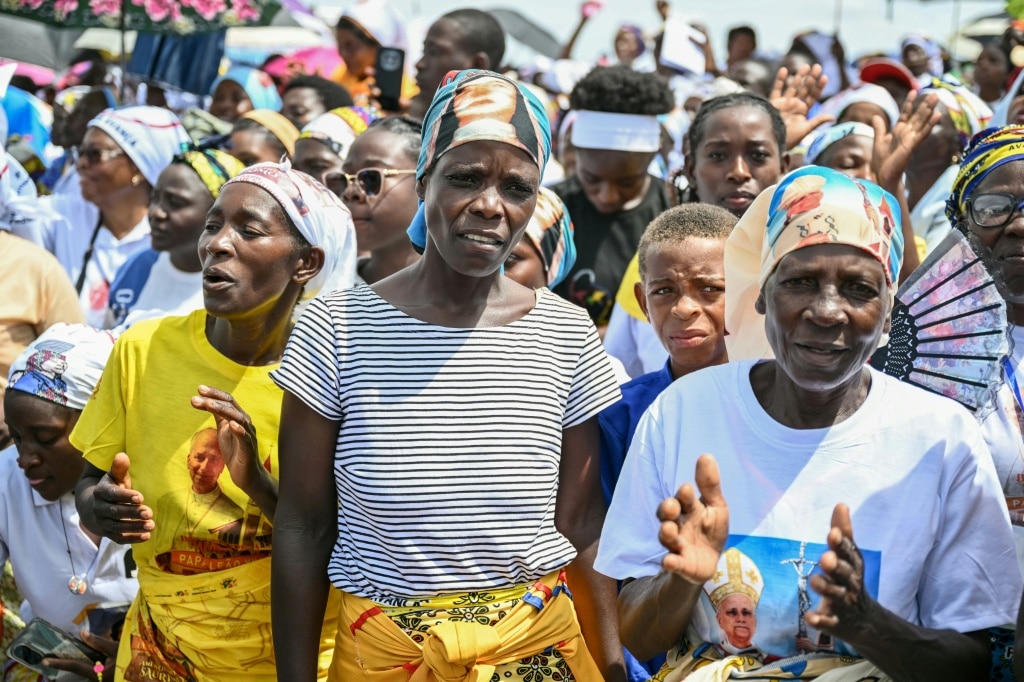
On the eighth day of his ambitious 11-day tour across four African nations, Pope Leo XIV brought his message of economic justice to Angola’s remote, diamond-abundant northeastern region, doubling down on a core theme that has defined his trip: calling out systemic exploitation and corruption by wealthy, powerful actors.\n\nArriving in Saurimo, the capital of historically marginalized Lunda Sul province located 800 kilometers east of Angola’s capital Luanda, the pontiff processed through the city of 200,000 residents under sweltering tropical heat, flanked by heavy security details. Lining his route were hundreds of local residents, clad in vibrant traditional clothing and waving white scarves, who greeted the first American pope with rousing songs and enthusiastic cheers.\n\nSaurimo sits just a short distance from Catoca, Angola’s largest diamond mine, which accounts for roughly 75 percent of the nation’s total diamond output. Despite being one of Africa’s leading producers of both crude oil and diamonds, Angola faces stark socioeconomic inequality: approximately one-third of its population lives below the World Bank’s poverty line. Lunda Sul, which shares a border with the Democratic Republic of the Congo, exemplifies this gap: even with its extensive mineral wealth, the province grapples with extreme poverty, while unregulated mining has been linked to widespread environmental degradation and the forced displacement of local communities.\n\nSpeaking to a crowd of an estimated 60,000 people — 40,000 gathered on-site for the giant open-air Mass, and another 20,000 joining from surrounding neighborhoods — Pope Leo delivered his remarks in Portuguese, the country’s official language. “We can see today how the hope of many people is frustrated by violence, exploited by the powerful and defrauded by the rich,” he told the assembly. “Consequently, when injustice corrupts hearts, the bread of all becomes the possession of a few.”\n\nBefore celebrating Mass, the pontiff paid a visit to a local care home that houses 60 elderly residents, many of whom were abandoned by their families or left displaced by regional violence. “Your presence in this home is a blessing from God,” 72-year-old resident Antonio Joaquin told him during the welcome.\n\nThis stop in Angola marked the third leg of Pope Leo’s African journey, following earlier visits to Algeria and Cameroon. Across both previous stops, the pontiff has already spoken out against tyranny and systemic exploitation, marking a sharper, more assertive tone than the more reserved approach many observers expected from him early in his papacy. He first addressed the harms of resource extraction on the African continent shortly after arriving in Angola Saturday, speaking directly to top government officials including President Joao Lourenco. “How much suffering, how many deaths, how many social and environmental disasters are caused by this logic of exploitation,” he said during that address.\n\nOn Sunday, the pope led a Mass in Luanda attended by more than 100,000 worshippers, where he urged Angola to move past the deep divisions left by its 27-year civil war, which broke out immediately after the country gained independence from Portugal in 1975 and left the nation deeply scarred. He called on Angolans to build a new future “where the scourge of corruption will be healed by a new culture of justice and sharing.” According to 2024 census data, Catholics make up roughly 44 percent of Angola’s population of 34 million, equal to around 15 million adherents. Pope Leo is only the third sitting pope to visit the country, following Pope John Paul II in 1992 and Pope Benedict XVI in 2009.\n\nBack in Luanda later Monday, the pontiff was scheduled to meet with local clergy to discuss pressing challenges facing the Catholic Church in Angola, including limited institutional resources and the growing popularity of evangelical Protestant denominations across the country. He is set to depart for Equatorial Guinea on Tuesday to wrap up his 18,000-kilometer transcontinental journey.