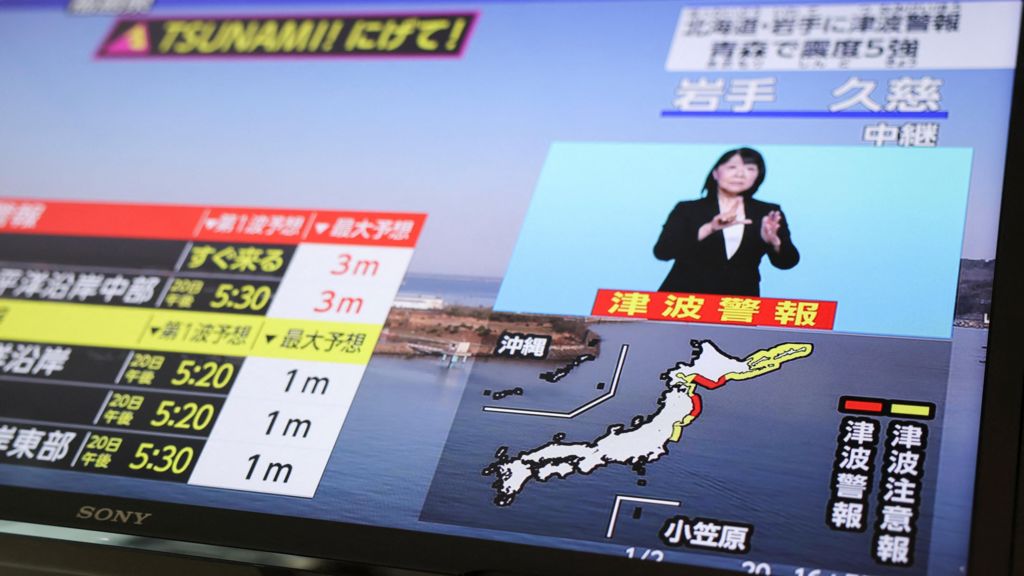
A powerful 7.7-magnitude undersea earthquake has shaken waters off Japan’s northeastern coast, prompting immediate evacuation orders and triggering warnings of potential 3-meter tsunami waves that have put the nation on high alert for aftershocks and major seismic activity in the coming week.
The temblor, registered at a depth of 10 kilometers, struck at 16:52 local time (08:52 BST) approximately 530 kilometers north of Tokyo off the coast of Iwate Prefecture. Shaking from the quake was felt as far south as the capital, prompting thousands of coastal residents across Honshu’s northeast and Hokkaido to immediately move to higher ground in line with official emergency protocols.
While initial monitoring showed the largest tsunami waves reached only 80 centimeters — far below the projected maximum — Japan’s Meteorological Agency (JMA) quickly issued an unprecedented warning: the risk of a catastrophic magnitude 8.0 or larger earthquake occurring within the next seven days remains “relatively higher than during normal periods.” Officials added that future quakes could generate far more destructive shaking and larger, more dangerous tsunami surges.
The 7.7 magnitude quake triggered a level two tsunami warning, the second-highest tier in Japan’s three-tier alert system, which was later downgraded to a lower-level advisory. Two hours after the quake, active tsunami alerts remained in place across parts of Hokkaido. Local authorities used street loudspeakers to circulate emergency updates, urging residents to stay vigilant, and many employers allowed office workers to dismiss early to allow staff to reach safe locations.
Chaw Su Thwe, a Myanmar national residing in Hokkaido, told reporters that the community moved swiftly once the earthquake alert was issued. “As soon as we heard the earthquake alert, everyone ran downstairs,” she said. “However, this time the shaking was relatively mild. Right now, local authorities are using loudspeakers in the neighbourhood to warn people about a possible tsunami and to stay alert.”
As of Monday evening, Japanese government officials confirmed there were no immediate reports of fatalities, major structural damage, or severe injuries. A total of 100 residential properties were left without power, and multiple high-speed bullet train services were temporarily suspended to conduct infrastructure safety inspections.
Prime Minister Sanae Takaichi echoed the JMA’s emergency guidance, urging at-risk residents to prioritize safety and move to elevated, secure locations immediately. “Tsunami waves are expected to hit repeatedly. Do not leave safe ground until the warning is lifted,” the JMA emphasized in its official post-quake briefing.
Japan’s location along the Pacific Ring of Fire leaves it uniquely vulnerable to seismic activity: the nation records roughly 1,500 earthquakes annually, and accounts for 10 percent of all global magnitude 6.0 or larger tremors. The new earthquake and warning come amid lingering national trauma from the 2011 Great East Japan Earthquake, a 9.0-magnitude undersea quake that struck south of Iwate Prefecture, triggering a massive tsunami that killed more than 18,000 people and caused a catastrophic nuclear meltdown at the Fukushima Daiichi Nuclear Power Plant — one of the worst nuclear disasters in recorded history. Since 2011, Japan has overhauled its emergency early warning and evacuation protocols to reduce casualties from future seismic and tsunami events.