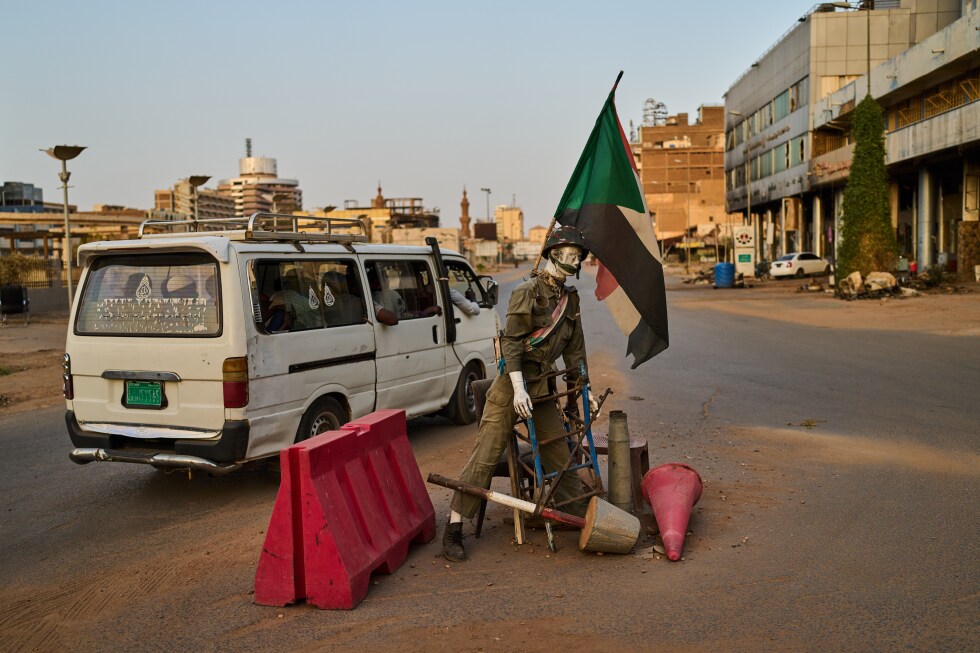
As Sudan’s devastating civil conflict stretches into its fourth year of brutal fighting, a high-ranking commander from the country’s powerful Rapid Support Forces (RSF) has announced his defection to the national army, a shift that Sudan’s top military leadership has framed as an opening for reconciliation and national rebuilding.
Army chief and Sovereign Council chair Gen. Abdel-Fattah Burhan formally welcomed Maj. Gen. al-Nour Ahmed Adam — widely known by the alias al-Qubba — in a meeting held Sunday in Sudan’s Northern province, which shares a border with Egypt. The country’s ruling transitional body publicly shared video footage of the meeting across its social media channels, confirming the defection that was first reported earlier this month. Local Sudanese media outlets have confirmed that Adam fled RSF-held territory in the Darfur region alongside dozens of armed fighters and military equipment to cross into government-controlled areas.
According to independent regional publication *Sudan Tribune*, the commander’s departure stemmed from internal leadership disputes within the RSF. Tensions boiled over after the paramilitary group captured el-Fasher in October 2024 — the last remaining army stronghold in the entire Darfur region — but failed to appoint Adam to the top military commander post for North Darfur province, a position he had reportedly expected. The RSF has so far declined to issue any public statement addressing Adam’s defection.
Burhan emphasized in an official statement following the meeting that Sudan’s military remains open to reconciliation for combatants willing to lay down their weapons and join efforts to rebuild the war-torn nation. “Doors are open to all those who lay down arms and join the path of national reconstruction,” Burhan said.
Adam’s defection marks one of the most high-profile departures from the RSF’s ranks since full-scale conflict erupted in April 2023. He is not the first senior RSF commander to switch allegiances in the past year: earlier in 2024, Abu Aqla Kaikel, leader of the Sudan Shield Forces, also left the RSF after the Sudanese Army retook control of the strategic central province of Gezira, a key agricultural and population hub.
The current conflict grew out of a years-long unresolved power struggle between the Sudanese Army, led by Burhan, and the RSF, a paramilitary force that evolved from the country’s former janjaweed militias tied to decades of conflict in Darfur. Fighting first broke out in the capital Khartoum before spreading across the vast northeast African nation, triggering one of the world’s worst humanitarian crises in modern history.
Data from the Armed Conflict Location & Event Data Project (ACLED), a U.S.-based conflict monitoring organization, records at least 59,000 confirmed deaths from the war to date. The group has repeatedly warned that the actual death toll is almost certainly far higher, as widespread insecurity, collapsed healthcare infrastructure, and limited access to conflict zones make accurate casualty reporting nearly impossible.