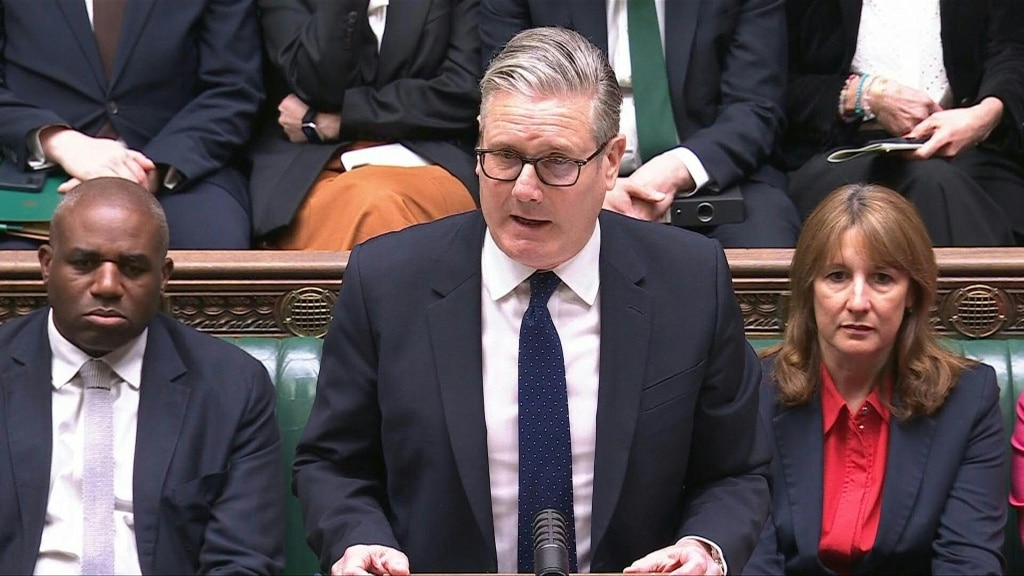
A deepening political scandal has engulfed British Prime Minister Keir Starmer this week, centered on his ill-fated appointment of veteran Labour politician Peter Mandelson as the UK’s ambassador to the United States. Appearing before parliament on Monday, Starmer issued a stark admission of error while pushing back against accusations that he intentionally misled lawmakers, laying blame squarely on senior Foreign Office officials for deliberately concealing critical information about Mandelson’s failed security vetting.
“I should not have appointed Peter Mandelson,” Starmer told MPs, acknowledging that his core judgment in selecting the 72-year-old for the prestigious Washington post was wrong. The controversy erupted in earnest last month when Starmer dismissed Mandelson from the role—seven months after he took up the post—after new details surfaced of Mandelson’s extensive personal ties to deceased American sex offender Jeffrey Epstein. Mandelson, who has a long history of controversy that includes two prior resignations from Labour cabinet posts, was arrested earlier this year on allegations of misconduct in office dating back more than 15 years. He has denied all criminal wrongdoing and has not been formally charged.
Starmer insisted that neither he nor other senior cabinet ministers were aware of the failed security clearance until last week, painting the withholding of information as a deliberate act by bureaucratic leadership rather than accidental oversight. “It beggars belief that throughout the whole timeline of events, officials in the Foreign Office saw fit to withhold this information from the most senior ministers in our system of government,” he said. “It wasn’t negligence. It was a deliberate decision not to tell me. Had I been provided this information, I wouldn’t have made the decision.”
The heated parliamentary session descended into chaos early on, when two opposition lawmakers—one from left-wing Your Party and a second from the far-right Reform UK—were ejected from the chamber after refusing to withdraw accusations that Starmer had lied to parliament. Zarah Sultana, the Your Party MP who first made the allegation, called Starmer “a bare-faced liar” who was “gaslighting the nation” before the speaker ordered her removal.
Last Thursday, in a move to address the fallout, Starmer dismissed the Foreign Office’s top civil servant, Olly Robbins, and launched a formal review of the UK’s security vetting process for senior political appointments. But the move has drawn sharp backlash from former civil servants, who accuse Starmer of scapegoating Robbins to deflect from his own missteps. Robbins is scheduled to deliver his own testimony before a parliamentary watchdog committee on Tuesday, where he is expected to push back against Starmer’s narrative.
Opposition leaders have united in calling for Starmer’s resignation, arguing that the prime minister has failed to answer lingering questions about when he learned of the failed vetting and whether he intentionally hid the information from parliament. “We still do not know exactly why Peter Mandelson failed that vetting,” Kemi Badenoch, leader of the main opposition Conservative Party, told parliament. She was joined by Liberal Democrat leader Ed Davey, who described the appointment as “a catastrophic error of judgment” and said the only honorable course of action for Starmer was to step down.
Senior figures within Starmer’s own Labour Party have so far rallied around the embattled prime minister. Scotland Secretary Douglas Alexander defended the original appointment logic on Monday, noting that “the Trump administration was an unconventional administration and an unconventional ambassador could do a job for the United Kingdom.” Other cabinet ministers have argued that maintaining stable government through ongoing global instability sparked by the Middle East war outweighs demands for a leadership change.
Public opinion remains deeply divided on the scandal, matching Starmer’s already abysmal approval ratings that rank him among the most unpopular prime ministers in modern British history. In on-the-record comments to AFP, 59-year-old retired dentist Andrews Connell said that if Starmer knew about the failed vetting ahead of the appointment, “then he has to go, he has to resign.” But 67-year-old retiree Duncan Moss offered a contrasting view, saying he would be “very worried if Starmer was to leave … I think he’s doing a very good job.”
The controversy comes at a precarious time for Starmer and Labour, who are bracing for crucial local and devolved elections across the UK next month, including votes for the Scottish Parliament and Welsh Senedd. Political analysts widely expect the party to face significant losses at the polls, in large part fueled by public anger over the Mandelson scandal.