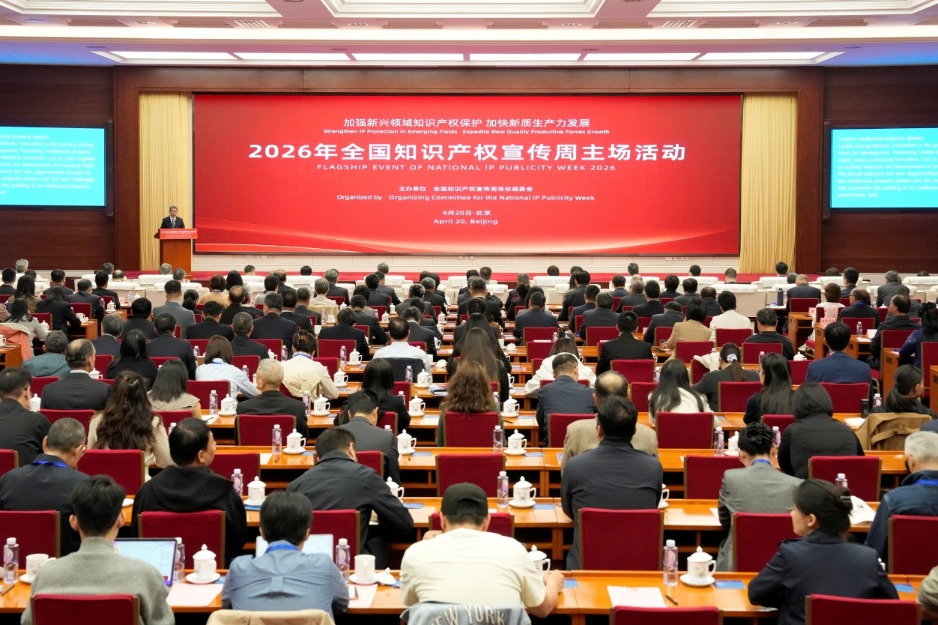
During the opening of China’s annual National Intellectual Property Publicity Week held in Beijing on Monday, a top World Intellectual Property Organization (WIPO) leader has publicly affirmed that China’s ongoing efforts to refine and strengthen its intellectual property (IP) protection framework are delivering robust, long-term support for sustainable global innovation — particularly in high-stakes frontier technology sectors, as China moves to upgrade its entire IP protection ecosystem.
Wang Binying, WIPO Deputy Director General, delivered her remarks at the main event of the publicity week, which this year centers on two core priorities: boosting IP safeguards for emerging technology sectors and accelerating the development of high-quality new productive forces. The week-long national initiative runs from April 20 to 26 this year, aimed at raising public awareness of IP rights across the country.
In her address, Wang pointed out that a growing group of frontier technologies — including artificial intelligence, cloud computing, biotechnology and nanotechnology — have emerged as the central driving forces of global innovation expansion. She emphasized that the global innovation landscape is steadily shifting toward the Asia-Pacific region, with China positioned as a central player in this ongoing technological transformation.
Wang noted, “China’s strengths in systematic cross-sector innovation across multiple key technologies, especially its proactive work to build a comprehensive, effective IP ecosystem, has become a core engine powering the country’s high-quality growth and nurturing the development of new quality productive forces.”
She also shared key data highlighting China’s rapid growth in IP output: as of 2026, China holds 5.32 million valid domestic invention patents, making it the first nation globally to cross the 5 million threshold in this category. Beyond that, China holds more than 60 percent of the world’s total artificial intelligence patents, and roughly two-thirds of all global patents related to robotics technology, Wang added.
The senior WIPO official also stressed that China has taken a constructive, collaborative approach to advancing multilateralism in global IP governance, bringing much-needed stability and new momentum to the international multilateral system amid rising global geopolitical uncertainty.
Speaking at the same event, Shen Changyu, Commissioner of the China National Intellectual Property Administration (CNIPA), noted that emerging technology sectors — led by artificial intelligence, big data, quantum technology and biomedicine — have become the primary frontline of global technological and economic competition today.
“We must proactively adapt to the unique demands of emerging sectors, and refine and update our IP protection system in a timely, responsive way to create a more enabling environment for innovators across the country,” Shen stated.
Shen also outlined key priorities for China’s top IP regulator in 2026. A core task this year is the rapid development of a targeted work plan to update IP protection rules specifically tailored to emerging technology sectors. In addition, the CNIPA will speed up revisions to existing regulations governing the protection of integrated circuit layout designs, changes that are intended to meet the technical requirements for developing ultra-large-scale integrated circuits and support the sustained growth of China’s domestic chip industry.