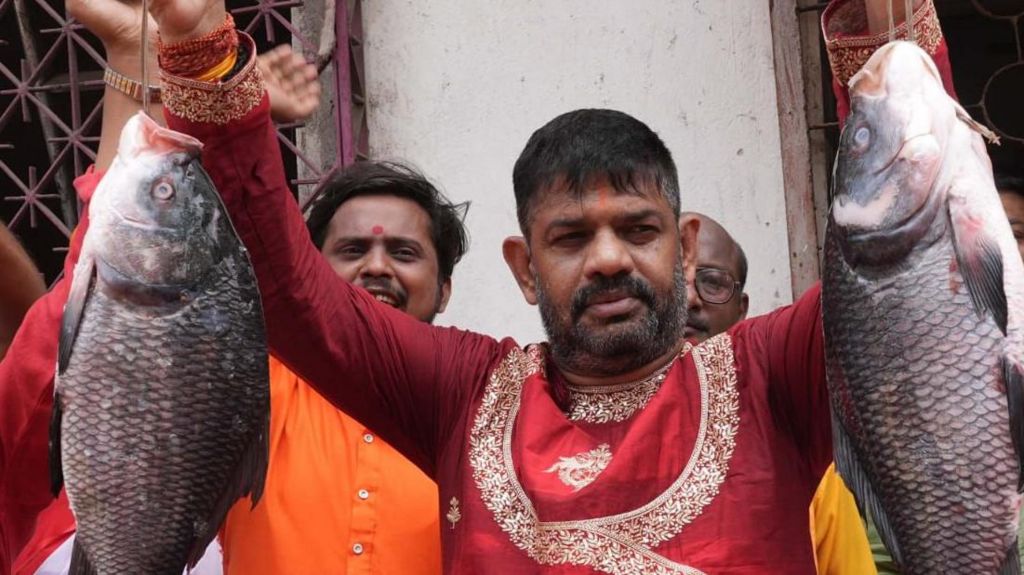
On a humid, sticky pre-election morning in Kolkata, the capital of India’s eastern state of West Bengal, BJP candidate Koustav Bagchi makes his way through residential neighborhoods, door to door. Clad in a crisp traditional red-and-white sari-inspired garb, the former lawyer carries one unusual campaign accessory: a fresh fish. Drums beat in the procession behind him, supporters roar his name, and there are no lengthy policy speeches, no dense policy brochures. Instead, Bagchi leans on a single, powerful visual message – one that needs no words: I share your identity. I belong here, just like you.
A few kilometers away, in Kolkata’s bustling port district, another BJP contender, Rakesh Singh, repeats the same striking campaign tactic. Dressed to draw a crowd and flanked by dozens of party workers, Singh hefts a large fish above his head again and again as he works the early morning foot traffic. He is running against incumbent Kolkata mayor Firhad Hakim in one of the most high-profile contests of the upcoming West Bengal Legislative Assembly elections, turning the humble aquatic staple into a political weapon.
For the people of West Bengal, fish is far more than a staple food item. It is woven into the very fabric of daily life, local cuisine, cultural memory and ritual, serving as an enduring marker of regional identity and communal belonging. Today, that deep cultural resonance has been transformed into full-blown political theater, as candidates from both major parties brandish fish to address a specific, widespread voter anxiety that has come to define the 2026 election.
In India, dietary habits have long been deeply politicized. The national ruling Bharatiya Janata Party (BJP) has been widely associated with an assertive, culturally framed push for vegetarianism, driven by the Hindu nationalist ideological underpinnings of the party. This perception has been cemented by periodic restrictions on meat sales in several BJP-governed states, as well as high-profile crackdowns tied to cow protection vigilante groups, even though the overwhelming majority of India’s population identifies as non-vegetarian. As the state election campaign heats up, fish has moved off dinner plates and into the political spotlight, recast as proof of cultural loyalty and a rebuttal to claims of outside ideological intrusion.
The incumbent ruling Trinamool Congress, led by three-term Chief Minister Mamata Banerjee who is running for a historic fourth consecutive term, has weaponized this public anxiety to attack the BJP. Banerjee has repeatedly warned voters that a BJP victory would threaten West Bengal’s centuries-old way of life, framing fish and rice – the iconic core of Bengali cuisine – as non-negotiable parts of regional identity. “The BJP will not allow you to eat fish. Nor will they allow you to eat meat or eggs,” Banerjee told a recent campaign rally. “Bengal lives on fish and rice. If you tell Bengal people they can’t have fish, meat or eggs, what will they eat then?” the 71-year-old firebrand leader asked the crowd.
The BJP has pushed back hard against these claims, working to neutralize the criticism while turning the political framing of fish back against the Trinamool Congress. Senior BJP leader Smriti Irani dismissed Banerjee’s warnings as an outright lie during her campaign stops in the state, insisting that “Bengal and fish and rice are a part of its culture which will never end.” Swapan Dasgupta, the BJP’s candidate from the high-profile Rashbehari constituency in Kolkata, called Banerjee’s narrative a deliberate distraction. “They are trying to divert public attention from their corruption with this false narrative that we will prohibit fish consumption. This is rubbish,” Dasgupta said.
Even Prime Minister Narendra Modi, a lifelong vegetarian, has leaned into fish as a political talking point – but reframed it as an indictment of Trinamool Congress governance failure. “Even after 15 years in power, the Trinamool Congress has failed to provide you with even something as basic as fish. Even fish has to be sourced from outside the state,” Modi told a campaign rally. Banerjee hit back immediately, countering that 80% of West Bengal’s domestic fish demand is met by local production, and attacking the BJP for its policies in other states. “You [BJP] do not allow fish consumption in Bihar, Uttar Pradesh and Rajasthan, states that you govern, and organise attacks on fish shops in Delhi. Aren’t you ashamed?” Banerjee asked.
Between overlapping claims of cultural threat and governance failure, fish has become far more than a dietary staple – it is now shorthand for everything that both parties say is at stake in this election. India ranks as the world’s third largest fish producer and the second largest in aquaculture, but it sits at a low 129th globally in per capita fish consumption. For West Bengal, however, fish consumption is near universal: a 2024 joint study by the Indian Council of Agricultural Research (ICAR) and WorldFish found that 65.7% of West Bengal residents eat fish on a weekly basis, and the state sits among a group of eastern and southern Indian states where more than 90% of the population includes fish in their regular diet. Overall fish consumption across India has risen steadily in recent years, now reaching more than 70% of the national population, per the study.
Fish has always carried layered cultural meaning in Bengali life beyond the dinner plate, making its emergence as a political symbol almost inevitable. In Manik Bandopadhyay’s iconic Bengali novel *Padma Nadir Majhi (The Boatman of the Padma)*, fish is tied to fate and survival for river communities. In Amitav Ghosh’s *The Hungry Tide*, the ingredient is woven into narratives of ecology and precarity in the Sundarban delta. The prized hilsa fish, journalist Samanth Subramanian writes in his book *Following Fish*, is so central to Bengali cuisine that “if Bengali cuisine were Wimbledon, the hilsa would always play on Centre Court.” Even the skill of deboning a hilsa deftly in one’s mouth is framed as a cultural rite of belonging for Bengalis.
The symbolism of fish extends even further: it signals geographic ties to the region’s sprawling river systems, carries echoes of the 1947 Partition that split Bengal into East and West, and even carries subtle class connotations tied to which varieties different groups can afford, and who holds the cultural knowledge to prepare them properly. Even the state’s most storied football rivalry is tied to fish: fans of East Bengal FC, many of whom have family roots in what is now Bangladesh, are playfully stereotyped as preferring hilsa, while supporters of Mohun Bagan Super Giant are said to favor prawns, a lighthearted shorthand for deeper histories of migration, class and regional identity.
Sociologists and historians argue that this dense, layered cultural symbolism is exactly what has made fish such a powerful political tool in this election campaign. Parties are not just invoking fish as a talking point – they have built entire campaign choreography around it to attack their opponents. “Fish is inseparable from Bengali cuisine, shaped by geography and its long role as an affordable source of protein,” explains historian Jayanta Sengupta. “As the BJP has, at times, been associated with a push toward vegetarian norms, Bengal’s ruling party has folded food into a broader pitch around cultural pride. Knowing the symbolic significance of fish, the BJP could not ignore the issue. That’s how we see both sides countering each other’s campaign over one of Bengal’s favourite foods.”
The BJP has even leaned into the joke of the fish-focused campaign to signal confidence ahead of the May 4 election results. Last week, BJP state president Samik Bhattacharya invited journalists to join the party for results day, promising to welcome them with fried fish. In a subsequent interview, Bhattacharya went even further, joking that after the BJP wins, the party will send a variety of small fish to Banerjee’s residence and invite Trinamool workers for a traditional mach bhaat – the iconic Bengali meal of fish and rice. The quip rests on an unspoken premise: that the BJP will be the one hosting the celebration, and the incumbent Trinamool Congress will be in a position to accept the invitation.
While fish as a political symbol may not ultimately decide the outcome of the close election, it has already reshaped the contours of the contest. It offers a clear, vivid example of how seamlessly culture and politics bleed into one another on the Indian campaign trail, turning a everyday staple into the most recognizable talking point of the 2026 West Bengal election.