In a dusty residential and commercial neighborhood of central Kabul, what remains of Syed Murtaza Sadar’s life and livelihood stands as a stark testament to the human cost of Afghanistan’s push for infrastructure renewal. Where a two-story building once housed his family’s barbershop and public bath on the ground floor, and their home above, only scattered piles of broken brick and crumbled mortar remain. Sadar, a 25-year-old head of an extended family, says he was forced to tear down most of the structure with his own hands after municipal authorities ordered the property seized for road widening.
“This was our house, and now I am destroying it with my own hands,” Sadar explained pausing mid-work, his hands dusted with mortar. “It will be very difficult for us.”
The land expropriation that displaced Sadar’s family is part of a broad infrastructure initiative that the ruling Taliban administration has revived, originally drafted decades ago under the former U.S.-backed Afghan government. The plan aims to untangle Kabul’s crippling traffic congestion by expanding narrow, pothole-riddled streets, adding new flyovers, and constructing modern underpasses across the capital. When the plan was first proposed, it never moved past the drafting stage: bureaucratic gridlock, systemic corruption, and widespread violence during the Taliban insurgency derailed all construction work. Within months of the Taliban seizing control of Kabul in August 2021, following the chaotic withdrawal of U.S.-led coalition troops, the new municipal government prioritized reviving the stalled projects.
According to city officials, the progress has been substantial over the past four and a half years. Naimatullah Barakzai, Kabul municipality’s cultural affairs representative, announced at a recent press briefing that construction crews have completed roughly 280 miles of new roads across the capital, while expropriating more than 11,000 private properties to make way for the expanded network. For 2025 alone, the city has greenlit 233 new projects, with an allocation of more than 1.9 billion afghanis, equal to roughly $29 million in funding. Mohammad Qasim Afghan, the municipality’s head of planning, confirmed the budget allocation, noting that all road construction costs are covered entirely by local municipal funds. Barakzai added that Kabul’s municipal government has raised more than 28 billion afghanis (approximately $434 million) over the past four and a half years to fund the initiative, and property owners receive three months’ advance notice plus compensation at rates set by the city. More than 1.2 billion afghanis ($18.6 million) has been paid out to displaced property owners over the past year alone, per city data.
For affected residents, however, the compensation and long-term infrastructure benefits often do little to ease immediate hardship. After the initial round of demolition cleared the front of his street, Sadar says authorities ordered remaining property owners to tear down the rest of their structures themselves, leaving residents with little room to push back against the orders. His former business employed 25 local workers and supported five extended families, each with three to four children. Today, Sadar and his family live in rented accommodation, drawing down their limited savings while waiting for compensation to be fully processed. “If the government gives us money, God willing, I will be able to go back to work and buy or build a new house for myself,” he said. Even amid his displacement, Sadar acknowledges the urgent need for the project: the existing single-lane road running past his former neighborhood is so chronically congested that any trip across the city requires more than an hour of sitting in gridlock.
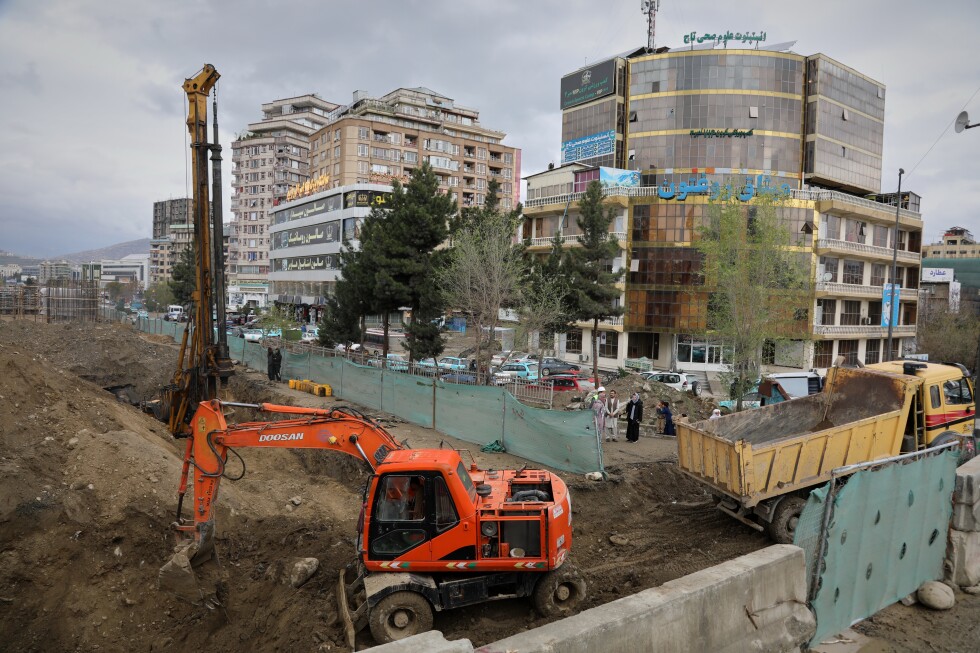
For a country grappling with widespread poverty and mass unemployment, the construction push has delivered one clear benefit: thousands of much-needed jobs for local workers. At the massive Baraki intersection construction site, project manager and civil engineer Obaidullah Elham says crews work around the clock, seven days a week, to complete a Turkish-designed $23 million flyover and underpass complex that will replace one of Kabul’s most congested junctions. The project employs 500 skilled and unskilled local workers, injecting much-needed income into a local economy reeling from international aid cuts and systemic economic collapse. Work on the 1,540-foot underpass began in July of last year and is already 80% complete, Elham said, standing beside a working excavator moving earth at the site. Construction on the flyover, only the second to be built in Kabul, started earlier this year.
The scope of the project has required clearing space even for longstanding community landmarks, including a 200-year-old graveyard in Kabul’s Qala-e-Khater neighborhood. The new planned road will cut directly through the historic burial ground, requiring the exhumation and relocation of hundreds of graves to a new section of the cemetery. Today, large rectangular empty holes mark where remains once rested, a quiet reminder of the project’s far-reaching impact.
Abdul Wadood Alokozay, a 21-year-old resident of the neighborhood, says his grandfather’s remains were among those moved. Alokozay’s extended family lost three properties in the area: a girls’ religious madrassa, and two multi-generational family homes, all of which were expropriated and leveled. “At first our family all were sad for this, that we lost our house,” Alokozay said. “It was even harder to tear it down ourselves, after we lived there for more than 20 years.” The family received roughly $13,000 in compensation for the three structures, with additional compensation promised for the land, and has since built a new three-story home on other family land overlooking the former property.
Shah Faisal Alokozay, a 30-year-old community representative and Abdul Wadood’s cousin, says plans for the connecting road have sat on city drawing boards for decades. “It’s a very important road, connecting east and north Kabul,” he explained. “So it is very important for the community.”
For Kabul’s new leadership, the infrastructure push represents both a practical solution to chronic urban congestion and a visible demonstration of the Taliban administration’s ability to deliver long-stalled public projects that the previous government could not complete. For displaced residents like Sadar, it is a complicated trade-off: short-term hardship and displacement in exchange for the promise of a more connected, less congested capital for future generations.