In the weeks following the April 8 announcement of a US-brokered ceasefire between Iran, the United States, and Israel, a striking contradiction has emerged in Tehran’s military actions: while pushing to expand the truce to cover Lebanon and Hezbollah, Iran has ramped up cross-border drone and missile attacks on Iranian Kurdish opposition groups based in Iraq’s autonomous Kurdistan Region.
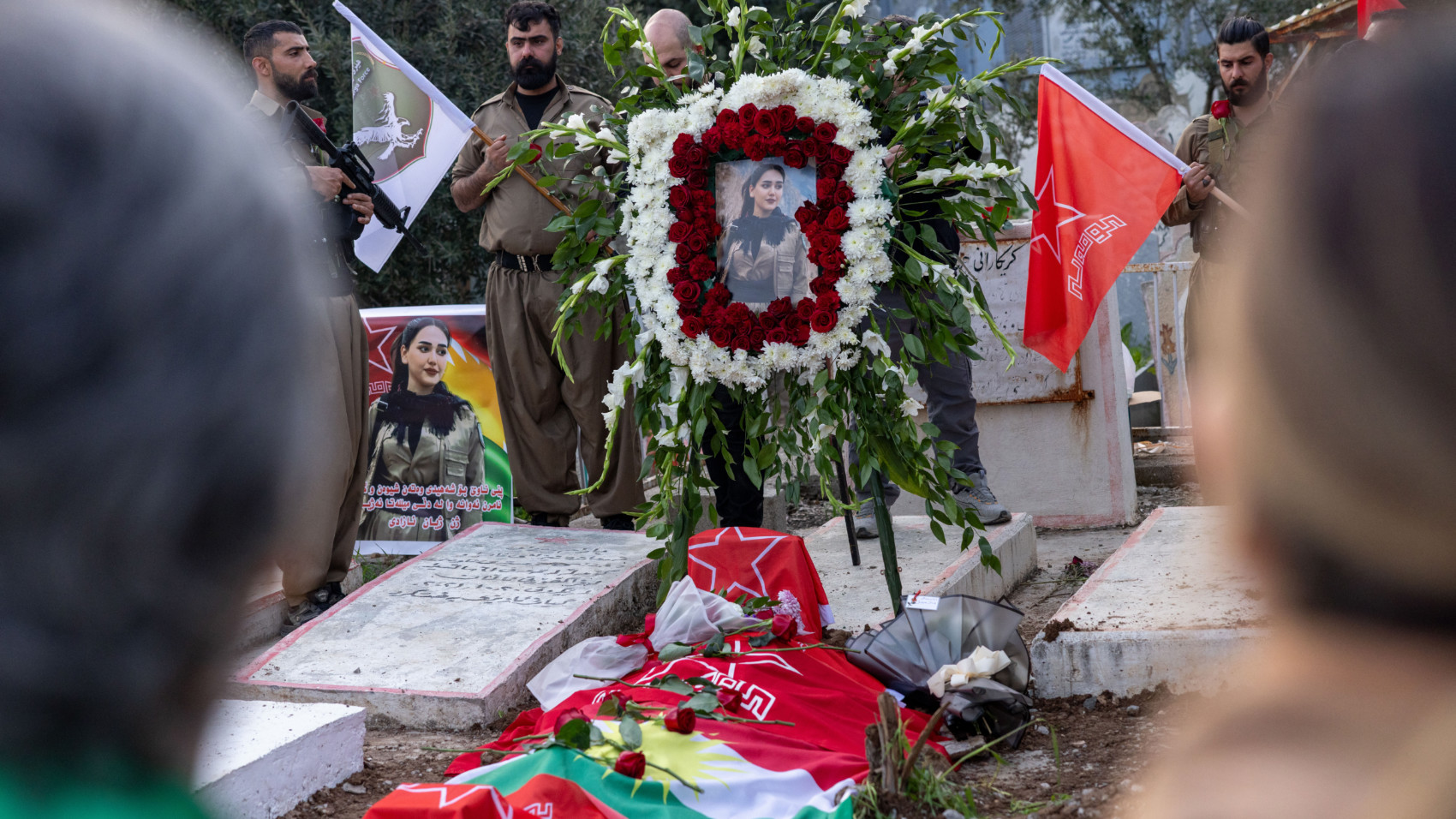
The latest deadly strike came on April 14, when an Iranian drone killed 19-year-old Ghazal Moulan, a female fighter with the Komala Toilers of Kurdistan, in the city of Sulaimaniyah. In a statement posted to X following the attack, Komala spokesperson Amjad Hossein Panahi condemned the killing, saying “the criminal hands of the Islamic Republic did not cease their bloodshed even under the shadow of a ceasefire.” Moulan’s funeral, held days later in Iraqi Kurdistan, drew public attention to the ongoing campaign of violence against Kurdish opposition figures.
Pattern of unrelenting attacks in the ceasefire era
Mustafa Mawloudi, deputy secretary general of the Kurdistan Democratic Party of Iran (PDKI), another major opposition group, confirmed that Iranian bombardment has not paused for a single day since the ceasefire took effect. “As far as we know, there is also a ceasefire for Lebanon, but for us, the attacks have been ongoing,” Mawloudi told Middle East Eye in an interview.
The wave of strikes has hit multiple opposition camps across Iraqi Kurdistan in recent days. On the Thursday following US President Donald Trump’s announcement of a 10-day Israel-Lebanon ceasefire that took effect at midnight, the PDKI confirmed Iranian drones targeted its camp in the town of Koya. Just hours before that strike, Komala’s base was also hit. A day earlier, both a PDKI encampment and a position held by the Kurdistan Freedom Party (PAK) came under attack.
These recent strikes are part of a much larger escalation that predates the current ceasefire. Data collected by Kurdish independent news outlet Rojhelat Info shows that starting on February 28, Iran and its allied militias have launched nearly 700 drone and missile attacks targeting areas within Iraqi Kurdistan. Around 170 of these strikes have specifically targeted Iranian Kurdish opposition parties based in the region. To date, the campaign has killed at least 15 people total, including six opposition fighters.
This escalation follows a shifting series of statements from Trump on Iranian Kurdish opposition groups. In early March, the US president announced he would back Iranian Kurds to launch an offensive against the Tehran government, only to reverse that position days later. Just one week before the April 8 ceasefire was announced, Trump claimed Iranian Kurdish groups had received US weapons intended for anti-government protesters inside Iran — a claim all Kurdish opposition groups have repeatedly denied.
Regional leaders have pushed back against efforts to draw Kurdish groups into cross-border conflict. The Kurdistan Regional Government (KRG) of Iraq has repeatedly emphasized it will not allow its territory to be used to escalate tensions with Iran, and issued a formal statement last week confirming that multiple drones targeting the region on April 9 were intercepted, reaffirming its “firm stance against involvement in conflict or escalation.”
Analysts point out Iranian hypocrisy in the dual ceasefire policy
Foreign policy analysts say the ongoing attacks against Kurdish groups represent a clear violation of the spirit of the US-brokered ceasefire, and highlight a stark double standard in Iran’s negotiating position. Mohammed A Salih, a non-resident senior fellow at the US-based Foreign Policy Research Institute, explained that Tehran has vehemently opposed Israeli targeting of Lebanese Hezbollah, which carried out 39 days of active strikes against Israeli targets during the recent conflict. Yet Tehran continues to attack Iranian Kurdish groups that have not fired a single shot at Iranian forces during the same period.
“It also shows a deep double standard in the Iranian position as Tehran is against Lebanese Hezbollah being targeted even though Hezbollah was actively striking Israel during the 39 days of conflict,” Salih noted. “Yet it insists on attacking Iranian Kurds based in Iraqi Kurdistan even though not a single shot was fired at Iranian troops by these groups during the war.”
Targeted strikes on Kurdish opposition groups are not a new development: Tehran has launched repeated attacks on opposition bases in Iraqi Kurdistan for decades. In a major 2020 strike, Iranian missiles and drones killed at least 16 opposition members in a single attack. Analysts say the recent escalation, even amid a broader ceasefire, reflects Tehran’s long-held concern about the political and ideological influence of opposition groups inside Iran.
Hana Yazdanpanah, foreign relations coordinator for the PAK, told Middle East Eye that Iran views even relatively small Kurdish opposition groups as a potential threat to its domestic stability, and uses cross-border strikes to prevent that influence from growing. “Therefore, through these attacks, Iran wants to prevent that influence and potential from growing,” she explained.
Ranj Talabani, a former intelligence official with the Patriotic Union of Kurdistan’s Zanyari agency, echoed that analysis, saying the strikes serve as a permanent warning to opposition groups against any effort to undermine the Iranian government, now or in the future. “The regime understands that, although limited in number, these groups still have the potential to cause problems, not only overtly along the borders, but also covertly deeper in the country,” Talabani said. He added that public calls by Kurdish opposition leaders for US support have reinforced Tehran’s perception that Kurdish groups pose a more immediate threat to the regime than exiled royalist opposition led by Reza Pahlavi.
Kurdish opposition leaders say US has remained silent on attacks
Kurdish opposition officials say they have called on the US to intervene to halt the strikes, but have so far seen no action from Washington. Mawloudi said he hopes the US will take steps to stop the attacks, but added “we don’t think they have a plan like this, the US did not even condemn these attacks.”
Yazdanpanah echoed that frustration, noting that the US has the leverage to force Iran to end the campaign if it chooses to act. “If the United States warns Iran that if even a single drone is launched in the Kurdistan Region, it will be hit, then they wouldn’t dare fire a single bullet,” she said.