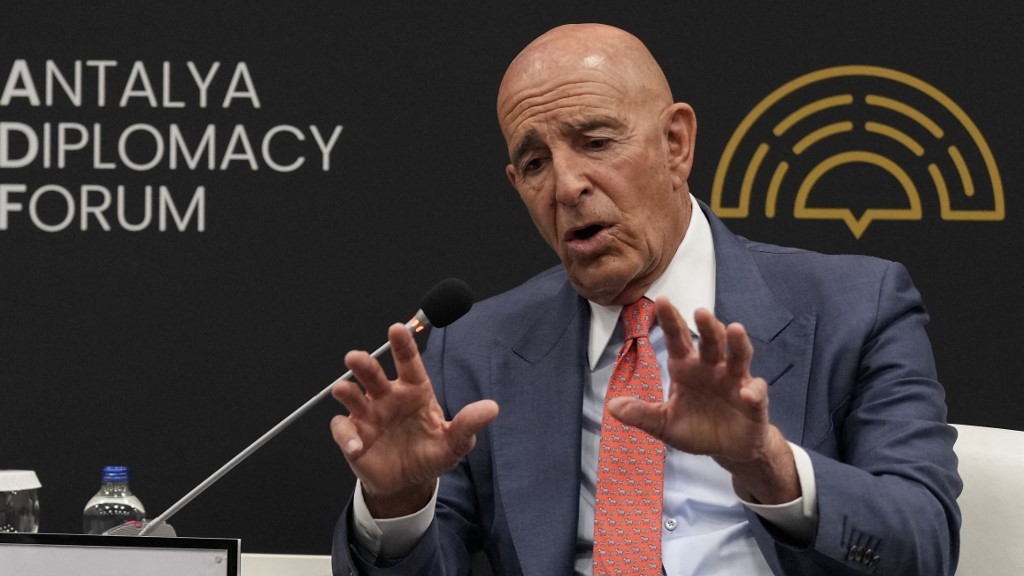
Appearing at a high-profile panel discussion during the Antalya Diplomacy Forum, senior U.S. envoy Tom Barrack has sought to de-escalate spiraling public tensions between NATO member Turkey and Israel, framing the heated exchanged rhetoric between the two countries as just verbal sparring rather than a precursor to open conflict. Barrack pushed back directly against growing warnings from political figures on both sides that a direct confrontation between Ankara and Tel Aviv could be on the near horizon.
Barrack opened his remarks by acknowledging Turkey’s regional standing, noting, “I think Turkey is just not a country to be messed with.” He went on to argue that sensationalized media coverage on both sides has created a deeply distorted, exaggerated perception of the other country’s ambitions, framing each side as aggressively expansionist to their domestic audiences.
“If you wake up in Tel Aviv, you read the newspaper, what do you see? You see the diagram on the paper of The Ottoman Empire 2.0, which is Vienna to the Maldives, right,” Barrack explained. “You wake up in Istanbul and read the paper and it’s Greater Israel.”
The two countries share a long history of largely cooperative relations: Turkey became the first Muslim-majority nation to formally recognize Israeli statehood in 1949, and maintained cordial security and commercial ties for most of their modern bilateral history. That stable dynamic shifted dramatically in 2010, when Israeli commandos raided the Mavi Marmara, a Turkish-flagged aid flotilla bound for Gaza, killing nine Turkish passengers on board (a tenth died of his injuries later). Since that incident, bilateral relations have remained strained, with successive Turkish governments increasingly criticizing Israel’s treatment of Palestinian people in the occupied territories and Gaza.
A recent push to normalize ties gained traction in September 2023, when Turkish President Recep Tayyip Erdogan and Israeli Prime Minister Benjamin Netanyahu met and shook hands for the first time in years on the sidelines of the United Nations General Assembly in New York. That progress unraveled just one month later, following the October 7 attacks on Israel led by Hamas and the subsequent Israeli military campaign in Gaza that has killed more than 34,000 Palestinians to date. Since the outbreak of the latest Gaza war, verbal attacks from political leaders on both sides have intensified, with former Israeli Prime Minister Naftali Bennett labeling Turkey as a potential “next Iran” in comments made in March 2024.
The U.S. government has maintained unwavering public support for Israel’s military actions across the Middle East, including its ongoing confrontation with Iran. However, Turkey’s status as a longstanding NATO ally and former U.S. President Donald Trump’s publicly stated positive regard for Erdogan has pushed American diplomatic officials to work toward repairing the fractured bilateral relationship between the two regional powers.
Speaking at the forum, Barrack pointed to recent global energy market shocks spurred by the ongoing conflict with Iran as clear evidence that deepened regional cooperation between Turkey and Israel is critical to shoring up long-term energy security for the entire region. “Everything comes from Turkey. It’s fiber optics. We’re talking about Azerbaijan and Armenia, which is flowing oil, gas, information, data and materials. Where does it go? How does it go?” he said. “So Israel aligned with Turkey, like Israel aligned with Abu Dhabi. Saudi Arabia could be aligned with Israel and, for the prosperity of the Israeli people, to me that’s the answer.”
Barrack went further, urging Israeli leaders to invite Turkey to take part in the proposed international stabilization force for Gaza that was outlined as part of ongoing ceasefire negotiations. “The smartest thing that Israel could do is to entice and embrace Turkey to enter that force,” he said. He added that Erdogan’s existing open channels to Hamas — which Ankara has not formally designated as a terrorist organization — were critical to securing earlier hostage release deals, making Turkey a uniquely valuable partner for post-ceasefire stability in Gaza.
The forum also saw a bilateral meeting between Barrack and Turkish Foreign Minister Hakan Fidan on Monday, which the pair described as “productive” in discussions of regional issues.