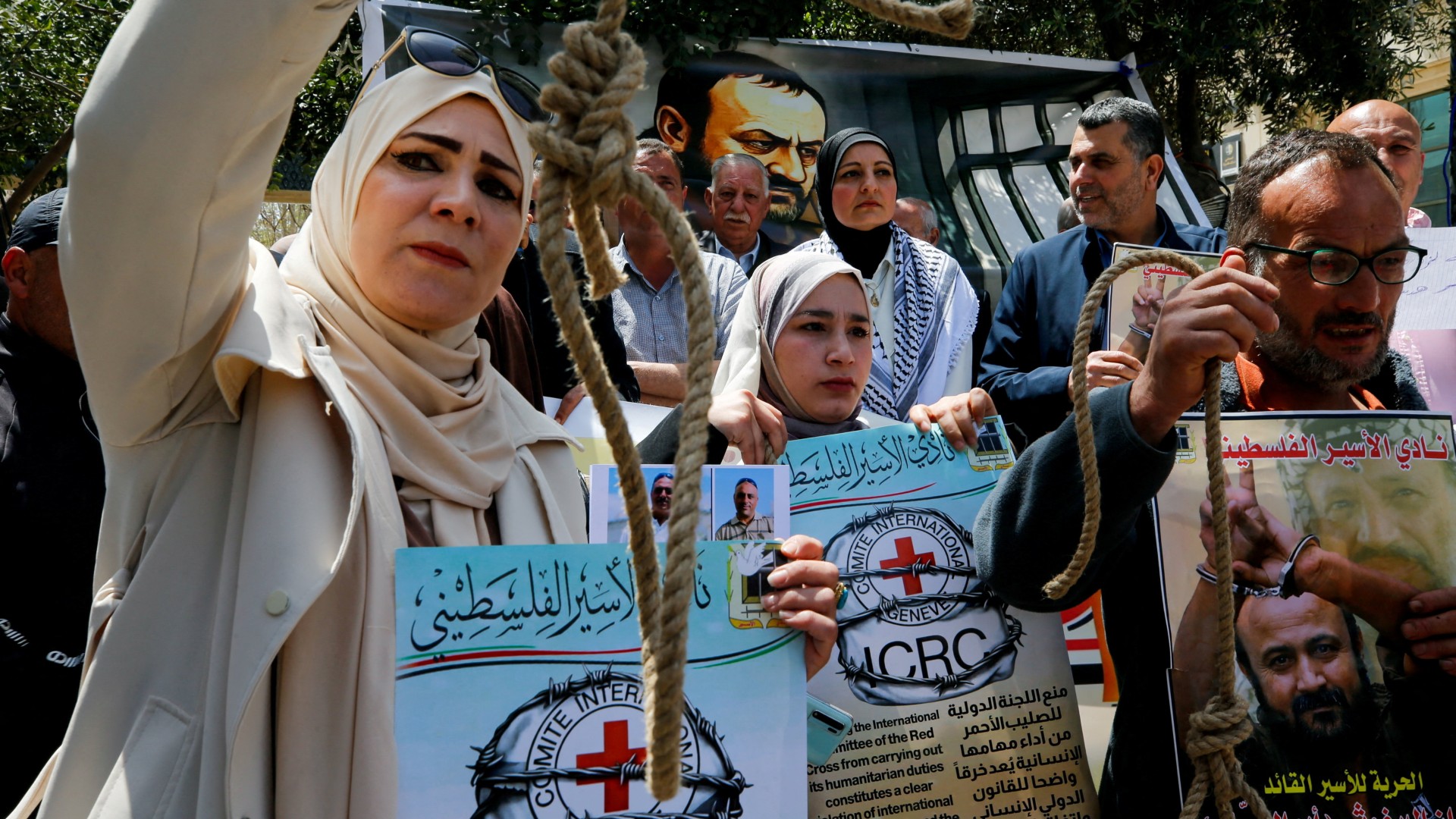
On Friday, activists and campaigners across 19 countries took coordinated action to observe the annual Palestinian Prisoners’ Day, uniting in a global call to free more than 9,600 Palestinian detainees held in Israeli facilities and overturn a recently enacted Israeli law that enables the execution of Palestinian prisoners.
This annual observance traces its origins back to 1974, when the Palestinian National Council first designated April 17 to draw international attention to the crisis of Palestinian incarceration. The date was chosen to mark the third anniversary of the first prisoner exchange between Israel and Palestinian factions, which saw Mahmoud Bakr Hejazi become the first Palestinian detainee to regain his freedom. For five decades, the day has served as a global platform to amplify the stories of detainees and document the systemic challenges they face.
Updated figures from the Red Ribbons Campaign, a leading grassroots movement advocating for the release of Palestinian detainees, confirm that as of April 2025, more than 9,600 Palestinians remain behind bars in Israeli prisons. Of this population, at least 3,532 are held under administrative detention – a controversial Israeli military policy that allows indefinite detention without charge or trial, with six-month detention orders that can be renewed repeatedly. The detainee population also includes 342 minor children, 84 women, and 119 individuals serving lifelong prison sentences.
Campaign data shows a dramatic 83% surge in detentions since Israel launched its large-scale military campaign in Gaza in October 2023. Prior to that offensive, just over 5,000 Palestinians were held in Israeli prisons. “Thousands of Palestinian prisoners and hostages remain held in Israeli occupation prisons, subjected to severe violations,” the Red Ribbons Campaign said in an official statement shared with Middle East Eye.
In total, the movement organized more than 137 public events across 19 nations to mark this year’s observance, encouraging supporters to wear or display red ribbons as a visual symbol of global solidarity with detainees. “It should remind the world of the blood being shed, the freedom we seek and the urgent cause we stand for,” explained Adnan Hmidan, coordinator of the Red Ribbons Campaign. Solidarity events were held in major nations across the globe, including the United Kingdom, United States, France, Germany, Australia, Japan, Morocco, Spain, Norway and the Netherlands, among others.
Prominent Palestinian politician and physician Mustafa Barghouti praised global supporters for their solidarity, noting that framing detained Palestinians as hostages accurately reflects their current situation. “The term ‘hostages’ accurately reflects their reality – they are forcibly held, subject to military courts lacking basic standards of justice, and repeatedly detained without charge or trial under administrative detention,” Barghouti said in comments carried by the Red Ribbons Campaign. “These are grave violations of international law carried out by an illegitimate occupation in full view of the world.”
Parallel demonstrations were also held a day earlier across occupied Palestinian territories, including the West Bank and Gaza Strip, where protesters carried banners, portraits of incarcerated loved ones, and lengths of rope to symbolize their opposition to the new execution legislation approved by Israel’s parliament last month.
Last month, Israel’s Knesset passed the execution bill by a 62-48 vote, despite widespread international condemnation and calls to withdraw the legislation. The law permits the death penalty for anyone convicted of intentionally killing a person with the intent to harm an Israeli citizen or threaten the existence of the Israeli state. Legal analysts and human rights groups warn the law’s wording is deliberately structured to target Palestinians almost exclusively: Jewish Israelis convicted of killing Palestinians face a maximum sentence of life imprisonment, with no eligibility for the death penalty.
The legislation has drawn fierce backlash from global and local human rights groups, which warn it enshrines systemic discrimination and violates fundamental right to life. Multiple leading Israeli human rights organizations – including Adalah, the Public Committee Against Torture in Israel, HaMoked, and Physicians for Human Rights-Israel – issued a joint statement condemning the policy, warning it would create what they called a “racialised system of capital punishment.” They added that the bill is “among the most extreme and dangerous legislative measures ever proposed by Israel against Palestinians”, establishing a “discriminatory punitive framework” that denies Palestinians equal protection under the law, fair trial guarantees, and safeguards against torture and cruel, inhumane treatment.
Widespread reports of abuse against Palestinian detainees have been well-documented by human rights groups for decades, but organizations confirm abuses have escalated dramatically since the October 2023 start of Israel’s Gaza campaign. At least 90 detainees have died in Israeli custody since that time. Last month, a group of United Nations independent experts warned that torture has become “state doctrine” in Israel, enabled by decades of official impunity and political protection for perpetrators. “Since the onset of the genocide, the Israeli prison system has degenerated into a laboratory of calculated cruelty,” said Francesca Albanese, the UN Special Rapporteur on human rights in the Palestinian territories.
Recent revelations have further deepened concerns about systemic abuse. Earlier this week, Israeli outlet Haaretz reported that Israel’s army chief Eyal Zamir has approved the return to reserve duty of five soldiers from elite Unit 100, who were implicated in the torture and rape of a Palestinian detainee at the notorious Sde Teiman detention camp in 2024. All criminal charges against the soldiers were dropped last month, and no formal internal military investigation into the incident has been launched.
The Euro-Med Human Rights Monitor released a report earlier this month compiling firsthand testimonies from former Gaza detainees that documented widespread, systematic sexual abuse, including rape with foreign objects and the use of trained dogs to assault detainees. The group concluded that sexual torture of Palestinian detainees from Gaza appears to be an “organised state policy” sanctioned by Israeli authorities.