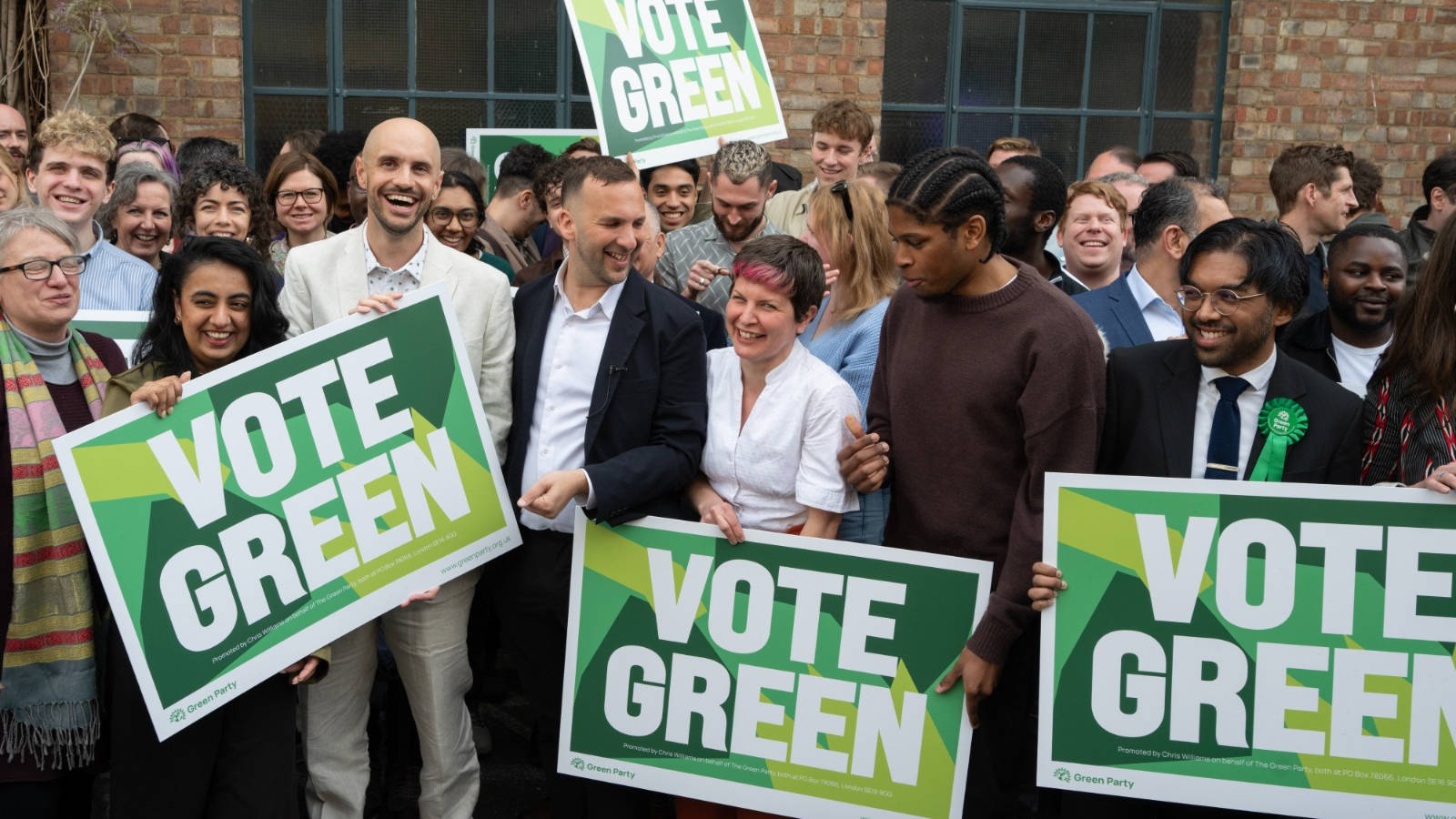
As the United Kingdom prepares for local elections across 136 councils on May 7, where more than 5,000 council seats will be contested, the Green Party has emerged as a formidable progressive challenger to Keir Starmer’s sitting Labour government — marking the most high-stakes electoral test since Starmer took office in July 2024.
Under the leadership of Zack Polanski, who has headed the party since last summer, the Greens have seen explosive growth in national polling. Their momentum was cemented in February, when the party secured a historic by-election victory in Greater Manchester’s Gorton and Denton constituency, defeating both Labour and the right-wing Reform UK.
In an exclusive interview with Middle East Eye this week, Faaiz Hasan, the Green Party’s national and London elections coordinator, laid out the party’s strategy for the upcoming vote, its policy priorities, and its vision for reshaping UK politics. Hasan, who relocated to the UK from Pakistan in 1997, cut his political teeth as a member of the Labour Party during Jeremy Corbyn’s leadership, before leaving the party shortly after Starmer took control in 2020. Last year, he served as campaign manager for Mothin Ali’s successful bid to become the Green Party’s co-deputy leader, and he is standing as a candidate in Westminster’s Harrow Road ward this May.
Hasan framed the 2025 local elections as a turning point for British progressive politics, saying the moment has arrived for the Greens to put forward a clear alternative vision that rejects the divisive scapegoating of migrants and racialized groups. Instead, he said, the party centers its platform on addressing the root of national inequality: the concentration of wealth and political power in the hands of a tiny elite. With 70% of the British public already rating Starmer’s performance in office as poor, and the national economy reeling from spillover effects of the US-Israeli war on Iran, the Labour government has been left floundering in the polls, creating an opening for progressive change.
Recalling his campaign work on the ground in Harrow Road, where he stood as a by-election candidate just two years ago and secured second place from a standing start, Hasan said voter attitudes have shifted dramatically. Two years ago, many residents told the party they supported Green policies but did not see the Greens as serious contenders. Today, amid rising poll numbers, increased national media coverage of Green leadership, Labour’s ongoing collapse in support, and widespread public disillusionment with Reform’s poor performance in areas the party controls, voters are increasingly open to backing Green candidates, he said. Hasan projects a major surge in Green support across the country next month.
Across London, the party’s momentum is already visible: Green councillor Areeq Chowdhury’s mayoral campaign in the east London borough of Newham is gaining traction, while former Labour councillor turned Green mayoral candidate Liam Shrivastava is targeting a takeover of Lewisham Council and mayoralty in southeast London, where polls currently forecast no party will win an overall majority. Nationally, polling data suggests the Greens could take control of up to nine councils, including long-held Labour strongholds such as Hackney and Lambeth in London.
The electoral landscape is complicated by the presence of Corbyn’s new Your Party, which has taken a selective approach to the election, backing independent candidates and targeted local groups. In some seats, including Newham, Your Party-backed candidates are standing against Greens. Hasan, who entered politics inspired by Corbyn and still holds him in high regard, said he finds the internal infighting plaguing Your Party disappointing for left-wing politics. While he wished the faction well and hopes it resolves its internal disputes, he noted the electoral timeline leaves no room for delay. Across London, where 1,800 seats are up for grabs, the Greens are contesting 80 to 90% of all seats, and Hasan said the party is the only major left force consistently speaking out against what the party describes as genocide in Gaza and advancing progressive solutions to national issues.
Hasan emphasized the party has no inherent conflict with Your Party or independent left candidates, and said there is substantial room for tactical cooperation in both local ward contests and the 2025 London elections, which include votes for mayor, a constituency seat, and a London-wide Assembly seat. Looking ahead to the next general election, Hasan said formal cooperation between left parties and independents will be essential to defeat Starmer and his centrist allies in their constituencies, echoing recent reporting from Middle East Eye that saw Health Secretary Wes Streeting attack independent left rivals in his east London seat for being “divisive” over foreign policy. In Birmingham, where 101 council seats are being contested and a hung council is forecast, Hasan said he has long pushed for strategic electoral alliances, and expects cooperation in roughly 90% of seats despite limited overlapping candidacies.
Hasan framed the 2025 local elections as a key milestone in a broader permanent realignment of British politics. The long-standing two-party, first-past-the-post system that dominated UK politics for generations is now dead, he argued, noting the two main parties are currently polling at less than 30% combined. He warned that the existing electoral system, which rewards the first-place finisher even with a tiny share of the vote, creates a dangerous democratic deficit: a fragmented field with five parties polling between 15% and 25% could see a candidate win a seat with just 24% to 26% of the vote, granting power that does not reflect the popular will. For that reason, Hasan said the UK must transition to a proportional representation electoral system that ensures representation matches the share of votes parties receive.
On policy, the Green campaign centers domestic working-class issues: the ongoing cost of living crisis, unsustainable household debt, the broken housing market marked by sky-high rents for poor-quality accommodation, and the inability of young people to get on the property ladder. The party also highlights the ongoing pressure on public services caused by the continuation of Conservative-era austerity policies. Local campaigns will also prioritize hyper-local issues specific to their communities, such as anti-social behavior, street litter, and road safety in Hasan’s own central London Harrow Road ward.
Foreign policy is also a core pillar of the Green campaign, with a sharp focus on the impacts of the US-Israeli war on Iran and the Starmer government’s decision to allow the US to use UK military bases to launch attacks on Iranian missile sites. Hasan argued there is no separation between local, national, and international issues: the illegal war in Iran has directly exacerbated the UK’s cost of living crisis, impacting every household in the country, so framing the conflict as a distant problem irrelevant to UK voters is false. The party is also campaigning for local councils to divest pension funds from companies that profit from what it calls genocide in Gaza, as well as from fossil fuel companies and arms manufacturers. Hasan noted that the UK’s continued reliance on oil and gas leaves the country vulnerable to global energy price shocks, and greater investment in renewable energy would insulate UK households from these crises. While Labour has attempted to distance itself from the war by claiming Starmer did not bring the UK into the conflict, Hasan said the Greens will challenge that narrative: Starmer’s decision to allow US bombers to launch attacks on Iran from UK bases makes him complicit, he said, a position that is completely unacceptable to British voters.
On the right, Nigel Farage’s Reform UK has led national polls for more than a year, and is targeting a major takeover of local councils in May, with forecasts suggesting the party could win as many as 17 councils and 1,500 council seats. After the Green’s February by-election win in Gorton and Denton, Reform accused the Greens of engaging in sectarian politics. Hasan dismissed the accusation as the complaints of sore losers, noting Reform attacked the Greens for producing multi-language leaflets in English, Bangla and Urdu — a practice that has been common in UK politics since the 1960s. Hasan said the attack stems from Reform’s ongoing targeting of migrant and Muslim communities, and it is no surprise that those communities rejected the right-wing party at the polls. He framed Reform’s complaints as an attempt to discredit democratic outcomes when the party loses, noting the Gorton and Denton seat saw a large Muslim community vote for a white working-class Green candidate led by a Jewish party leader — a demonstration of the Greens’ broad, inclusive appeal.
Hasan also rejected claims that the Green’s focus on the crisis in Gaza is a niche issue only of concern to Muslim voters. He pointed to the enormous diversity of the British pro-Palestine movement, which includes people of all faiths and no faith, all racial backgrounds, all age groups, and large contingents of Jewish and LGBTQ organizers. Framing the issue as a narrow concern is factually wrong, he said, because the crisis impacts every person in the UK through its economic and political ripple effects.