Nairobi, Kenya – Ahead of the 17th annual United Nations Chinese Language Day, observed globally on April 20, a growing cohort of young Kenyans are embracing Mandarin studies, framing the language as a transformative pathway to expanded education, employment, and cross-cultural connection amid deepening bilateral relations between Kenya and China.
For 20-year-old John Waigua, a second-year education student at Kenyatta University who also studies Mandarin at the institution’s Confucius Institute, a last-minute teaching gap turned into a life-altering perspective shift. When the school’s permanent Mandarin instructor resigned unexpectedly during Waigua’s university holiday internship, he stepped in to cover the role – and the experience revealed just how much demand exists for Mandarin speakers across the country. That firsthand insight reshaped his long-term goals: he now aims to become a certified Mandarin educator and eventually pursue a scholarship to advance his studies in China.
Waigna’s journey is far from unique. Across Kenyan universities, growing numbers of young people are integrating Mandarin studies into their academic plans, drawn by both academic relevance and clear professional advantages. Rebecca Bukachi, an architecture student studying Mandarin at the University of Nairobi’s Confucius Institute, notes that Chinese firms lead many of Kenya’s largest infrastructure and construction projects. For her, learning Mandarin is not an extracurricular hobby – it is a direct investment in her future career, aligning perfectly with her architectural training. Damaris Gathoni, another Kenyatta University student, echoes that sentiment: as Chinese businesses and cultural exchanges become increasingly embedded in Kenya’s economy and society, the ability to speak Mandarin opens doors to interactions and opportunities that would otherwise remain out of reach.
Educators confirm that this growing interest has translated to a rapid surge in demand for Mandarin courses. Leonard Chacha Mwita, director of the Confucius Institute at Kenyatta University, says the institute now receives daily inquiries from prospective students and their parents eager to enroll. He attributes the boom to three key drivers: expanding trade ties between China and Kenya, growing educational exchange opportunities between the two countries, and shifting global economic dynamics that have put China at the center of many young Africans’ professional outlooks. “People are traveling to China for trade, for education, and suddenly everyone recognizes that Mandarin is the language that opens those doors,” Mwita explained. “This rising enthusiasm isn’t just about language – it’s a reflection of how much stronger our cultural and educational bonds with China have become.”
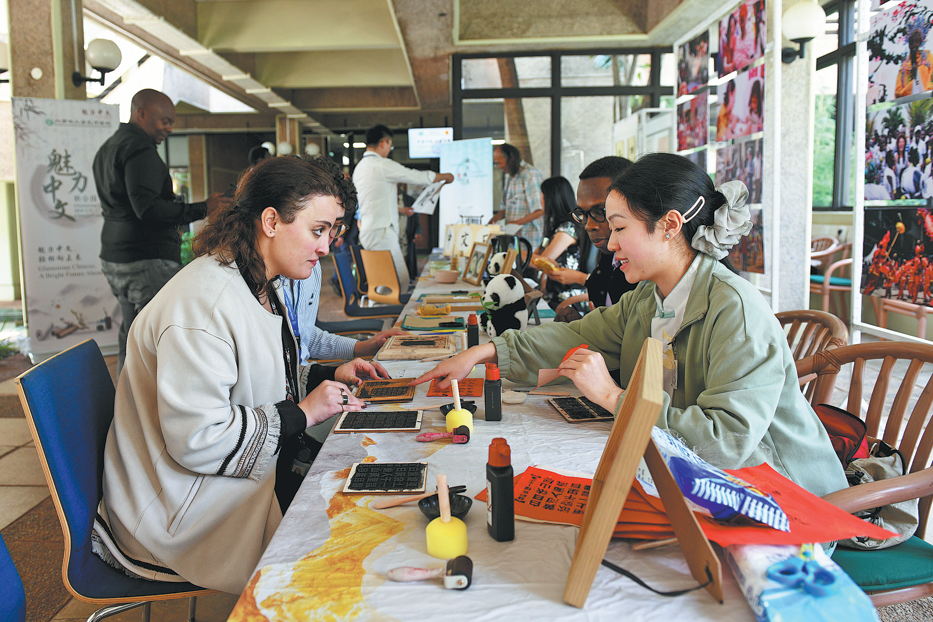
The growing embrace of Mandarin in Kenya was highlighted at a pre-UN Chinese Language Day cultural event held earlier this week at the UN Office at Nairobi, where attendees tried traditional Chinese calligraphy rubbing and other cultural activities. Zainab Hawa Bangura, director-general of the UN Office at Nairobi – the only UN headquarters located in the Global South – emphasized that linguistic diversity is a core pillar of inclusive global cooperation. As one of the UN’s six official languages, Mandarin plays a critical role in strengthening cross-border dialogue and mutual understanding, she said, adding that “here in Nairobi, we see firsthand how linguistic diversity strengthens dialogue, fosters mutual understanding, and enhances cooperation to tackle complex shared global challenges.”
Chinese Ambassador to Kenya Guo Haiyan echoed those remarks, noting that rising interest in Mandarin among Kenyan youth speaks to the language’s growing practical value across education, skills development, and cultural exchange. “I am pleased to see that in Africa, and in Kenya in particular, the Chinese language is becoming a ‘golden key’ to unlocking new opportunities,” she said. Guo added that beyond basic communication, more young Kenyans are using Mandarin to build technical skills and engage more deeply with Chinese culture, supported by institutions ranging from Confucius Institutes to Luban Workshops, which focus on vocational training. This year, 2026, has been designated the China-Africa Year of People-to-People Exchanges, and people-to-people connections will remain a central pillar of advancing bilateral cooperation between China and African nations, Guo noted.
As Kenya’s youth continue to turn to Mandarin to expand their horizons, the trend underscores how deepening ties between China and Kenya are creating tangible new opportunities for the next generation of East African leaders.